

82
M.B. Giordano et al.
IIJ 30
I Q,.
":'
20
~
....
'r::
E 10
lie
I
o
EROD
Nov Dec Jan Feb Mar Apr May Jun Jul Sep Oct
THI
6
o
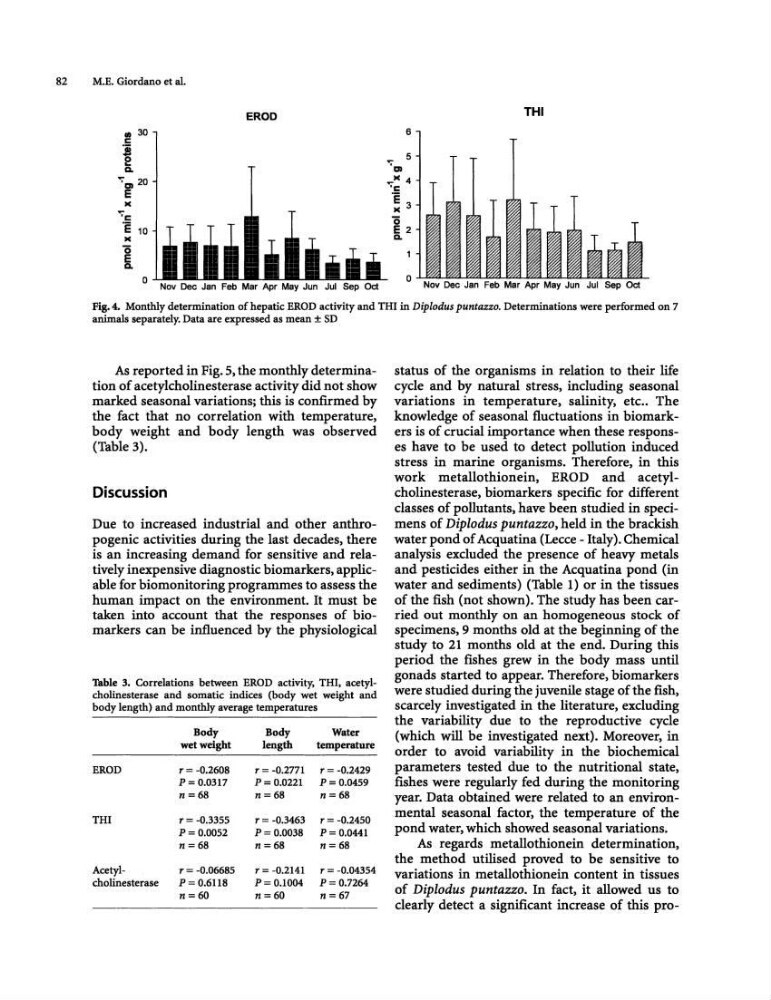
Fig. 4. Monthly determination of hepatic BROD activity and THI in Diplodus puntazzo. Determinations were performed on 7
animals separately. Data are expressed as mean ± SD
As reported in Fig. 5, the monthly determination of acetylcholinesterase activity did not show
marked seasonal variations; this is confirmed by
the fact that no correlation with temperature,
body weight and body length was observed
(Table 3).
Discussion
Due to increased industrial and other anthropogenic activities during the last decades, there
is an increasing demand for sensitive and relatively inexpensive diagnostic biomarkers, applicable for biomonitoring programmes to assess the
human impact on the environment. It must be
taken into account that the responses of biomarkers can be influenced by the physiological
Table 3. Correlations between BROD activity, THI, acetylcholinesterase and somatic indices (body wet weight and
body length) and monthly average temperatures
Body
Body
Water
wet weight
length
temperature
BROD
r= -0.2608
r = -0.2771 r= -0.2429
P=0.0317
P=0.0221
P=0.0459
n=68
n=68
n=68
THI
r= -0.3355
r = -0.3463 r= -0.2450
P=0.OO52
P= 0.0038
P= 0.0441
n=68
n=68
n=68
.Acetylr= -0.06685
r= -0.2141 r = -0.04354
cholinellterase
P= 0.6118
P=0.1004
P=O.7264
n=60
n=60
n=67
status of the organisms in relation to their life
cycle and by natural stress, including seasonal
variations in temperature, salinity, etc.. The
knowledge of seasonal fluctuations in biomarkers is of crucial importance when these responses have to be used to detect pollution induced
stress in marine organisms. Therefore, in this
work metallothionein, EROD and acetylcholinesterase, biomarkers specific for different
classes of pollutants, have been studied in specimens of Diplodus puntazzo, held in the brackish
water pond of Acquatina (Leece - Italy). Chemical
analysis excluded the presence of heavy metals
and pesticides either in the Acquatina pond (in
water and sediments) (Table 1) or in the tissues
of the fish (not shown). The study has been carried out monthly on an homogeneous stock of
specimens, 9 months old at the beginning of the
study to 21 months old at the end. During this
period the fishes grew in the body mass until
gonads started to appear. Therefore, biomarkers
were studied during the juvenile stage of the fish,
scarcely investigated in the literature, excluding
the variability due to the reproductive cycle
(which will be investigated next). Moreover, in
order to avoid variability in the biochemical
parameters tested due to the nutritional state,
fishes were regularly fed during the monitoring
year. Data obtained were related to an environmental seasonal factor, the temperature of the
pond water, which showed seasonal variations.
As regards metallothionein determination,
the method utilised proved to be sensitive to
variations in metallothionein content in tissues
of Diplodus puntazzo. In fact, it allowed us to
clearly detect a significant increase of this pro-
M.B. Giordano et al.
IIJ 30
I Q,.
":'
20
~
....
'r::
E 10
lie
I
o
EROD
Nov Dec Jan Feb Mar Apr May Jun Jul Sep Oct
THI
6
o
Fig. 4. Monthly determination of hepatic BROD activity and THI in Diplodus puntazzo. Determinations were performed on 7
animals separately. Data are expressed as mean ± SD
As reported in Fig. 5, the monthly determination of acetylcholinesterase activity did not show
marked seasonal variations; this is confirmed by
the fact that no correlation with temperature,
body weight and body length was observed
(Table 3).
Discussion
Due to increased industrial and other anthropogenic activities during the last decades, there
is an increasing demand for sensitive and relatively inexpensive diagnostic biomarkers, applicable for biomonitoring programmes to assess the
human impact on the environment. It must be
taken into account that the responses of biomarkers can be influenced by the physiological
Table 3. Correlations between BROD activity, THI, acetylcholinesterase and somatic indices (body wet weight and
body length) and monthly average temperatures
Body
Body
Water
wet weight
length
temperature
BROD
r= -0.2608
r = -0.2771 r= -0.2429
P=0.0317
P=0.0221
P=0.0459
n=68
n=68
n=68
THI
r= -0.3355
r = -0.3463 r= -0.2450
P=0.OO52
P= 0.0038
P= 0.0441
n=68
n=68
n=68
.Acetylr= -0.06685
r= -0.2141 r = -0.04354
cholinellterase
P= 0.6118
P=0.1004
P=O.7264
n=60
n=60
n=67
status of the organisms in relation to their life
cycle and by natural stress, including seasonal
variations in temperature, salinity, etc.. The
knowledge of seasonal fluctuations in biomarkers is of crucial importance when these responses have to be used to detect pollution induced
stress in marine organisms. Therefore, in this
work metallothionein, EROD and acetylcholinesterase, biomarkers specific for different
classes of pollutants, have been studied in specimens of Diplodus puntazzo, held in the brackish
water pond of Acquatina (Leece - Italy). Chemical
analysis excluded the presence of heavy metals
and pesticides either in the Acquatina pond (in
water and sediments) (Table 1) or in the tissues
of the fish (not shown). The study has been carried out monthly on an homogeneous stock of
specimens, 9 months old at the beginning of the
study to 21 months old at the end. During this
period the fishes grew in the body mass until
gonads started to appear. Therefore, biomarkers
were studied during the juvenile stage of the fish,
scarcely investigated in the literature, excluding
the variability due to the reproductive cycle
(which will be investigated next). Moreover, in
order to avoid variability in the biochemical
parameters tested due to the nutritional state,
fishes were regularly fed during the monitoring
year. Data obtained were related to an environmental seasonal factor, the temperature of the
pond water, which showed seasonal variations.
As regards metallothionein determination,
the method utilised proved to be sensitive to
variations in metallothionein content in tissues
of Diplodus puntazzo. In fact, it allowed us to
clearly detect a significant increase of this pro-