

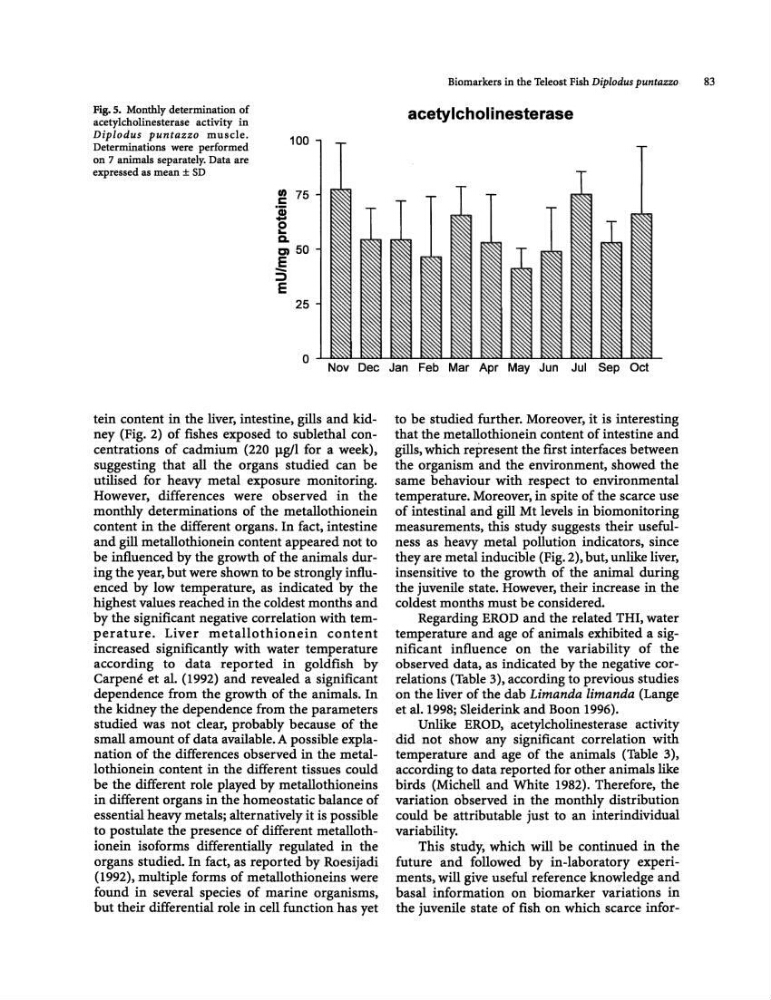
Fig. 5. Monthly determination of
acetylcholinesterase activity in
Diplodus puntazzo muscle.
Determinations were performed
on 7 animals separately. Data are
expressed as mean ± SD
100
! 75
~ a.
CJ 50
.e
::l
E
25
Biomarkers in the Teleost Fish Diplodus puntazzo
83
acetylcholinesterase
a ~~~~~~~~~~-=~~~~~~~~~~~
Nov Dec Jan Feb Mar Apr May Jun Jul Sep Oct
tein content in the liver, intestine, gills and kidney (Fig. 2) of fishes exposed to sublethal concentrations of cadmium (220 llg/l for a week),
suggesting that all the organs studied can be
utilised for heavy metal exposure monitoring.
However, differences were observed in the
monthly determinations of the metallothionein
content in the different organs. In fact, intestine
and gill metallothionein content appeared not to
be influenced by the growth of the animals during the year, but were shown to be strongly influenced by low temperature, as indicated by the
highest values reached in the coldest months and
by the significant negative correlation with temperature. Liver metallothionein content
increased significantly with water temperature
according to data reported in goldfish by
Carpene et al. (1992) and revealed a significant
dependence from the growth of the animals. In
the kidney the dependence from the parameters
studied was not clear, probably because of the
small amount of data available. A possible explanation of the differences observed in the metallothionein content in the different tissues could
be the different role played by metallothioneins
in different organs in the homeostatic balance of
essential heavy metals; alternatively it is possible
to postulate the presence of different metallothionein isoforms differentially regulated in the
organs studied. In fact, as reported by Roesijadi
(1992), multiple forms of metallothioneins were
found in several species of marine organisms,
but their differential role in cell function has yet
to be studied further. Moreover, it is interesting
that the metallothionein content of intestine and
gills, which represent the frrst interfaces between
the organism and the environment, showed the
same behaviour with respect to environmental
temperature. Moreover, in spite of the scarce use
of intestinal and gill Mt levels in biomonitoring
measurements, this study suggests their usefulness as heavy metal pollution indicators, since
they are metal inducible (Fig. 2), but, unlike liver,
insensitive to the growth of the animal during
the juvenile state. However, their increase in the
coldest months must be considered.
Regarding BROD and the related THI, water
temperature and age of animals exhibited a significant influence on the variability of the
observed data, as indicated by the negative correlations (Table 3), according to previous studies
on the liver of the dab Limanda limanda (Lange
et al.1998; Sleiderink and Boon 1996).
Unlike BROD, acetylcholinesterase activity
did not show any significant correlation with
temperature and age of the animals (Table 3),
according to data reported for other animals like
birds (Michell and White 1982). Therefore, the
variation observed in the monthly distribution
could be attributable just to an interindividual
variability.
This study, which will be continued in the
future and followed by in-laboratory experiments, will give useful reference knowledge and
basal information on biomarker variations in
the juvenile state of fish on which scarce infor-
acetylcholinesterase activity in
Diplodus puntazzo muscle.
Determinations were performed
on 7 animals separately. Data are
expressed as mean ± SD
100
! 75
~ a.
CJ 50
.e
::l
E
25
Biomarkers in the Teleost Fish Diplodus puntazzo
83
acetylcholinesterase
a ~~~~~~~~~~-=~~~~~~~~~~~
Nov Dec Jan Feb Mar Apr May Jun Jul Sep Oct
tein content in the liver, intestine, gills and kidney (Fig. 2) of fishes exposed to sublethal concentrations of cadmium (220 llg/l for a week),
suggesting that all the organs studied can be
utilised for heavy metal exposure monitoring.
However, differences were observed in the
monthly determinations of the metallothionein
content in the different organs. In fact, intestine
and gill metallothionein content appeared not to
be influenced by the growth of the animals during the year, but were shown to be strongly influenced by low temperature, as indicated by the
highest values reached in the coldest months and
by the significant negative correlation with temperature. Liver metallothionein content
increased significantly with water temperature
according to data reported in goldfish by
Carpene et al. (1992) and revealed a significant
dependence from the growth of the animals. In
the kidney the dependence from the parameters
studied was not clear, probably because of the
small amount of data available. A possible explanation of the differences observed in the metallothionein content in the different tissues could
be the different role played by metallothioneins
in different organs in the homeostatic balance of
essential heavy metals; alternatively it is possible
to postulate the presence of different metallothionein isoforms differentially regulated in the
organs studied. In fact, as reported by Roesijadi
(1992), multiple forms of metallothioneins were
found in several species of marine organisms,
but their differential role in cell function has yet
to be studied further. Moreover, it is interesting
that the metallothionein content of intestine and
gills, which represent the frrst interfaces between
the organism and the environment, showed the
same behaviour with respect to environmental
temperature. Moreover, in spite of the scarce use
of intestinal and gill Mt levels in biomonitoring
measurements, this study suggests their usefulness as heavy metal pollution indicators, since
they are metal inducible (Fig. 2), but, unlike liver,
insensitive to the growth of the animal during
the juvenile state. However, their increase in the
coldest months must be considered.
Regarding BROD and the related THI, water
temperature and age of animals exhibited a significant influence on the variability of the
observed data, as indicated by the negative correlations (Table 3), according to previous studies
on the liver of the dab Limanda limanda (Lange
et al.1998; Sleiderink and Boon 1996).
Unlike BROD, acetylcholinesterase activity
did not show any significant correlation with
temperature and age of the animals (Table 3),
according to data reported for other animals like
birds (Michell and White 1982). Therefore, the
variation observed in the monthly distribution
could be attributable just to an interindividual
variability.
This study, which will be continued in the
future and followed by in-laboratory experiments, will give useful reference knowledge and
basal information on biomarker variations in
the juvenile state of fish on which scarce infor-