

80
M.E. Giordano et al.
temperature was registered) and all the other
months (except March), which, on the other
hand, did not reveal any significanct differences
between each other. In the gills the increase in
the coldest months (January and February)
appeared more marked. In fact, the gill metallothionein content measured in January and
February resulted highly significantly different
(P
the other months. On the contrary, in the liver a
general upwards trend was observed in spring
and summer months with the maximum value
in June. Regarding the kidney, each monthly
value was obtained from a pool of seven tissues,
because of the small amount of kidney samples
obtained; therefore, unlike the other organs,
these values lack in standard deviation. Kidney
intestine
'*'*
_ 400
.c
OJ
,- 300
1
- 1 200
OJ
- OJ 100
:::t
0
control
+ cadmium
kidney
*
-
200
.c
OJ
';
150
- 1
100
OJ
- OJ 50
:::t
0
control
+cadmium
metallothionein content data showed a high seasonal variation with increased value in autumn
and winter months.
The ANOVA analysis and post test applied to
all the months (reported above) or to three
month groups (a season) (not reported) could
not represent the best way to evidence a seasonal trend and could cancel slight differences
between one month and the other. Therefore, for
a better understanding of the variability
observed in these data, the metallothionein content in the four organs studied was correlated
with an environmental seasonal factor (temperature of the water) and somatic indices (body wet
weight and body length). Intestinal and gill metallothioneins showed a significant negative correlation only with temperature; liver revealed a
significant positive correlation with all the paraliver
_ 200
'*
.c
OJ
'I 150
- 1
100
~
OJ 50
:::t
0
control
+cadmium
gills
20
- .c OJ
'**
';
15
'S
~
10
~
en
:::t
5
0
control
+cadmium
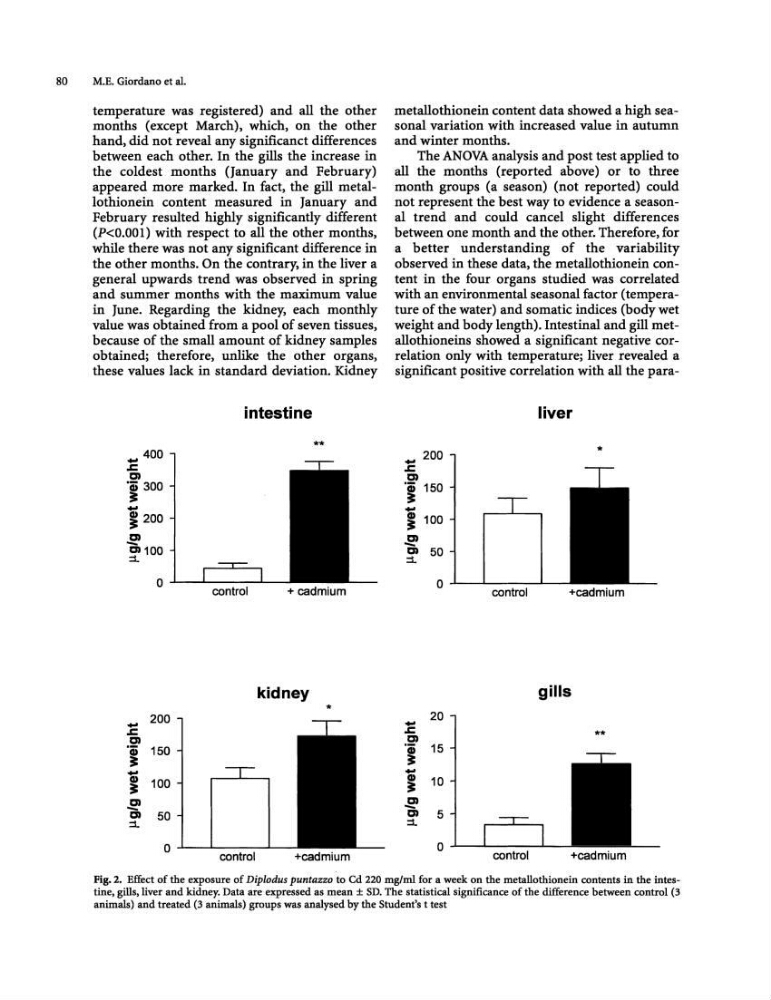
Fig, 2. Effect of the exposure of Diplodus puntazzo to Cd 220 mglml for a week on the metallothionein contents in the intestine, gills, liver and kidney. Data are expressed as mean ± SD. The statistical significance of the difference between control (3
animals) and treated (3 animals) groups was analysed by the Student's t test
M.E. Giordano et al.
temperature was registered) and all the other
months (except March), which, on the other
hand, did not reveal any significanct differences
between each other. In the gills the increase in
the coldest months (January and February)
appeared more marked. In fact, the gill metallothionein content measured in January and
February resulted highly significantly different
(P
the other months. On the contrary, in the liver a
general upwards trend was observed in spring
and summer months with the maximum value
in June. Regarding the kidney, each monthly
value was obtained from a pool of seven tissues,
because of the small amount of kidney samples
obtained; therefore, unlike the other organs,
these values lack in standard deviation. Kidney
intestine
'*'*
_ 400
.c
OJ
,- 300
1
- 1 200
OJ
- OJ 100
:::t
0
control
+ cadmium
kidney
*
-
200
.c
OJ
';
150
- 1
100
OJ
- OJ 50
:::t
0
control
+cadmium
metallothionein content data showed a high seasonal variation with increased value in autumn
and winter months.
The ANOVA analysis and post test applied to
all the months (reported above) or to three
month groups (a season) (not reported) could
not represent the best way to evidence a seasonal trend and could cancel slight differences
between one month and the other. Therefore, for
a better understanding of the variability
observed in these data, the metallothionein content in the four organs studied was correlated
with an environmental seasonal factor (temperature of the water) and somatic indices (body wet
weight and body length). Intestinal and gill metallothioneins showed a significant negative correlation only with temperature; liver revealed a
significant positive correlation with all the paraliver
_ 200
'*
.c
OJ
'I 150
- 1
100
~
OJ 50
:::t
0
control
+cadmium
gills
20
- .c OJ
'**
';
15
'S
~
10
~
en
:::t
5
0
control
+cadmium
Fig, 2. Effect of the exposure of Diplodus puntazzo to Cd 220 mglml for a week on the metallothionein contents in the intestine, gills, liver and kidney. Data are expressed as mean ± SD. The statistical significance of the difference between control (3
animals) and treated (3 animals) groups was analysed by the Student's t test