

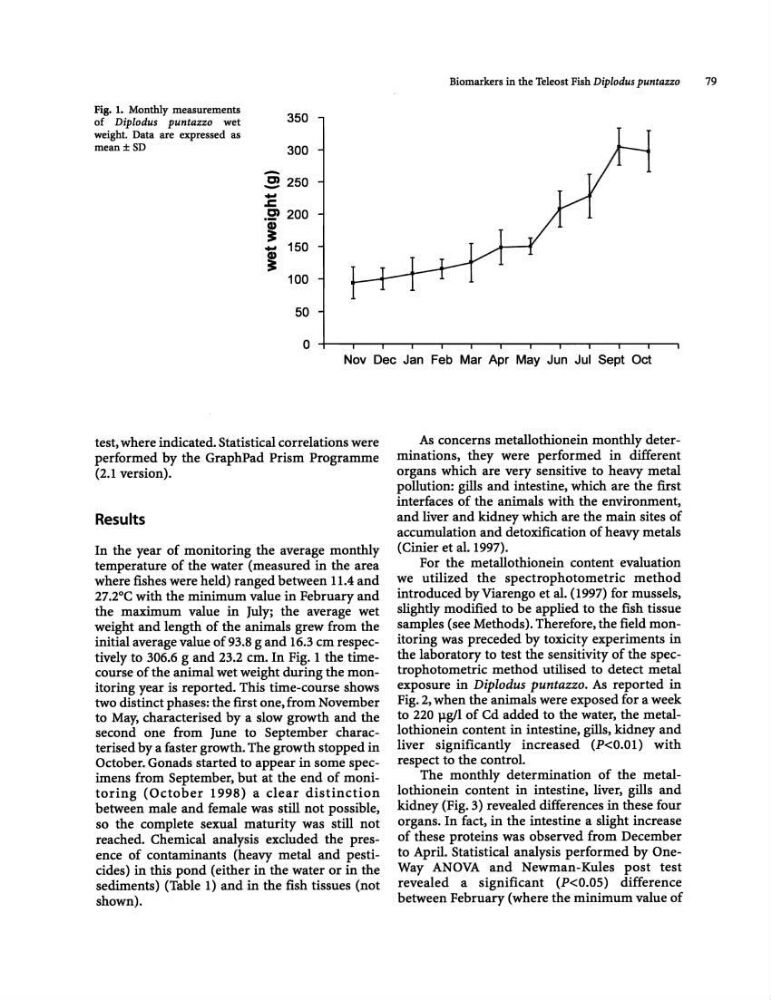
Fig. 1. Monthly measurements
of Diplodus puntazzo wet
weight. Data are expressed as
mean± SD
350
300
- S 250
- .c
.2' 200
;
_ 150
;
100
50
Biomarkers in the Teleost Fish Diplodus puntazzo
79
Nov Dec Jan Feb Mar Apr May Jun Jul Sept Oct
test, where indicated. Statistical correlations were
performed by the GraphPad Prism Programme
(2.1 version).
Results
In the year of monitoring the average monthly
temperature of the water (measured in the area
where fishes were held) ranged between 11.4 and
27.2°C with the minimum value in February and
the maximum value in July; the average wet
weight and length of the animals grew from the
initial average value of 93.8 g and 16.3 em respectively to 306.6 g and 23.2 em. In Fig. 1 the timecourse of the animal wet weight during the monitoring year is reported. This time-course shows
two distinct phases: the first one, from November
to May, characterised by a slow growth and the
second one from June to September characterised by a faster growth. The growth stopped in
October. Gonads started to appear in some specimens from September, but at the end of monitoring (October 1998) a clear distinction
between male and female was still not possible,
so the complete sexual maturity was still not
reached. Chemical analysis excluded the presence of contaminants (heavy metal and pesticides) in this pond (either in the water or in the
sediments) (Table 1) and in the fish tissues (not
shown).
As concerns metallothionein monthly determinations, they were performed in different
organs which are very sensitive to heavy metal
pollution: gills and intestine, which are the first
interfaces of the animals with the environment,
and liver and kidney which are the main sites of
accumulation and detoxification of heavy metals
(Cinier et al. 1997).
For the metallothionein content evaluation
we utilized the spectrophotometric method
introduced by Viarengo et al. (1997) for mussels,
slightly modified to be applied to the fish tissue
samples (see Methods). Therefore, the field monitoring was preceded by toxicity experiments in
the laboratory to test the sensitivity of the spectrophotometric method utilised to detect metal
exposure in Diplodus puntazzo. As reported in
Fig. 2. when the animals were exposed for a week
to 220 llg/l of Cd added to the water, the metallothionein content in intestine, gills. kidney and
liver significantly increased (P
The monthly determination of the metallothionein content in intestine, liver, gills and
kidney (Fig. 3) revealed differences in these four
organs. In fact, in the intestine a slight increase
of these proteins was observed from December
to April. Statistical analysis performed by OneWay ANOVA and Newman-Kules post test
revealed a significant (P<0.05) difference
between February (where the minimum value of
of Diplodus puntazzo wet
weight. Data are expressed as
mean± SD
350
300
- S 250
- .c
.2' 200
;
_ 150
;
100
50
Biomarkers in the Teleost Fish Diplodus puntazzo
79
Nov Dec Jan Feb Mar Apr May Jun Jul Sept Oct
test, where indicated. Statistical correlations were
performed by the GraphPad Prism Programme
(2.1 version).
Results
In the year of monitoring the average monthly
temperature of the water (measured in the area
where fishes were held) ranged between 11.4 and
27.2°C with the minimum value in February and
the maximum value in July; the average wet
weight and length of the animals grew from the
initial average value of 93.8 g and 16.3 em respectively to 306.6 g and 23.2 em. In Fig. 1 the timecourse of the animal wet weight during the monitoring year is reported. This time-course shows
two distinct phases: the first one, from November
to May, characterised by a slow growth and the
second one from June to September characterised by a faster growth. The growth stopped in
October. Gonads started to appear in some specimens from September, but at the end of monitoring (October 1998) a clear distinction
between male and female was still not possible,
so the complete sexual maturity was still not
reached. Chemical analysis excluded the presence of contaminants (heavy metal and pesticides) in this pond (either in the water or in the
sediments) (Table 1) and in the fish tissues (not
shown).
As concerns metallothionein monthly determinations, they were performed in different
organs which are very sensitive to heavy metal
pollution: gills and intestine, which are the first
interfaces of the animals with the environment,
and liver and kidney which are the main sites of
accumulation and detoxification of heavy metals
(Cinier et al. 1997).
For the metallothionein content evaluation
we utilized the spectrophotometric method
introduced by Viarengo et al. (1997) for mussels,
slightly modified to be applied to the fish tissue
samples (see Methods). Therefore, the field monitoring was preceded by toxicity experiments in
the laboratory to test the sensitivity of the spectrophotometric method utilised to detect metal
exposure in Diplodus puntazzo. As reported in
Fig. 2. when the animals were exposed for a week
to 220 llg/l of Cd added to the water, the metallothionein content in intestine, gills. kidney and
liver significantly increased (P
The monthly determination of the metallothionein content in intestine, liver, gills and
kidney (Fig. 3) revealed differences in these four
organs. In fact, in the intestine a slight increase
of these proteins was observed from December
to April. Statistical analysis performed by OneWay ANOVA and Newman-Kules post test
revealed a significant (P<0.05) difference
between February (where the minimum value of