

78
M.E. Giordano et al.
ers. Fishes were held for a year in Aequatina
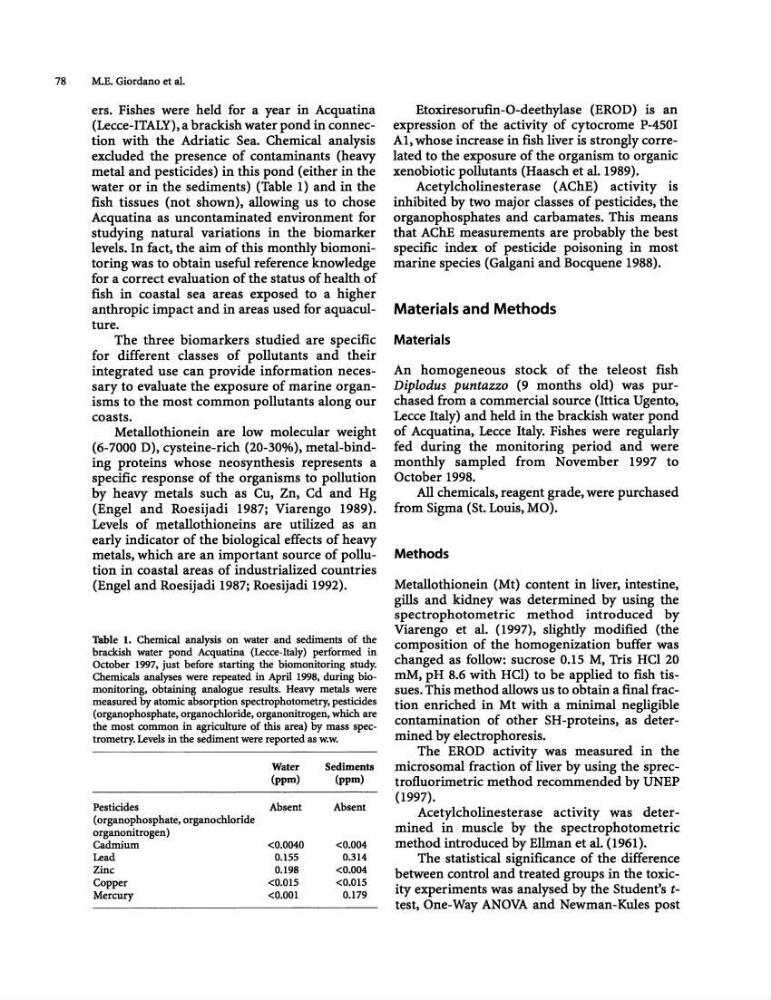
(Leece-ITALY), a brackish water pond in connection with the Adriatic Sea. Chemical analysis
excluded the presence of contaminants (heavy
metal and pesticides) in this pond (either in the
water or in the sediments) (Table 1) and in the
fish tissues (not shown), allowing us to chose
Acquatina as uncontaminated environment for
studying natural variations in the biomarker
levels. In fact, the aim of this monthly biomonitoring was to obtain useful reference knowledge
for a correct evaluation of the status of health of
fish in coastal sea areas exposed to a higher
anthropic impact and in areas used for aquaculture.
The three biomarkers studied are specific
for different classes of pollutants and their
integrated use can provide information necessary to evaluate the exposure of marine organisms to the most common pollutants along our
coasts.
Metallothionein are low molecular weight
(6-7000 D), cysteine-rich (20-30%), metal-binding proteins whose neosynthesis represents a
specific response of the organisms to pollution
by heavy metals such as Cu, Zn, Cd and Hg
(Engel and Roesijadi 1987; Viarengo 1989).
Levels of metallothioneins are utilized as an
early indicator of the biological effects of heavy
metals, which are an important source of pollution in coastal areas of industrialized countries
(Engel and Roesijadi 1987; Roesijadi 1992).
Table 1. Chemical analysis on water and sediments of the
brackish water pond Acquatina (Lecre-ltaly) performed in
October 1997, just before starting the biomonitoring study.
Chemicals analyses were repeated in April 1998, during biomonitoring. obtaining analogue results. Heavy metals were
measured by atomic absorption spectrophotometry, pesticides
(organophosphate, organochloride. organonitrogen, which are
the most common in agriculture of this area) by mass spectrometry. Levels in the sediment were reported as w.w.
Water
Sediments
(ppm)
(ppm)
Pesticides
Absent
Absent
(organophosphate. organochloride
organorutrogen)
Cadmium
<0.0040
<0.004
Lead
0.155
0.314
Zinc
0.198
<0.004
Copper
<0.015
<0.015
Mercury
<0.001
0.179
Etoxiresorufin-O-deethylase (EROD) is an
expression of the activity of cytocrome P-45OI
AI, whose increase in ftsh liver is strongly correlated to the exposure of the organism to organic
xenobiotic pollutants (Haasch et al. 1989).
Acetylcholinesterase (AChE) activity is
inhibited by two major classes of pesticides, the
organophosphates and carbamates. This means
that AChE measurements are probably the best
specific index of pesticide poisoning in most
marine species (Galgani and Bocquene 1988).
Materials and Methods
Materials
An homogeneous stock of the teleost fish
Diplodus puntazzo (9 months old) was purchased from a commercial source (Ittica Ugento.
Leece Italy) and held in the brackish water pond
of Aequatina, Leece Italy. Fishes were regularly
fed during the monitoring period and were
monthly sampled from November 1997 to
October 1998.
All chemicals. reagent grade, were purchased
from Sigma (St. Louis, MO).
Methods
Metallothionein (Mt) content in liver, intestine,
gills and kidney was determined by using the
spectrophotometric method introduced by
Viarengo et ala (1997), slightly modified (the
composition of the homogenization buffer was
changed as follow: sucrose 0.15 M, Tris HC} 20
mM, pH 8.6 with Hel) to be applied to fish tissues. This method allows us to obtain a fmal fraction enriched in Mt with a minimal negligible
contamination of other SH -proteins. as determined by electrophoresis.
The EROD activity was measured in the
microsomal fraction of liver by using the sprectrofluorimetric method recommended by UNEP
(1997).
Acetylcholinesterase activity was determined in muscle by the spectrophotometric
method introduced by Ellman et al. (1961).
The statistical significance of the difference
between control and treated groups in the toxicity experiments was analysed by the Student's ttest, One-Way ANOVA and Newman-Kules post
M.E. Giordano et al.
ers. Fishes were held for a year in Aequatina
(Leece-ITALY), a brackish water pond in connection with the Adriatic Sea. Chemical analysis
excluded the presence of contaminants (heavy
metal and pesticides) in this pond (either in the
water or in the sediments) (Table 1) and in the
fish tissues (not shown), allowing us to chose
Acquatina as uncontaminated environment for
studying natural variations in the biomarker
levels. In fact, the aim of this monthly biomonitoring was to obtain useful reference knowledge
for a correct evaluation of the status of health of
fish in coastal sea areas exposed to a higher
anthropic impact and in areas used for aquaculture.
The three biomarkers studied are specific
for different classes of pollutants and their
integrated use can provide information necessary to evaluate the exposure of marine organisms to the most common pollutants along our
coasts.
Metallothionein are low molecular weight
(6-7000 D), cysteine-rich (20-30%), metal-binding proteins whose neosynthesis represents a
specific response of the organisms to pollution
by heavy metals such as Cu, Zn, Cd and Hg
(Engel and Roesijadi 1987; Viarengo 1989).
Levels of metallothioneins are utilized as an
early indicator of the biological effects of heavy
metals, which are an important source of pollution in coastal areas of industrialized countries
(Engel and Roesijadi 1987; Roesijadi 1992).
Table 1. Chemical analysis on water and sediments of the
brackish water pond Acquatina (Lecre-ltaly) performed in
October 1997, just before starting the biomonitoring study.
Chemicals analyses were repeated in April 1998, during biomonitoring. obtaining analogue results. Heavy metals were
measured by atomic absorption spectrophotometry, pesticides
(organophosphate, organochloride. organonitrogen, which are
the most common in agriculture of this area) by mass spectrometry. Levels in the sediment were reported as w.w.
Water
Sediments
(ppm)
(ppm)
Pesticides
Absent
Absent
(organophosphate. organochloride
organorutrogen)
Cadmium
<0.0040
<0.004
Lead
0.155
0.314
Zinc
0.198
<0.004
Copper
<0.015
<0.015
Mercury
<0.001
0.179
Etoxiresorufin-O-deethylase (EROD) is an
expression of the activity of cytocrome P-45OI
AI, whose increase in ftsh liver is strongly correlated to the exposure of the organism to organic
xenobiotic pollutants (Haasch et al. 1989).
Acetylcholinesterase (AChE) activity is
inhibited by two major classes of pesticides, the
organophosphates and carbamates. This means
that AChE measurements are probably the best
specific index of pesticide poisoning in most
marine species (Galgani and Bocquene 1988).
Materials and Methods
Materials
An homogeneous stock of the teleost fish
Diplodus puntazzo (9 months old) was purchased from a commercial source (Ittica Ugento.
Leece Italy) and held in the brackish water pond
of Aequatina, Leece Italy. Fishes were regularly
fed during the monitoring period and were
monthly sampled from November 1997 to
October 1998.
All chemicals. reagent grade, were purchased
from Sigma (St. Louis, MO).
Methods
Metallothionein (Mt) content in liver, intestine,
gills and kidney was determined by using the
spectrophotometric method introduced by
Viarengo et ala (1997), slightly modified (the
composition of the homogenization buffer was
changed as follow: sucrose 0.15 M, Tris HC} 20
mM, pH 8.6 with Hel) to be applied to fish tissues. This method allows us to obtain a fmal fraction enriched in Mt with a minimal negligible
contamination of other SH -proteins. as determined by electrophoresis.
The EROD activity was measured in the
microsomal fraction of liver by using the sprectrofluorimetric method recommended by UNEP
(1997).
Acetylcholinesterase activity was determined in muscle by the spectrophotometric
method introduced by Ellman et al. (1961).
The statistical significance of the difference
between control and treated groups in the toxicity experiments was analysed by the Student's ttest, One-Way ANOVA and Newman-Kules post