

in 113 P and 116 P cultures were 39 and 73%
respectively of that present in f/2 control culture
(Guerrini et al. 1998). The cells under phosphate
limitation showed, however, a higher total and
extracellular carbohydrate production which
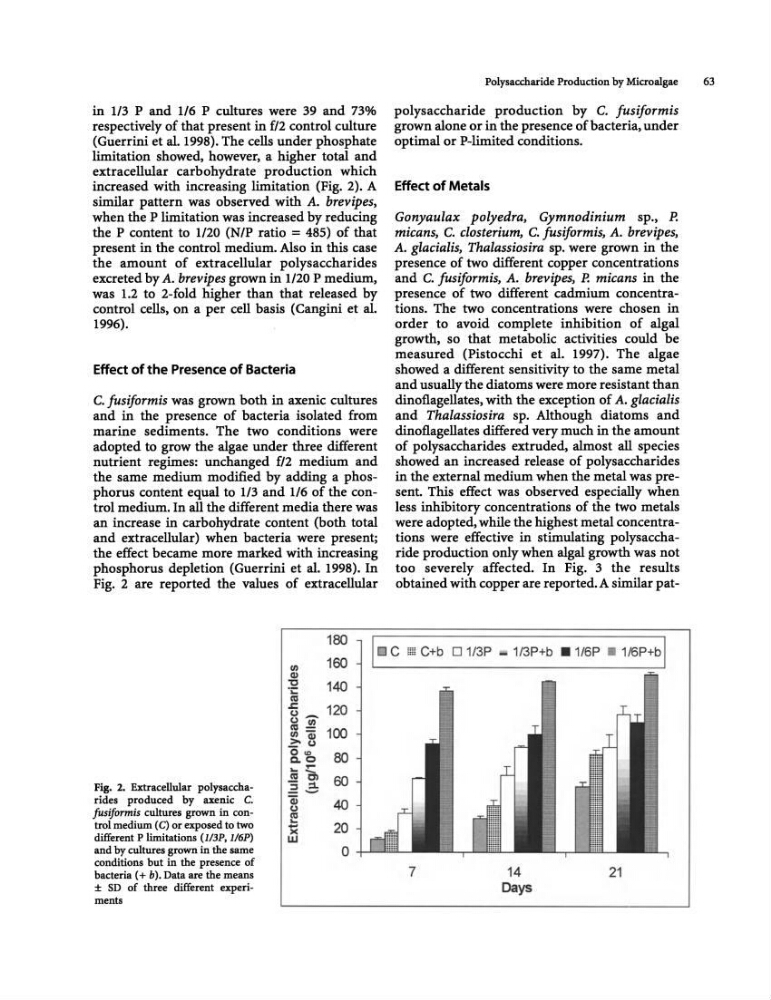
increased with increasing limitation (Fig. 2). A
similar pattern was observed with A. brevi pes,
when the P limitation was increased by reducing
the P content to 1120 (NIP ratio = 485) of that
present in the control medium. Also in this case
the amount of extracellular polysaccharides
excreted by A. brevipes grown in 1/20 P medium,
was 1.2 to 2-fold higher than that released by
control cells, on a per cell basis (Cangini et al.
1996).
Effect of the Presence of Bacteria
C. fusiformis was grown both in axenic cultures
and in the presence of bacteria isolated from
marine sediments. The two conditions were
adopted to grow the algae under three different
nutrient regimes: unchanged f/2 medium and
the same medium modified by adding a phosphorus content equal to 1/3 and 116 of the control medium. In all the different media there was
an increase in carbohydrate content (both total
and extracellular) when bacteria were present;
the effect became more marked with increasing
phosphorus depletion (Guerrini et al. 1998). In
Fig. 2 are reported the values of extracellular
Polysaccharide Production by Microalgae
63
polysaccharide production by C. fusiformis
grown alone or in the presence of bacteria, under
optimal or P-limited conditions.
Effect of Metals
Gonyaulax polyedra, Gymnodinium sp., P.
micans, C. closterium, C. fusiformis, A. brevipes,
A. glacialis, Thalassiosira sp. were grown in the
presence of two different copper concentrations
and C. fusiformis, A. brevipes, P. micans in the
presence of two different cadmium concentrations. The two concentrations were chosen in
order to avoid complete inhibition of algal
growth, so that metabolic activities could be
measured (Pistocchi et al. 1997). The algae
showed a different sensitivity to the same metal
and usually the diatoms were more resistant than
dinoflagellates, with the exception of A. glacialis
and Thalassiosira sp. Although diatoms and
dinoflagellates differed very much in the amount
of polysaccharides extruded, almost all species
showed an increased release of polysaccharides
in the external medium when the metal was present. This effect was observed especially when
less inhibitory concentrations of the two metals
were adopted, while the highest metal concentrations were effective in stimulating polysaccharide production only when algal growth was not
too severely affected. In Fig. 3 the results
obtained with copper are reported. A similar patfIl
Q)
180
160
140
120
100
1 0 C 1m C+b D1/3P - 1/3P+b .1/6P • 1/6P+b I
"0
.;::
C'tI
.s:::::
u
u0'
C'tIfila;
>u
0<0
0.0
........
C'tIc,
'5 :L.
- .......
a;
u
C'tI
....
- ><
LIJ
80
60
40
20
Fig. 2. Extracellular polysaccharides produced by axenic C.
fusiformis cultures grown in control medium (C) or exposed to two
different P limitations (1I3P, 1/6P)
and by cultures grown in the same
conditions but in the presence of
bacteria (+ b). Data are the means
± SD of three different experiments
0 +-'"-""--7
14
Days
21
respectively of that present in f/2 control culture
(Guerrini et al. 1998). The cells under phosphate
limitation showed, however, a higher total and
extracellular carbohydrate production which
increased with increasing limitation (Fig. 2). A
similar pattern was observed with A. brevi pes,
when the P limitation was increased by reducing
the P content to 1120 (NIP ratio = 485) of that
present in the control medium. Also in this case
the amount of extracellular polysaccharides
excreted by A. brevipes grown in 1/20 P medium,
was 1.2 to 2-fold higher than that released by
control cells, on a per cell basis (Cangini et al.
1996).
Effect of the Presence of Bacteria
C. fusiformis was grown both in axenic cultures
and in the presence of bacteria isolated from
marine sediments. The two conditions were
adopted to grow the algae under three different
nutrient regimes: unchanged f/2 medium and
the same medium modified by adding a phosphorus content equal to 1/3 and 116 of the control medium. In all the different media there was
an increase in carbohydrate content (both total
and extracellular) when bacteria were present;
the effect became more marked with increasing
phosphorus depletion (Guerrini et al. 1998). In
Fig. 2 are reported the values of extracellular
Polysaccharide Production by Microalgae
63
polysaccharide production by C. fusiformis
grown alone or in the presence of bacteria, under
optimal or P-limited conditions.
Effect of Metals
Gonyaulax polyedra, Gymnodinium sp., P.
micans, C. closterium, C. fusiformis, A. brevipes,
A. glacialis, Thalassiosira sp. were grown in the
presence of two different copper concentrations
and C. fusiformis, A. brevipes, P. micans in the
presence of two different cadmium concentrations. The two concentrations were chosen in
order to avoid complete inhibition of algal
growth, so that metabolic activities could be
measured (Pistocchi et al. 1997). The algae
showed a different sensitivity to the same metal
and usually the diatoms were more resistant than
dinoflagellates, with the exception of A. glacialis
and Thalassiosira sp. Although diatoms and
dinoflagellates differed very much in the amount
of polysaccharides extruded, almost all species
showed an increased release of polysaccharides
in the external medium when the metal was present. This effect was observed especially when
less inhibitory concentrations of the two metals
were adopted, while the highest metal concentrations were effective in stimulating polysaccharide production only when algal growth was not
too severely affected. In Fig. 3 the results
obtained with copper are reported. A similar patfIl
Q)
180
160
140
120
100
1 0 C 1m C+b D1/3P - 1/3P+b .1/6P • 1/6P+b I
"0
.;::
C'tI
.s:::::
u
u0'
C'tIfila;
>u
0<0
0.0
........
C'tIc,
'5 :L.
- .......
a;
u
C'tI
....
- ><
LIJ
80
60
40
20
Fig. 2. Extracellular polysaccharides produced by axenic C.
fusiformis cultures grown in control medium (C) or exposed to two
different P limitations (1I3P, 1/6P)
and by cultures grown in the same
conditions but in the presence of
bacteria (+ b). Data are the means
± SD of three different experiments
0 +-'"-""--7
14
Days
21