

64
1. Boni et al.
800
e 700
o Control
D Cu min
0,03
::l
a 600
• Cu max
>
Q)
0.01
0 500
0,03
0')
::L 400
..... cr
(j) 300
Q)
0.01
I/)
0
g 200
0,04
0')
01 100
0,03
::L
0
Gon
Gymn
Pror
Thai
Aster
Ach
Species
tern was also observed in the presence of cadmium (data not shown).
Conclusions
All the different results showed, not unexpectedly, that an increase in polysaccharide extrusion
occurred when various stress conditions were
present. We can, however, attribute a different significance to this increase. The nutrient stress, for
example, causes a metabolic switch from protein
synthesis to carbohydrate synthesis in that the
photosynthetic activity proceeds to a normal
extent and only carbonic hydrates can be produced in high amounts. The fact that the presence of bacteria can increase this effect is ecologically relevant. In fact bacteria, which usually act
as remineralizers, under nutrient depletion
become competitors with micro algae for inorganic nutrients so that the nutrient stress
becomes even higher and the algae are more
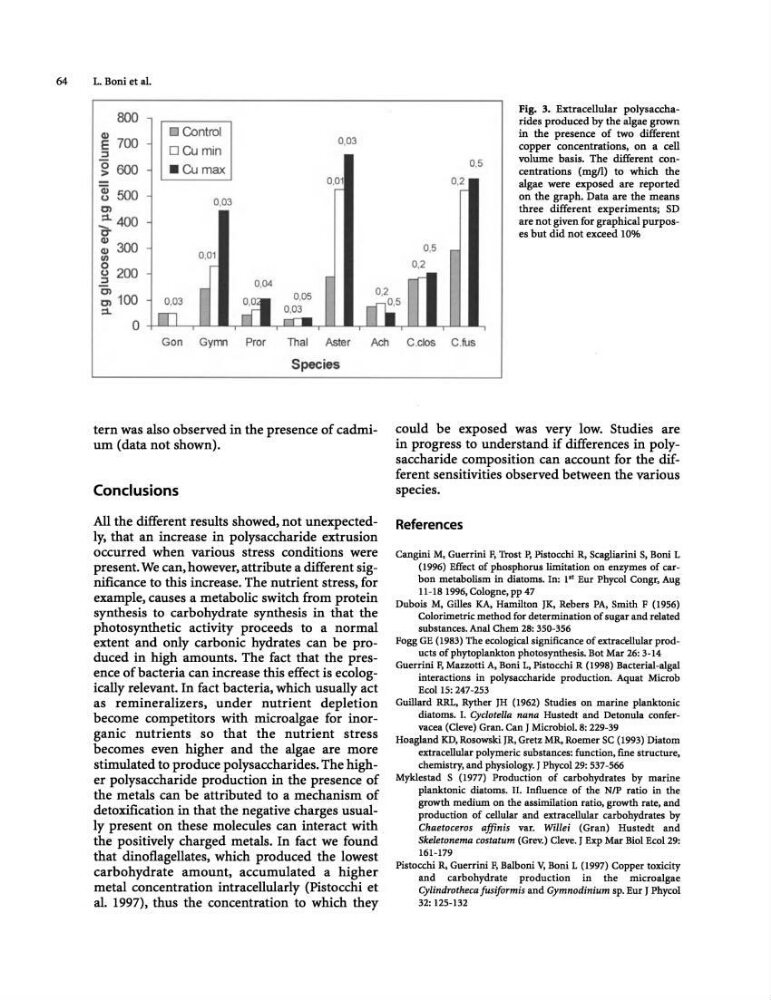
stimulated to produce polysaccharides. The higher polysaccharide production in the presence of
the metals can be attributed to a mechanism of
detoxification in that the negative charges usually present on these molecules can interact with
the positively charged metals. In fact we found
that dinoflagellates, which produced the lowest
carbohydrate amount, accumulated a higher
metal concentration intracellularly (Pistocchi et
al. 1997), thus the concentration to which they
Fig. 3. Extracellular polysaccharides produced by the algae grown
in the presence of two different
copper concentrations, on a cell
volume basis. The different con0,5
centrations (mg/l) to which the
0,2
algae were exposed are reported
on the graph. Data are the means
three different experiments; SD
are not given for graphical purposes but did not exceed 10%
0,5
0,2
C.clos C.fus
could be exposed was very low. Studies are
in progress to understand if differences in polysaccharide composition can account for the different sensitivities observed between the various
species.
References
Cangini M, Guerrini F, Trost P, Pistocchi R, Scagliarini S, Boni L
(1996) Effect of phosphorus limitation on enzymes of carbon metabolism in diatoms. In: l't Eur Phyrol Congr, Aug
11-18 1996, Cologne, pp 47
Dubois M, Gilles KA, Hamilton JK, Rebers PA, Smith F (1956)
Colorimetric method for determination of sugar and related
substances. Anal Chern 28: 350-356
Fogg GE (1983) The ecologkal significance of extracellular products of phytoplankton photosynthesis. Bot Mar 26: 3-14
Guerrini F, Mazzotti A, Boni L, Pistocchi R (1998) Bacterial-algal
interactions in polysaccharide production. Aquat Microb
Eroi15: 247-253
Guillard RRL, Ryther JH (1962) Studies on marine planktonic
diatoms. I. Cyclotella nan a Hustedt and Detonula confervacea (Cleve) Gran. Can J Microbiol. 8: 229-39
Hoagland KD, Rosowski JR, Gretz MR. Roemer SC (1993) Diatom
extracellular polymeric substances: function, fine structure,
chemistry, and physiology. J Phyco129: 537-566
Myklestad S (1977) Production of carbohydrates by marine
planktonic diatoms. II. Influence of the NIP ratio in the
growth medium on the assimilation ratio, growth rate, and
production of cellular and extracellular carbohydrates by
Chaetoceros a!finis var. Willei (Gran) Hustedt and
Skeletonema costatum (Grev.) Cleve. J Exp Mar BioI Eco129:
161-179
Pistocchi R, Guerrini F, Balboni V; Bani L (1997) Copper toxicity
and carbohydrate production in the micro algae
Cylindrotheca fusiformis and Gymnodinium sp. Eur J Phycol
32: 125-132
1. Boni et al.
800
e 700
o Control
D Cu min
0,03
::l
a 600
• Cu max
>
Q)
0.01
0 500
0,03
0')
::L 400
..... cr
(j) 300
Q)
0.01
I/)
0
g 200
0,04
0')
01 100
0,03
::L
0
Gon
Gymn
Pror
Thai
Aster
Ach
Species
tern was also observed in the presence of cadmium (data not shown).
Conclusions
All the different results showed, not unexpectedly, that an increase in polysaccharide extrusion
occurred when various stress conditions were
present. We can, however, attribute a different significance to this increase. The nutrient stress, for
example, causes a metabolic switch from protein
synthesis to carbohydrate synthesis in that the
photosynthetic activity proceeds to a normal
extent and only carbonic hydrates can be produced in high amounts. The fact that the presence of bacteria can increase this effect is ecologically relevant. In fact bacteria, which usually act
as remineralizers, under nutrient depletion
become competitors with micro algae for inorganic nutrients so that the nutrient stress
becomes even higher and the algae are more
stimulated to produce polysaccharides. The higher polysaccharide production in the presence of
the metals can be attributed to a mechanism of
detoxification in that the negative charges usually present on these molecules can interact with
the positively charged metals. In fact we found
that dinoflagellates, which produced the lowest
carbohydrate amount, accumulated a higher
metal concentration intracellularly (Pistocchi et
al. 1997), thus the concentration to which they
Fig. 3. Extracellular polysaccharides produced by the algae grown
in the presence of two different
copper concentrations, on a cell
volume basis. The different con0,5
centrations (mg/l) to which the
0,2
algae were exposed are reported
on the graph. Data are the means
three different experiments; SD
are not given for graphical purposes but did not exceed 10%
0,5
0,2
C.clos C.fus
could be exposed was very low. Studies are
in progress to understand if differences in polysaccharide composition can account for the different sensitivities observed between the various
species.
References
Cangini M, Guerrini F, Trost P, Pistocchi R, Scagliarini S, Boni L
(1996) Effect of phosphorus limitation on enzymes of carbon metabolism in diatoms. In: l't Eur Phyrol Congr, Aug
11-18 1996, Cologne, pp 47
Dubois M, Gilles KA, Hamilton JK, Rebers PA, Smith F (1956)
Colorimetric method for determination of sugar and related
substances. Anal Chern 28: 350-356
Fogg GE (1983) The ecologkal significance of extracellular products of phytoplankton photosynthesis. Bot Mar 26: 3-14
Guerrini F, Mazzotti A, Boni L, Pistocchi R (1998) Bacterial-algal
interactions in polysaccharide production. Aquat Microb
Eroi15: 247-253
Guillard RRL, Ryther JH (1962) Studies on marine planktonic
diatoms. I. Cyclotella nan a Hustedt and Detonula confervacea (Cleve) Gran. Can J Microbiol. 8: 229-39
Hoagland KD, Rosowski JR, Gretz MR. Roemer SC (1993) Diatom
extracellular polymeric substances: function, fine structure,
chemistry, and physiology. J Phyco129: 537-566
Myklestad S (1977) Production of carbohydrates by marine
planktonic diatoms. II. Influence of the NIP ratio in the
growth medium on the assimilation ratio, growth rate, and
production of cellular and extracellular carbohydrates by
Chaetoceros a!finis var. Willei (Gran) Hustedt and
Skeletonema costatum (Grev.) Cleve. J Exp Mar BioI Eco129:
161-179
Pistocchi R, Guerrini F, Balboni V; Bani L (1997) Copper toxicity
and carbohydrate production in the micro algae
Cylindrotheca fusiformis and Gymnodinium sp. Eur J Phycol
32: 125-132