

Trophic Conditions and Dystrophy in the Sacca di Gore Lagoon
471
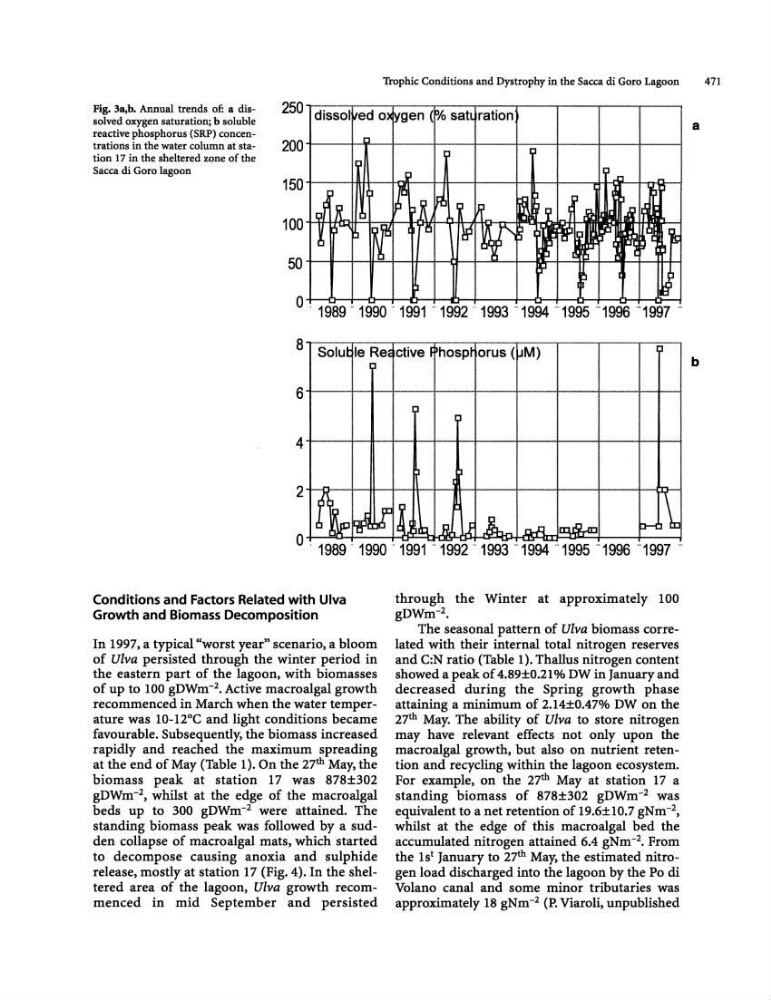
Fig. 3a,b. Annual trends of. a dissolved oxygen saturation; b soluble
reactive phosphorus (SRP) concentrations in the water column at station 17 in the sheltered zone of the
Sacca di Goro lagoon
250 dissol~ed OJIygen (FlO sah ration
200r---~~~--~-4r--4-=-4--~---+--~
~
150~--~~~j~~-4~-+---+~~--~~~~
Q~K ~ !fK~ ~ ~~ j,lda >~'
100 1l~~~"'fi~~fMgf-1~rfl~I\H1a11K'tfl'1r~ ~~ ~~~~:JI. ~K:J~tl~[-1IQj~
W+-~;-~~~-r~-+~-4~~~~~~+-~
~
o , 1989 "1990'1991 1992 1993 '1994'1995 ~1996"1997
8
.
-Solut Ie Ree ctlve F~hospt orus (~M)
~
6
~
4
f ~ll
irn6Lm
~,\
2
~ It Itt ~ u= ~ [']...Q
o '1989 1990' 1991 1992 "1993 '1994 "1995 -1996 "1997
Conditions and Factors Related with Ulva
Growth and Biomass Decomposition
In 1997, a typical "worst year" scenario, a bloom
of Ulva persisted through the winter period in
the eastern part of the lagoon, with biomasses
of up to 100 gDWm- 2 • Active macro algal growth
recommenced in March when the water temperature was lO-12°C and light conditions became
favourable. Subsequently, the biomass increased
rapidly and reached the maximum spreading
at the end of May (Table 1). On the 27 th May, the
biomass peak at station 17 was 878±302
gDWm- 2 , whilst at the edge of the macroalgal
beds up to 300 gDWm- 2 were attained. The
standing biomass peak was followed by a sudden collapse of macroalgal mats, which started
to decompose causing anoxia and sulphide
release, mostly at station 17 (Fig. 4). In the sheltered area of the lagoon, Ulva growth recommenced in mid September and persisted
through the Winter at approximately 100
gDWm- 2 •
The seasonal pattern of Ulva biomass correlated with their internal total nitrogen reserves
and C:N ratio (Table 1). Thallus nitrogen content
showed a peak of 4.89±0.21 % DW in January and
decreased during the Spring growth phase
attaining a minimum of 2.14±O.47% DW on the
2]ili May. The ability of Ulva to store nitrogen
may have relevant effects not only upon the
macro algal growth, but also on nutrient retention and recycling within the lagoon ecosystem.
For example, on the 27 th May at station 17 a
standing biomass of 878±302 gDWm- 2 was
equivalent to a net retention of 19.6±10.7 gNm- 2 ,
whilst at the edge of this macro algal bed the
accumulated nitrogen attained 6.4 gNm- 2 • From
the 1st January to 27 th May, the estimated nitrogen load discharged into the lagoon by the Po di
Volano canal and some minor tributaries was
approximately 18 gNm- 2 (P. Viaroli, unpublished
a
b
471
Fig. 3a,b. Annual trends of. a dissolved oxygen saturation; b soluble
reactive phosphorus (SRP) concentrations in the water column at station 17 in the sheltered zone of the
Sacca di Goro lagoon
250 dissol~ed OJIygen (FlO sah ration
200r---~~~--~-4r--4-=-4--~---+--~
~
150~--~~~j~~-4~-+---+~~--~~~~
Q~K ~ !fK~ ~ ~~ j,lda >~'
100 1l~~~"'fi~~fMgf-1~rfl~I\H1a11K'tfl'1r~ ~~ ~~~~:JI. ~K:J~tl~[-1IQj~
W+-~;-~~~-r~-+~-4~~~~~~+-~
~
o , 1989 "1990'1991 1992 1993 '1994'1995 ~1996"1997
8
.
-Solut Ie Ree ctlve F~hospt orus (~M)
~
6
~
4
f ~ll
irn6Lm
~,\
2
~ It Itt ~ u= ~ [']...Q
o '1989 1990' 1991 1992 "1993 '1994 "1995 -1996 "1997
Conditions and Factors Related with Ulva
Growth and Biomass Decomposition
In 1997, a typical "worst year" scenario, a bloom
of Ulva persisted through the winter period in
the eastern part of the lagoon, with biomasses
of up to 100 gDWm- 2 • Active macro algal growth
recommenced in March when the water temperature was lO-12°C and light conditions became
favourable. Subsequently, the biomass increased
rapidly and reached the maximum spreading
at the end of May (Table 1). On the 27 th May, the
biomass peak at station 17 was 878±302
gDWm- 2 , whilst at the edge of the macroalgal
beds up to 300 gDWm- 2 were attained. The
standing biomass peak was followed by a sudden collapse of macroalgal mats, which started
to decompose causing anoxia and sulphide
release, mostly at station 17 (Fig. 4). In the sheltered area of the lagoon, Ulva growth recommenced in mid September and persisted
through the Winter at approximately 100
gDWm- 2 •
The seasonal pattern of Ulva biomass correlated with their internal total nitrogen reserves
and C:N ratio (Table 1). Thallus nitrogen content
showed a peak of 4.89±0.21 % DW in January and
decreased during the Spring growth phase
attaining a minimum of 2.14±O.47% DW on the
2]ili May. The ability of Ulva to store nitrogen
may have relevant effects not only upon the
macro algal growth, but also on nutrient retention and recycling within the lagoon ecosystem.
For example, on the 27 th May at station 17 a
standing biomass of 878±302 gDWm- 2 was
equivalent to a net retention of 19.6±10.7 gNm- 2 ,
whilst at the edge of this macro algal bed the
accumulated nitrogen attained 6.4 gNm- 2 • From
the 1st January to 27 th May, the estimated nitrogen load discharged into the lagoon by the Po di
Volano canal and some minor tributaries was
approximately 18 gNm- 2 (P. Viaroli, unpublished
a
b