

470
P. Viaroli et aI.
ing the procedures of Fossing and J rargensen
(1989). Details dealing with incubation and
extraction techniques and analytical methods
are reported by Giordani et al. (1997).
Results
A Decadal trend of Macroalgal Growth
and Water Quality
Lagoon trophic status and water quality depend
mostly on the growth and decomposition of
Ulva. In the sheltered zone of the lagoon
(approximately 10 km 2 ) abnormal macro algal
growths have been frequently observed in
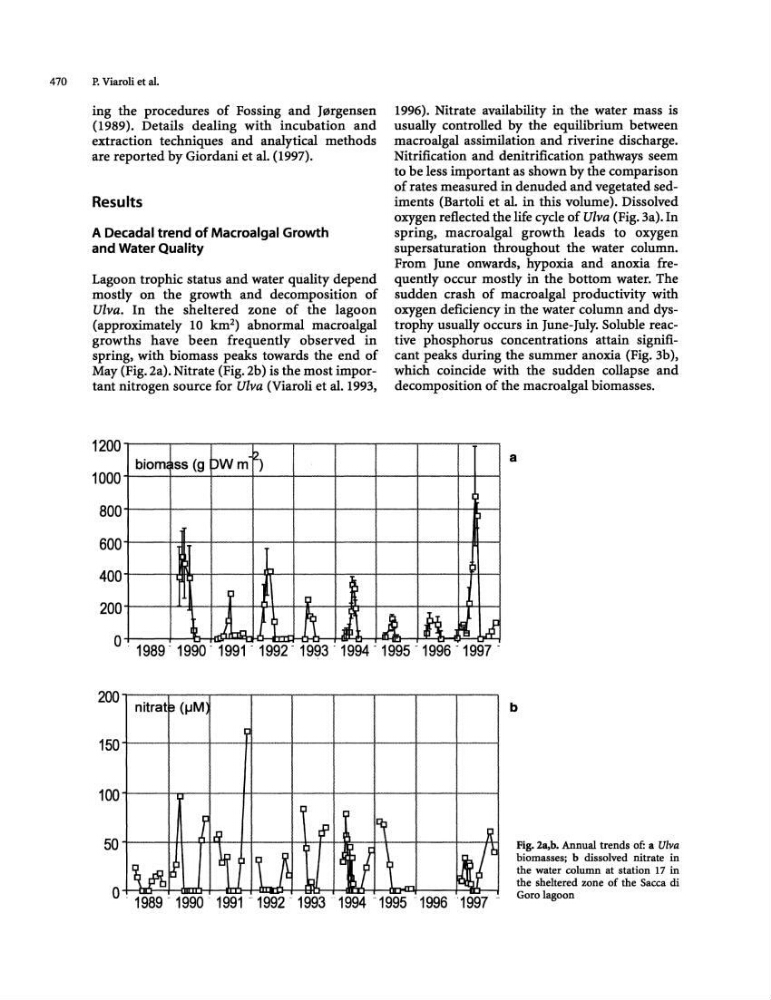
spring, with biomass peaks towards the end of
May (Fig. 2a). Nitrate (Fig. 2b) is the most important nitrogen source for Ulva (Viaroli et al. 1993,
1200
1000
800
600
400
200
biomc 88 (9 JWm ~)
~
J;J
>
1996). Nitrate availability in the water mass is
usually controlled by the equilibrium between
macro algal assimilation and riverine discharge.
Nitrification and denitrification pathways seem
to be less important as shown by the comparison
of rates measured in denuded and vegetated sediments (Bartoli et al. in this volume). Dissolved
oxygen reflected the life cycle of Ulva (Fig. 3a). In
spring, macro algal growth leads to oxygen
supersaturation throughout the water column.
From June onwards, hypoxia and anoxia frequently occur mostly in the bottom water. The
sudden crash of macroalgal productivity with
oxygen deficiency in the water column and dystrophy usually occurs in June-JUly. Soluble reactive phosphorus concentrations attain significant peaks during the summer anoxia (Fig. 3b),
which coincide with the sudden collapse and
decomposition of the macroalgal biomasses.
a
a . 1989' 1990·· 1991 . 1992 - 1993 . 1994 - 1995 . . 1996 -1997 -
t .1
~ :id A fi ~ ..t
ha.
t
- - - - - - - - -
200 nitrat 9 (pM'
150
100
~
rl}
~
, R
~
IV
~
~ 11 It
\fh~
t~
j
IfIl
.....
~
-
~
~
-
50
o . 1989·· 1990 1991 1992 1993 ·1994 1995 19961997
b
Fig. 2a,b. Annual trends of: a mVQ
biomasses; b dissolved nitrate in
the water column at station 17 in
the sheltered zone of the Sacca di
Gorolagoon
P. Viaroli et aI.
ing the procedures of Fossing and J rargensen
(1989). Details dealing with incubation and
extraction techniques and analytical methods
are reported by Giordani et al. (1997).
Results
A Decadal trend of Macroalgal Growth
and Water Quality
Lagoon trophic status and water quality depend
mostly on the growth and decomposition of
Ulva. In the sheltered zone of the lagoon
(approximately 10 km 2 ) abnormal macro algal
growths have been frequently observed in
spring, with biomass peaks towards the end of
May (Fig. 2a). Nitrate (Fig. 2b) is the most important nitrogen source for Ulva (Viaroli et al. 1993,
1200
1000
800
600
400
200
biomc 88 (9 JWm ~)
~
J;J
>
1996). Nitrate availability in the water mass is
usually controlled by the equilibrium between
macro algal assimilation and riverine discharge.
Nitrification and denitrification pathways seem
to be less important as shown by the comparison
of rates measured in denuded and vegetated sediments (Bartoli et al. in this volume). Dissolved
oxygen reflected the life cycle of Ulva (Fig. 3a). In
spring, macro algal growth leads to oxygen
supersaturation throughout the water column.
From June onwards, hypoxia and anoxia frequently occur mostly in the bottom water. The
sudden crash of macroalgal productivity with
oxygen deficiency in the water column and dystrophy usually occurs in June-JUly. Soluble reactive phosphorus concentrations attain significant peaks during the summer anoxia (Fig. 3b),
which coincide with the sudden collapse and
decomposition of the macroalgal biomasses.
a
a . 1989' 1990·· 1991 . 1992 - 1993 . 1994 - 1995 . . 1996 -1997 -
t .1
~ :id A fi ~ ..t
ha.
t
- - - - - - - - -
200 nitrat 9 (pM'
150
100
~
rl}
~
, R
~
IV
~
~ 11 It
\fh~
t~
j
IfIl
.....
~
-
~
~
-
50
o . 1989·· 1990 1991 1992 1993 ·1994 1995 19961997
b
Fig. 2a,b. Annual trends of: a mVQ
biomasses; b dissolved nitrate in
the water column at station 17 in
the sheltered zone of the Sacca di
Gorolagoon