

450
M. Fabiano et aI.
a
particulate organic matter
b
-----~-----...",
•
300
• •
44.00
250
\
250
\
4470
200
'\,
j - " ' . / \ (
200
4400
150
. ( \ 150
\
4450
\
100
l ./
100
\
l ./
4440 I
20 '\
40'
50
44' ~220 -'2 :-: 30 :c=---,- '~ 2 4O ---::-- ' ".- 2= 50, - - - - ;~2- - : : c .
00 ::--: 12-=. 70 -=-- '2 : - - - : _
80 -:'- \ - "2.90 :-:-'-3.-- 00--- '3-. 'O --=-= 13l--:::' 20 0
50
12.20 12 3O~-1 "" 2.--: 4O"----'--: 12-=-. 50~'2:-: 00 -=------:C12 ::-::.7 =- 0 ----,1-=- 2. 80~':-::- 2 = 90"-1 ~3""'. OO::--: 13-. 1 0 :--: '3 ~ 2O '
0
a
sedimentary organic matter
b
3000
r
3000
2500
:2500
2000
T
2000
1500
1500
1000
1000
T
500
500
0
Coast
Opensea
0
coast
Cent ral
Open sea
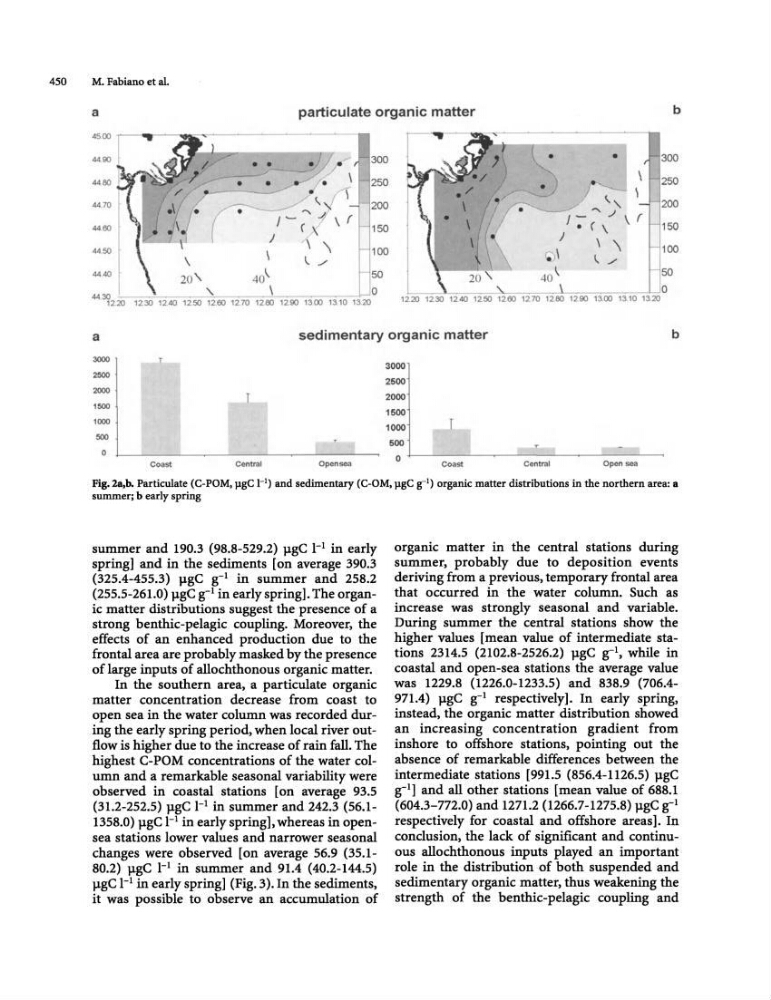
Fig.2a,b. Particulate (C-POM, J-lgC 1-1) and sedimentary (C-OM, J-lgC g--I) organic matter distributions in the northern area: a
summer; b early spring
summer and 190.3 (98.8-529.2) p.gC 1-1 in early
spring] and in the sediments [on average 390.3
(325.4-455.3) p.gC g-I in summer and 258.2
(255.5-261.0) p.gC g-I in early spring]. The organic matter distributions suggest the presence of a
strong benthic-pelagic coupling. Moreover, the
effects of an enhanced production due to the
frontal area are probably masked by the presence
of large inputs of allochthonous organic matter.
In the southern area, a particulate organic
matter concentration decrease from coast to
open sea in the water column was recorded during the early spring period, when local river outflow is higher due to the increase of rain fall. The
highest C-POM concentrations of the water column and a remarkable seasonal variability were
observed in coastal stations [on average 93.5
(31.2-252.5) p.gC 1-1 in summer and 242.3 (56.11358.0) p.gC 1-1 in early spring], whereas in opensea stations lower values and narrower seasonal
changes were observed [on average 56.9 (35.180.2) p.gC I-i in summer and 91.4 (40.2-144.5)
p.gC 1-1 in early spring] (Fig. 3). In the sediments,
it was possible to observe an accumulation of
organic matter in the central stations during
summer, probably due to deposition events
deriving from a previous, temporary frontal area
that occurred in the water column. Such as
increase was strongly seasonal and variable.
During summer the central stations show the
higher values [mean value of intermediate stations 2314.5 (2102.8-2526.2) p.gC g-l, while in
coastal and open-sea stations the average value
was 1229.8 (1226.0-1233.5) and 838.9 (706.4971.4) p.gC g-1 respectively]. In early spring,
instead, the organic matter distribution showed
an increasing concentration gradient from
inshore to offshore stations, pointing out the
absence of remarkable differences between the
intermediate stations [991.5 (856.4-1126.5) p.gC
g-l] and all other stations [mean value of 688.1
(604.3-772.0) and 1271.2 (1266.7-1275.8) p.gC g-1
respectively for coastal and offshore areas]. In
conclusion, the lack of significant and continuous allochthonous inputs played an important
role in the distribution of both suspended and
sedimentary organic matter, thus weakening the
strength of the benthic-pelagic coupling and
M. Fabiano et aI.
a
particulate organic matter
b
-----~-----...",
•
300
• •
44.00
250
\
250
\
4470
200
'\,
j - " ' . / \ (
200
4400
150
. ( \ 150
\
4450
\
100
l ./
100
\
l ./
4440 I
20 '\
40'
50
44' ~220 -'2 :-: 30 :c=---,- '~ 2 4O ---::-- ' ".- 2= 50, - - - - ;~2- - : : c .
00 ::--: 12-=. 70 -=-- '2 : - - - : _
80 -:'- \ - "2.90 :-:-'-3.-- 00--- '3-. 'O --=-= 13l--:::' 20 0
50
12.20 12 3O~-1 "" 2.--: 4O"----'--: 12-=-. 50~'2:-: 00 -=------:C12 ::-::.7 =- 0 ----,1-=- 2. 80~':-::- 2 = 90"-1 ~3""'. OO::--: 13-. 1 0 :--: '3 ~ 2O '
0
a
sedimentary organic matter
b
3000
r
3000
2500
:2500
2000
T
2000
1500
1500
1000
1000
T
500
500
0
Coast
Opensea
0
coast
Cent ral
Open sea
Fig.2a,b. Particulate (C-POM, J-lgC 1-1) and sedimentary (C-OM, J-lgC g--I) organic matter distributions in the northern area: a
summer; b early spring
summer and 190.3 (98.8-529.2) p.gC 1-1 in early
spring] and in the sediments [on average 390.3
(325.4-455.3) p.gC g-I in summer and 258.2
(255.5-261.0) p.gC g-I in early spring]. The organic matter distributions suggest the presence of a
strong benthic-pelagic coupling. Moreover, the
effects of an enhanced production due to the
frontal area are probably masked by the presence
of large inputs of allochthonous organic matter.
In the southern area, a particulate organic
matter concentration decrease from coast to
open sea in the water column was recorded during the early spring period, when local river outflow is higher due to the increase of rain fall. The
highest C-POM concentrations of the water column and a remarkable seasonal variability were
observed in coastal stations [on average 93.5
(31.2-252.5) p.gC 1-1 in summer and 242.3 (56.11358.0) p.gC 1-1 in early spring], whereas in opensea stations lower values and narrower seasonal
changes were observed [on average 56.9 (35.180.2) p.gC I-i in summer and 91.4 (40.2-144.5)
p.gC 1-1 in early spring] (Fig. 3). In the sediments,
it was possible to observe an accumulation of
organic matter in the central stations during
summer, probably due to deposition events
deriving from a previous, temporary frontal area
that occurred in the water column. Such as
increase was strongly seasonal and variable.
During summer the central stations show the
higher values [mean value of intermediate stations 2314.5 (2102.8-2526.2) p.gC g-l, while in
coastal and open-sea stations the average value
was 1229.8 (1226.0-1233.5) and 838.9 (706.4971.4) p.gC g-1 respectively]. In early spring,
instead, the organic matter distribution showed
an increasing concentration gradient from
inshore to offshore stations, pointing out the
absence of remarkable differences between the
intermediate stations [991.5 (856.4-1126.5) p.gC
g-l] and all other stations [mean value of 688.1
(604.3-772.0) and 1271.2 (1266.7-1275.8) p.gC g-1
respectively for coastal and offshore areas]. In
conclusion, the lack of significant and continuous allochthonous inputs played an important
role in the distribution of both suspended and
sedimentary organic matter, thus weakening the
strength of the benthic-pelagic coupling and