

Suspended and Sedimentary Organic Matter in the Northern Adriatic
451
increasing the influence of temporary events as
the assessment of frontal, highly productive
areas.
In the Northern area proteins are the main
biochemical class of organic compounds (Table
and Fig. 4), and their concentration is slightly
higher in summer [60.8% (42.6-71.5%) in water
and 73.0% (68.1-79.8%) in sediments]. In the
water column, the diminished protein contribution during spring (52.5%,32.4-70.4%) is largely
due to the increase of the lipid fraction [17.5%
(7.8-30.5%) in summer and 26.2% (5.9-50.7%) in
early spring]. By contrast, in the sediments the
biochemical composition of organic matter
showed limited seasonal changes (percentage
values of proteins during early spring 66.9%,
from 58.2 to 77.3%) (Table and Fig. 4).
In the southern area, the percentage of proteins in the water column, despite their dominance (Fig. 5), is more variable than in the northern area [59.8% (39.6-86.3%) in summer and
38.6% (19.5-61.4%) in early spring]. Lower variability but higher protein contents were observed
in the sediments [proteins amounting to 78.1 %
(74.2-82.0%) in summer and 75.7 % (71.7-80.5%)
in early spring] (Fig. 5).
The higher values of the PRT:CHO ratio in
the sediment as compared to the water column
(on average 7.S±1.7 vs 2.2±O.6, respectively,
Table), might be related to an increase of the bacterial secondary production induced by the
enhanced C-POM rain. The accumulation of the
protein fraction in the sediments is a typical feature of the loss systems and of highly productive
environments (Fabiano et al. 1997). Moreover, in
the coastal waters of the northern Adriatic, where
the input of allochthonous material provided by
the Po river is higher, the chemical link between
proteins and carbohydrates of vegetal origin may
produce complex macromolecular compounds
which can contribute to the gelbstoff production
(Ferrari and Mingazzini 1995). Keil and
Kirchman (1993) observed that protein-sugar
complexes have lower degradation rates than
a
particulate organic matter
b
44.10
300
.......
'\
300
"......
44.00
.......
'\
•
".......
.......
.......
\...
250
.......
.......
"250
.......
43.90
......
.......
\...
.......
........
".......
43.80
200
"200
' -
......
--43.70
150
-.t.
......
150
43.60
'\
100
\
100
<:.
50
1
<.
50
a
sedimentary organic matter
b
3000
3000
2500
f
2500
2000
2000
1500
1500
1000
1000
T
T
500
500
0
0
Coast
Central
Open sea
Coast
Central
Open sea
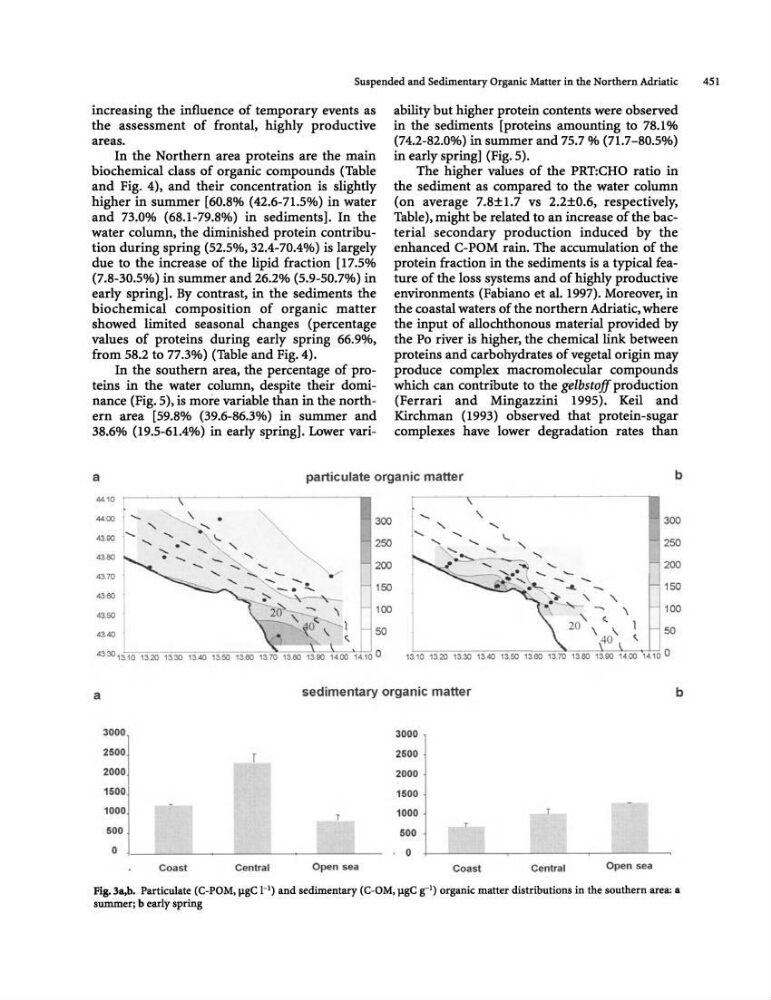
Fig.3a,b. Particulate (C-POM,llSC 1- 1 ) and sedimentary (C-OM, llgC g-l) organic matter distributions in the southern area: a
summer; b early spring
451
increasing the influence of temporary events as
the assessment of frontal, highly productive
areas.
In the Northern area proteins are the main
biochemical class of organic compounds (Table
and Fig. 4), and their concentration is slightly
higher in summer [60.8% (42.6-71.5%) in water
and 73.0% (68.1-79.8%) in sediments]. In the
water column, the diminished protein contribution during spring (52.5%,32.4-70.4%) is largely
due to the increase of the lipid fraction [17.5%
(7.8-30.5%) in summer and 26.2% (5.9-50.7%) in
early spring]. By contrast, in the sediments the
biochemical composition of organic matter
showed limited seasonal changes (percentage
values of proteins during early spring 66.9%,
from 58.2 to 77.3%) (Table and Fig. 4).
In the southern area, the percentage of proteins in the water column, despite their dominance (Fig. 5), is more variable than in the northern area [59.8% (39.6-86.3%) in summer and
38.6% (19.5-61.4%) in early spring]. Lower variability but higher protein contents were observed
in the sediments [proteins amounting to 78.1 %
(74.2-82.0%) in summer and 75.7 % (71.7-80.5%)
in early spring] (Fig. 5).
The higher values of the PRT:CHO ratio in
the sediment as compared to the water column
(on average 7.S±1.7 vs 2.2±O.6, respectively,
Table), might be related to an increase of the bacterial secondary production induced by the
enhanced C-POM rain. The accumulation of the
protein fraction in the sediments is a typical feature of the loss systems and of highly productive
environments (Fabiano et al. 1997). Moreover, in
the coastal waters of the northern Adriatic, where
the input of allochthonous material provided by
the Po river is higher, the chemical link between
proteins and carbohydrates of vegetal origin may
produce complex macromolecular compounds
which can contribute to the gelbstoff production
(Ferrari and Mingazzini 1995). Keil and
Kirchman (1993) observed that protein-sugar
complexes have lower degradation rates than
a
particulate organic matter
b
44.10
300
.......
'\
300
"......
44.00
.......
'\
•
".......
.......
.......
\...
250
.......
.......
"250
.......
43.90
......
.......
\...
.......
........
".......
43.80
200
"200
' -
......
--43.70
150
-.t.
......
150
43.60
'\
100
\
100
<:.
50
1
<.
50
a
sedimentary organic matter
b
3000
3000
2500
f
2500
2000
2000
1500
1500
1000
1000
T
T
500
500
0
0
Coast
Central
Open sea
Coast
Central
Open sea
Fig.3a,b. Particulate (C-POM,llSC 1- 1 ) and sedimentary (C-OM, llgC g-l) organic matter distributions in the southern area: a
summer; b early spring