

410
P. Picon et aI.
50
'? 40
N
~
"0 30
E
.5,
u
20
u (/) 10
0
August 97
June 95
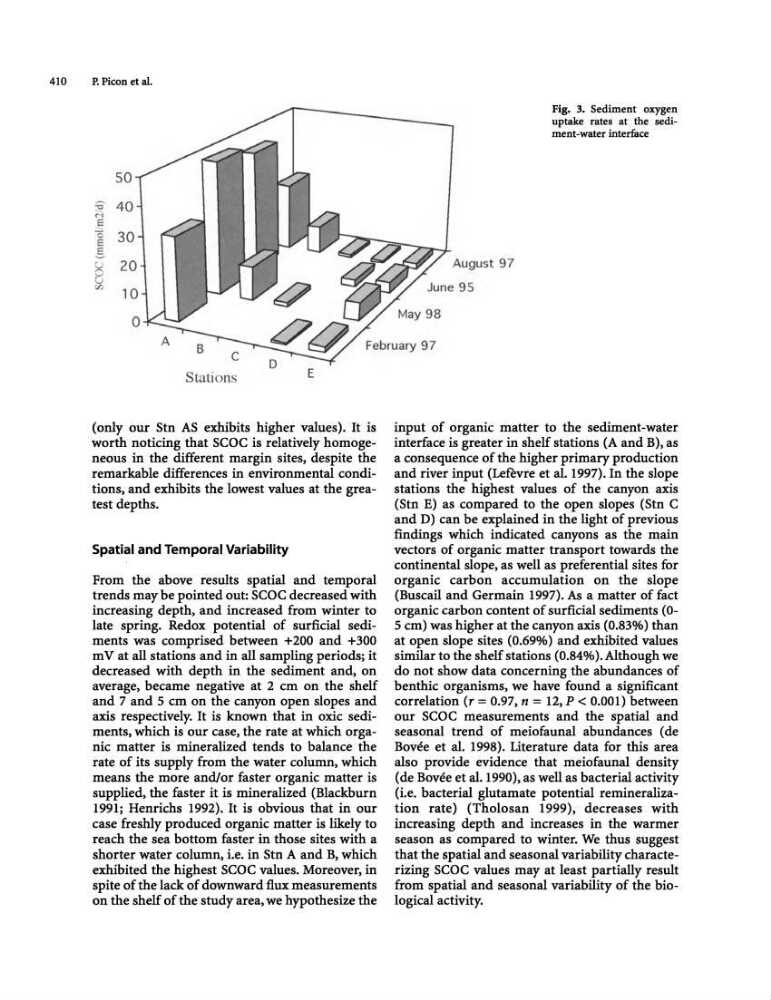
Fig. 3. Sediment oxygen
uptake rates at the sediment-water interface
February 97
Stations
E
(only our Stn AS exhibits higher values). It is
worth noticing that SCOC is relatively homogeneous in the different margin sites, despite the
remarkable differences in environmental conditions, and exhibits the lowest values at the greatest depths.
Spatial and Temporal Variability
From the above results spatial and temporal
trends may be pointed out: SCOc decreased with
increasing depth, and increased from winter to
late spring. Redox potential of surficial sediments was comprised between +200 and +300
m V at all stations and in all sampling periods; it
decreased with depth in the sediment and, on
average) became negative at 2 cm on the shelf
and 7 and 5 em on the canyon open slopes and
axis respectively. It is known that in oxic sediments, which is our case, the rate at which organic matter is mineralized tends to balance the
rate of its supply from the water column, which
means the more andlor faster organic matter is
supplied, the faster it is mineralized (Blackburn
1991; Henrichs 1992). It is obvious that in our
case freshly produced organic matter is likely to
reach the sea bottom faster in those sites with a
shorter water column, i.e. in Stn A and B, which
exhibited the highest SCOC values. Moreover, in
spite of the lack of downward flux measurements
on the shelf of the study area, we hypothesize the
input of organic matter to the sediment-water
interface is greater in shelf stations (A and B), as
a consequence of the higher primary production
and river input (Lefevre et al. 1997). In the slope
stations the highest values of the canyon axis
(Stn E) as compared to the open slopes (Stn C
and D) can be explained in the light of previous
findings which indicated canyons as the main
vectors of organic matter transport towards the
continental slope, as well as preferential sites for
organic carbon accumulation on the slope
(Buscail and Germain 1997). As a matter of fact
organic carbon content of surficial sediments (05 cm) was higher at the canyon axis (0.83%) than
at open slope sites (0.69%) and exhibited values
similar to the shelf stations (0.84%). Although we
do not show data concerning the abundances of
benthic organisms, we have found a significant
correlation (r = 0.97, n = 12, P < 0.001) between
our SCOC measurements and the spatial and
seasonal trend of meiofaunal abundances (de
Bovee et al. 1998). Literature data for this area
also provide evidence that meiofaunal density
(de Bovee et al. 1990), as well as bacterial activity
(i.e. bacterial glutamate potential remineralization rate) (Tholosan 1999), decreases with
increasing depth and increases in the warmer
season as compared to winter. We thus suggest
that the spatial and seasonal variability characterizing SCOC values may at least partially result
from spatial and seasonal variability of the biological activity.
P. Picon et aI.
50
'? 40
N
~
"0 30
E
.5,
u
20
u (/) 10
0
August 97
June 95
Fig. 3. Sediment oxygen
uptake rates at the sediment-water interface
February 97
Stations
E
(only our Stn AS exhibits higher values). It is
worth noticing that SCOC is relatively homogeneous in the different margin sites, despite the
remarkable differences in environmental conditions, and exhibits the lowest values at the greatest depths.
Spatial and Temporal Variability
From the above results spatial and temporal
trends may be pointed out: SCOc decreased with
increasing depth, and increased from winter to
late spring. Redox potential of surficial sediments was comprised between +200 and +300
m V at all stations and in all sampling periods; it
decreased with depth in the sediment and, on
average) became negative at 2 cm on the shelf
and 7 and 5 em on the canyon open slopes and
axis respectively. It is known that in oxic sediments, which is our case, the rate at which organic matter is mineralized tends to balance the
rate of its supply from the water column, which
means the more andlor faster organic matter is
supplied, the faster it is mineralized (Blackburn
1991; Henrichs 1992). It is obvious that in our
case freshly produced organic matter is likely to
reach the sea bottom faster in those sites with a
shorter water column, i.e. in Stn A and B, which
exhibited the highest SCOC values. Moreover, in
spite of the lack of downward flux measurements
on the shelf of the study area, we hypothesize the
input of organic matter to the sediment-water
interface is greater in shelf stations (A and B), as
a consequence of the higher primary production
and river input (Lefevre et al. 1997). In the slope
stations the highest values of the canyon axis
(Stn E) as compared to the open slopes (Stn C
and D) can be explained in the light of previous
findings which indicated canyons as the main
vectors of organic matter transport towards the
continental slope, as well as preferential sites for
organic carbon accumulation on the slope
(Buscail and Germain 1997). As a matter of fact
organic carbon content of surficial sediments (05 cm) was higher at the canyon axis (0.83%) than
at open slope sites (0.69%) and exhibited values
similar to the shelf stations (0.84%). Although we
do not show data concerning the abundances of
benthic organisms, we have found a significant
correlation (r = 0.97, n = 12, P < 0.001) between
our SCOC measurements and the spatial and
seasonal trend of meiofaunal abundances (de
Bovee et al. 1998). Literature data for this area
also provide evidence that meiofaunal density
(de Bovee et al. 1990), as well as bacterial activity
(i.e. bacterial glutamate potential remineralization rate) (Tholosan 1999), decreases with
increasing depth and increases in the warmer
season as compared to winter. We thus suggest
that the spatial and seasonal variability characterizing SCOC values may at least partially result
from spatial and seasonal variability of the biological activity.