

seoc along a Shelf-slope Transect in the Western Gulf of lions
411
Carbon Mineralization versus Carbon Input
Data obtained from sediment trap measurements performed at the same sites as our slope
stations resulted in an average annual input of
particulate organic carbon to the benthic boundary layer in the slope region equal to 45 mg e
m- 2 d- 1 (Heussner et al. 1996).
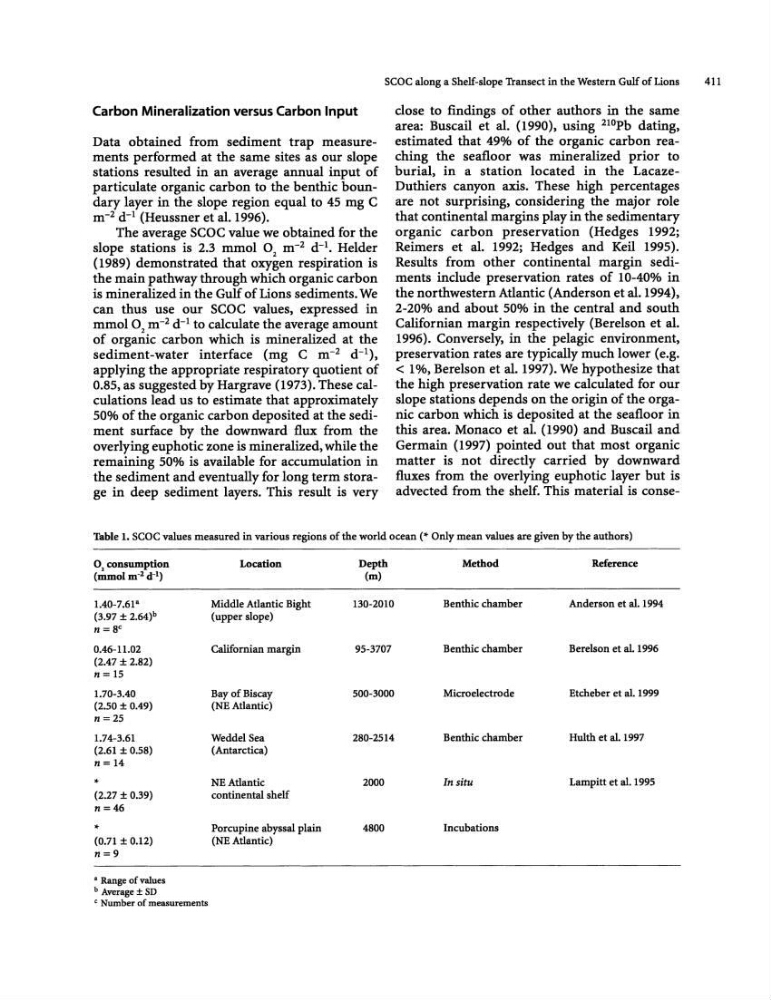
The average seoe value we obtained for the
slope stations is 2.3 mmol 0. m- 2 d- 1 • Helder
(1989) demonstrated that oxygen respiration is
the main pathway through which organic carbon
is mineralized in the Gulf of Lions sediments. We
can thus use our seoe values, expressed in
mmol 02 m- 2 d- 1 to calculate the average amount
of organic carbon which is mineralized at the
sediment-water interface (mg e m- 2 d- 1 ),
applying the appropriate respiratory quotient of
0.85, as suggested by Hargrave (1973). These calculations lead us to estimate that approximately
50% of the organic carbon deposited at the sediment surface by the downward flux from the
overlying euphotic zone is mineralized, while the
remaining 50% is available for accumulation in
the sediment and eventually for long term storage in deep sediment layers. This result is very
close to findings of other authors in the same
area: Buscail et al. (1990), using 210Pb dating,
estimated that 49% of the organic carbon reaching the seafloor was mineralized prior to
burial, in a station located in the LacazeDuthiers canyon axis. These high percentages
are not surprising, considering the major role
that continental margins play in the sedimentary
organic carbon preservation (Hedges 1992;
Reimers et al. 1992; Hedges and Keil 1995).
Results from other continental margin sediments include preservation rates of 10-40% in
the northwestern Atlantic (Anderson et al. 1994),
2-20% and about 50% in the central and south
Californian margin respectively (Berelson et al.
1996). Conversely, in the pelagic environment,
preservation rates are typically much lower (e.g.
< 1 %. Berelson et al. 1997). We hypothesize that
the high preservation rate we calculated for our
slope stations depends on the origin of the organic carbon which is deposited at the seafloor in
this area. Monaco et al. (1990) and Buscail and
Germain (1997) pointed out that most organic
matter is not directly carried by downward
fluxes from the overlying euphotic layer but is
advected from the shelf. This material is conseTable 1. seoe values measured in various regions of the world ocean ('" Only mean values are given by the authon;)
0. consumption
Location
Depth
Method
Reference
(mmol m- 2 dol)
(m)
1.40-7.6}&
Middle Atlantic Bight
130-2010
Benthic chamber
Anderson et al.1994
(3.97 ± 2.64)b
(upper slope)
n =8 c
0.46-11.02
Californian margin
95-3707
Benthic chamber
Berelson et aL 1996
(2.47 ± 2.82)
n = 15
1.70-3.40
Bay of Biscay
500-3000
Microelectrode
Etcheber et al. 1999
(2.50 ± 0.49)
(NE Atlantic)
n=25
1.74-3.61
Weddel Sea
280-2514
Benthic chamber
Hulth et al. 1997
(2.61 ± 0.58)
(Antarctica)
n = 14
' "
NEAtlantic
2000
In situ
Lampitt et al. 1995
(2.27 ± 0.39)
continental shelf
n=46
,.
Porcupine abyssal plain
4800
Incubations
(0.71 ± 0.12)
(NE Atlantic)
n=9
a Range of values
b Average ± SD
C Number of measurements
411
Carbon Mineralization versus Carbon Input
Data obtained from sediment trap measurements performed at the same sites as our slope
stations resulted in an average annual input of
particulate organic carbon to the benthic boundary layer in the slope region equal to 45 mg e
m- 2 d- 1 (Heussner et al. 1996).
The average seoe value we obtained for the
slope stations is 2.3 mmol 0. m- 2 d- 1 • Helder
(1989) demonstrated that oxygen respiration is
the main pathway through which organic carbon
is mineralized in the Gulf of Lions sediments. We
can thus use our seoe values, expressed in
mmol 02 m- 2 d- 1 to calculate the average amount
of organic carbon which is mineralized at the
sediment-water interface (mg e m- 2 d- 1 ),
applying the appropriate respiratory quotient of
0.85, as suggested by Hargrave (1973). These calculations lead us to estimate that approximately
50% of the organic carbon deposited at the sediment surface by the downward flux from the
overlying euphotic zone is mineralized, while the
remaining 50% is available for accumulation in
the sediment and eventually for long term storage in deep sediment layers. This result is very
close to findings of other authors in the same
area: Buscail et al. (1990), using 210Pb dating,
estimated that 49% of the organic carbon reaching the seafloor was mineralized prior to
burial, in a station located in the LacazeDuthiers canyon axis. These high percentages
are not surprising, considering the major role
that continental margins play in the sedimentary
organic carbon preservation (Hedges 1992;
Reimers et al. 1992; Hedges and Keil 1995).
Results from other continental margin sediments include preservation rates of 10-40% in
the northwestern Atlantic (Anderson et al. 1994),
2-20% and about 50% in the central and south
Californian margin respectively (Berelson et al.
1996). Conversely, in the pelagic environment,
preservation rates are typically much lower (e.g.
< 1 %. Berelson et al. 1997). We hypothesize that
the high preservation rate we calculated for our
slope stations depends on the origin of the organic carbon which is deposited at the seafloor in
this area. Monaco et al. (1990) and Buscail and
Germain (1997) pointed out that most organic
matter is not directly carried by downward
fluxes from the overlying euphotic layer but is
advected from the shelf. This material is conseTable 1. seoe values measured in various regions of the world ocean ('" Only mean values are given by the authon;)
0. consumption
Location
Depth
Method
Reference
(mmol m- 2 dol)
(m)
1.40-7.6}&
Middle Atlantic Bight
130-2010
Benthic chamber
Anderson et al.1994
(3.97 ± 2.64)b
(upper slope)
n =8 c
0.46-11.02
Californian margin
95-3707
Benthic chamber
Berelson et aL 1996
(2.47 ± 2.82)
n = 15
1.70-3.40
Bay of Biscay
500-3000
Microelectrode
Etcheber et al. 1999
(2.50 ± 0.49)
(NE Atlantic)
n=25
1.74-3.61
Weddel Sea
280-2514
Benthic chamber
Hulth et al. 1997
(2.61 ± 0.58)
(Antarctica)
n = 14
' "
NEAtlantic
2000
In situ
Lampitt et al. 1995
(2.27 ± 0.39)
continental shelf
n=46
,.
Porcupine abyssal plain
4800
Incubations
(0.71 ± 0.12)
(NE Atlantic)
n=9
a Range of values
b Average ± SD
C Number of measurements