

380
C. Morti and C.N. Bianchi
16.5
Air temperature
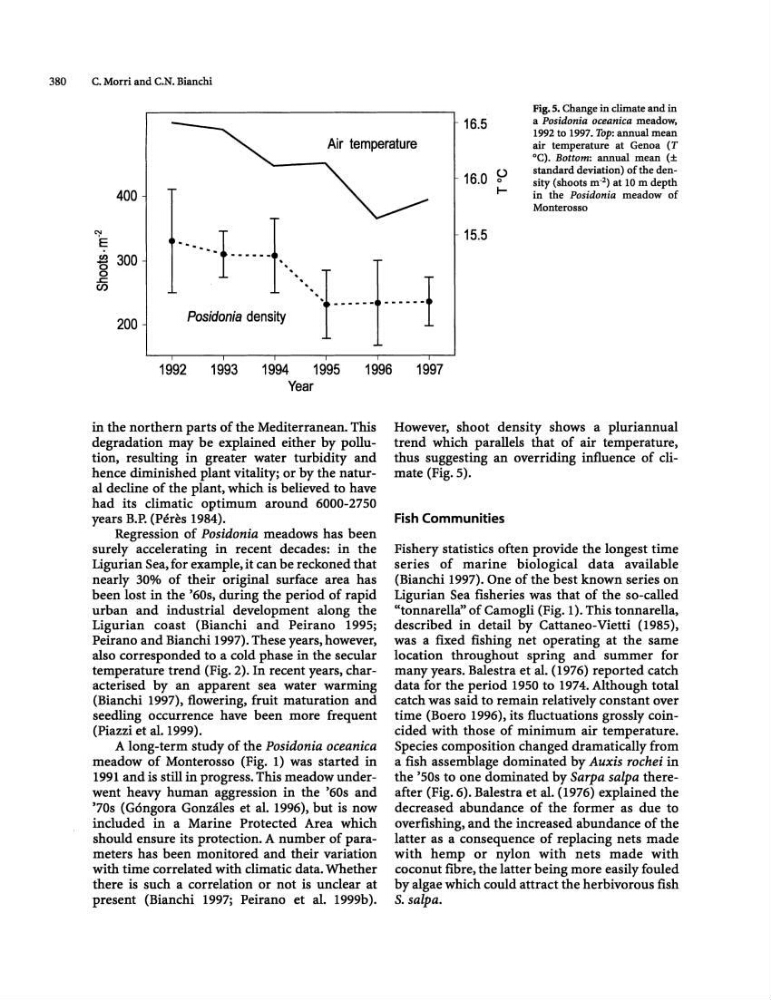
Fig. 5. Change in climate and in
a Posidonia oceanica meadow,
1992 to 1997. Top: annual mean
air temperature at Genoa (T
°C). Bottom: annual mean (±
standard deviation) of the density (shoots m- 2 ) at 10 m depth
in the Posidonia meadow of
Monterosso
~
E
400
16.0 ~
I15.5
~ 300
-c
en
200
······1·····-j. ..... .
PosIdonia density
·l··········-I
1992
1993 1994 1995 1996
Year
in the northern parts of the Mediterranean. This
degradation may be explained either by pollution, resulting in greater water turbidity and
hence diminished plant vitality; or by the natural decline of the plant, which is believed to have
had its climatic optimum around 6000-2750
years B.P. (Peres 1984).
Regression of Posidonia meadows has been
surely accelerating in recent decades: in the
Ligurian Sea, for example, it can be reckoned that
nearly 30% of their original surface area has
been lost in the '60s. during the period of rapid
urban and industrial development along the
Ligurian coast (Bianchi and Peirano 1995;
Peirano and Bianchi 1997). These years, however,
also corresponded to a cold phase in the secular
temperature trend (Fig. 2). In recent years, characterised by an apparent sea water warming
(Bianchi 1997), flowering, fruit maturation and
seedling occurrence have been more frequent
(Piazzi et al. 1999).
A long-term study of the Posidonia oceanica
meadow of Monterosso (Fig. 1) was started in
1991 and is still in progress. This meadow underwent heavy human aggression in the '60s and
'70s (Gongora Gonzales et a1. 1996), but is now
included in a Marine Protected Area which
should ensure its protection. A number of parameters has been monitored and their variation
with time correlated with climatic data. Whether
there is such a correlation or not is unclear at
present (Bianchi 1997; Peirano et al. 1999b).
1997
However. shoot density shows a pluriannual
trend which parallels that of air temperature,
thus suggesting an overriding influence of climate (Fig. 5),
Fish Communities
Fishery statistics often provide the longest time
series of marine biological data available
(Bianchi 1997). One of the best known series on
Ligurian Sea fisheries was that of the so-called
"tonnarella" of Camogli (Fig. 1). This tonnarell~
described in detail by Cattaneo-Vietti (1985),
was a fixed fishing net operating at the same
location throughout spring and summer for
many years. Balestra et al. (1976) reported catch
data for the period 1950 to 1974. Although total
catch was said to remain relatively constant over
time (Boero 1996), its fluctuations grossly coincided with those of minimum air temperature.
Species composition changed dramatically from
a fish assemblage dominated by Auxis rochei in
the '50s to one dominated by Sarpa salpa thereafter (Fig. 6). Balestra et al. (1976) explained the
decreased abundance of the former as due to
overfishing, and the increased abundance of the
latter as a consequence of replacing nets made
with hemp or nylon with nets made with
coconut fibre, the latter being more easily fouled
by algae which could attract the herbivorous fish
S. salpa.
C. Morti and C.N. Bianchi
16.5
Air temperature
Fig. 5. Change in climate and in
a Posidonia oceanica meadow,
1992 to 1997. Top: annual mean
air temperature at Genoa (T
°C). Bottom: annual mean (±
standard deviation) of the density (shoots m- 2 ) at 10 m depth
in the Posidonia meadow of
Monterosso
~
E
400
16.0 ~
I15.5
~ 300
-c
en
200
······1·····-j. ..... .
PosIdonia density
·l··········-I
1992
1993 1994 1995 1996
Year
in the northern parts of the Mediterranean. This
degradation may be explained either by pollution, resulting in greater water turbidity and
hence diminished plant vitality; or by the natural decline of the plant, which is believed to have
had its climatic optimum around 6000-2750
years B.P. (Peres 1984).
Regression of Posidonia meadows has been
surely accelerating in recent decades: in the
Ligurian Sea, for example, it can be reckoned that
nearly 30% of their original surface area has
been lost in the '60s. during the period of rapid
urban and industrial development along the
Ligurian coast (Bianchi and Peirano 1995;
Peirano and Bianchi 1997). These years, however,
also corresponded to a cold phase in the secular
temperature trend (Fig. 2). In recent years, characterised by an apparent sea water warming
(Bianchi 1997), flowering, fruit maturation and
seedling occurrence have been more frequent
(Piazzi et al. 1999).
A long-term study of the Posidonia oceanica
meadow of Monterosso (Fig. 1) was started in
1991 and is still in progress. This meadow underwent heavy human aggression in the '60s and
'70s (Gongora Gonzales et a1. 1996), but is now
included in a Marine Protected Area which
should ensure its protection. A number of parameters has been monitored and their variation
with time correlated with climatic data. Whether
there is such a correlation or not is unclear at
present (Bianchi 1997; Peirano et al. 1999b).
1997
However. shoot density shows a pluriannual
trend which parallels that of air temperature,
thus suggesting an overriding influence of climate (Fig. 5),
Fish Communities
Fishery statistics often provide the longest time
series of marine biological data available
(Bianchi 1997). One of the best known series on
Ligurian Sea fisheries was that of the so-called
"tonnarella" of Camogli (Fig. 1). This tonnarell~
described in detail by Cattaneo-Vietti (1985),
was a fixed fishing net operating at the same
location throughout spring and summer for
many years. Balestra et al. (1976) reported catch
data for the period 1950 to 1974. Although total
catch was said to remain relatively constant over
time (Boero 1996), its fluctuations grossly coincided with those of minimum air temperature.
Species composition changed dramatically from
a fish assemblage dominated by Auxis rochei in
the '50s to one dominated by Sarpa salpa thereafter (Fig. 6). Balestra et al. (1976) explained the
decreased abundance of the former as due to
overfishing, and the increased abundance of the
latter as a consequence of replacing nets made
with hemp or nylon with nets made with
coconut fibre, the latter being more easily fouled
by algae which could attract the herbivorous fish
S. salpa.