

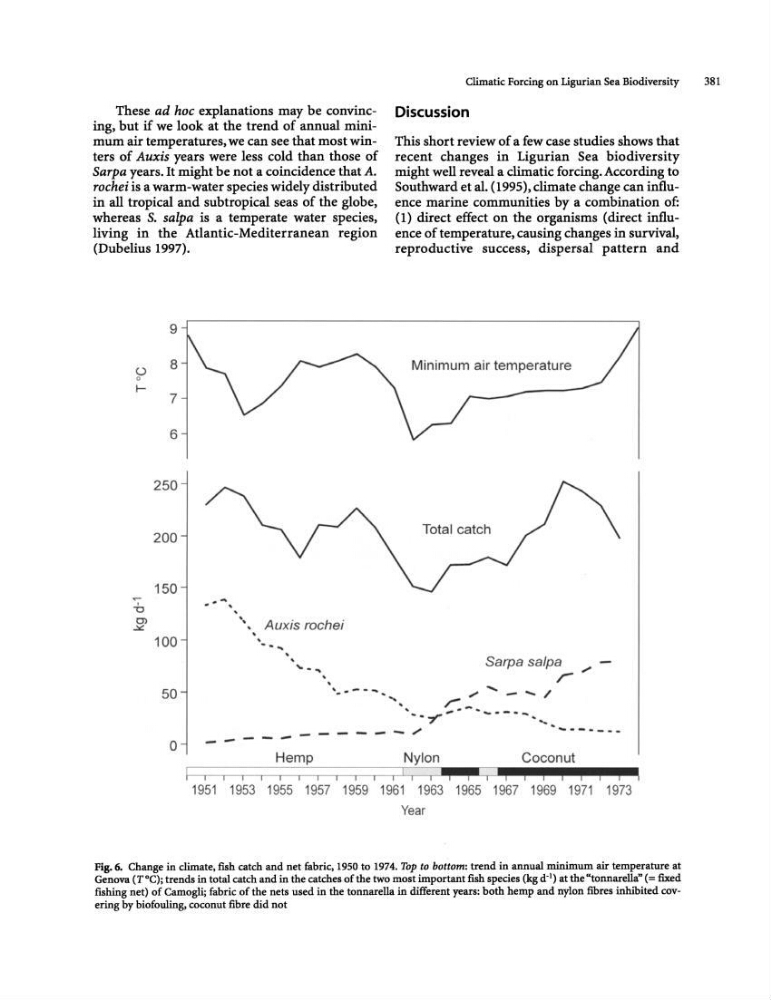
These ad hoc explanations may be convincing, but if we look at the trend of annual minimum air temperatures, we can see that most winters of Auxis years were less cold than those of
Sarpa years. It might be not a coincidence that A.
rochei is a warm-water species widely distributed
in all tropical and subtropical seas of the globe,
whereas S. salpa is a temperate water species,
living in the Atlantic-Mediterranean region
(Dubelius 1997).
u o
I9
8
7
6
250
200
150
100
....
. , . . " , . .
Auxis rochei
--. .. ,
Climatic Forcing on Ligurian Sea Biodiversity
381
Discussion
This short review of a few case studies shows that
recent changes in Ligurian Sea biodiversity
might well reveal a climatic forcing. According to
Southward et al. (1995), climate change can influence marine communities by a combination of:
(1) direct effect on the organisms (direct influence of temperature, causing changes in survival,
reproductive success, dispersal pattern and
Minimum air temperature
Total catch
, " _ ..
Sarpa salpa
;
"
r
50
o
~---..
; -- , /
"'..
r
...
.- .........
-
•
. " . ' "
. . . . . - . -
111, ..
-,.,... -
- -
- -
- /
..... _---Hemp
Nylon
Coconut
1951 1953 1955 1957 1959 1961 1963 1965 1967 1969 1971 1973
Year
Fig.6. Change in climate, fish catch and net fabric, 1950 to 1974. Top to bottom: trend in annual minimum air temperature at
Genova (TOC); trends in total catch and in the catches of the two most important fish species (kg d- 1 ) at the "tonnarella" (= fixed
fishing net) of Camogli; fabric of the nets used in the tonnarella in different years: both hemp and nylon fibres inhibited covering by biofouling, coconut fibre did not
Sarpa years. It might be not a coincidence that A.
rochei is a warm-water species widely distributed
in all tropical and subtropical seas of the globe,
whereas S. salpa is a temperate water species,
living in the Atlantic-Mediterranean region
(Dubelius 1997).
u o
I9
8
7
6
250
200
150
100
....
. , . . " , . .
Auxis rochei
--. .. ,
Climatic Forcing on Ligurian Sea Biodiversity
381
Discussion
This short review of a few case studies shows that
recent changes in Ligurian Sea biodiversity
might well reveal a climatic forcing. According to
Southward et al. (1995), climate change can influence marine communities by a combination of:
(1) direct effect on the organisms (direct influence of temperature, causing changes in survival,
reproductive success, dispersal pattern and
Minimum air temperature
Total catch
, " _ ..
Sarpa salpa
;
"
r
50
o
~---..
; -- , /
"'..
r
...
.- .........
-
•
. " . ' "
. . . . . - . -
111, ..
-,.,... -
- -
- -
- /
..... _---Hemp
Nylon
Coconut
1951 1953 1955 1957 1959 1961 1963 1965 1967 1969 1971 1973
Year
Fig.6. Change in climate, fish catch and net fabric, 1950 to 1974. Top to bottom: trend in annual minimum air temperature at
Genova (TOC); trends in total catch and in the catches of the two most important fish species (kg d- 1 ) at the "tonnarella" (= fixed
fishing net) of Camogli; fabric of the nets used in the tonnarella in different years: both hemp and nylon fibres inhibited covering by biofouling, coconut fibre did not