

378
C. Morri and C.N. Bianchi
20
Air temperature
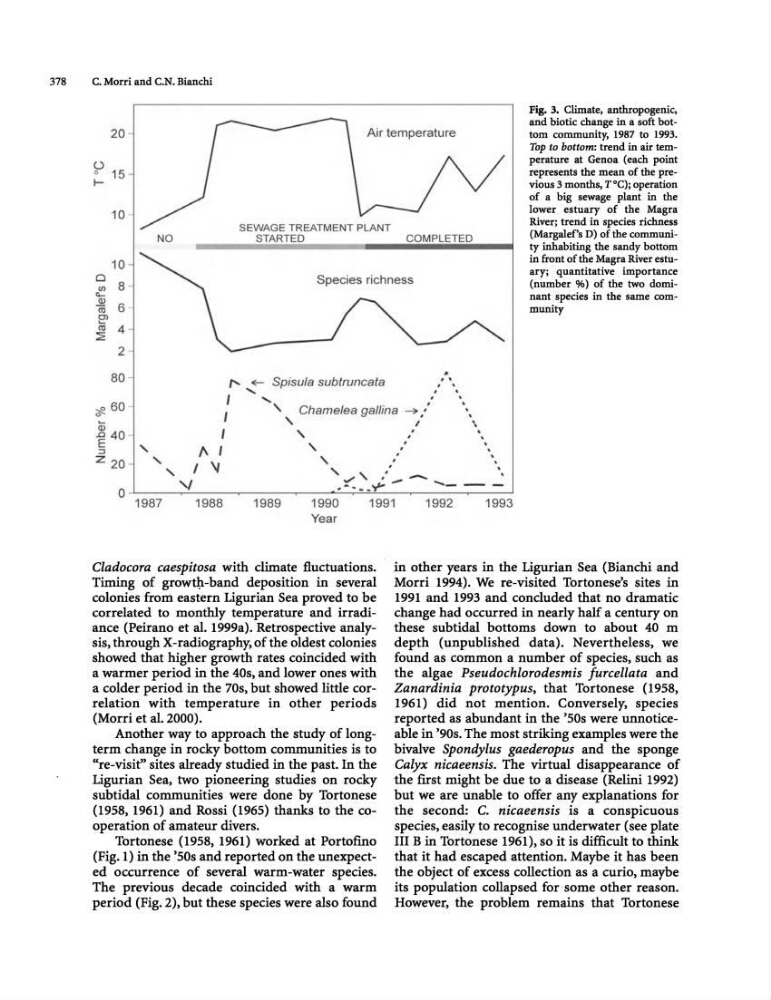
Fig. 3. Climate, anthropogenic.
and biotic change in a soft bottom community. 1987 to 1993.
Top to bottom: trend in air temperature at Genoa (each point
represents the mean of the previous 3 months, T°C); operation
of a big sewage plant in the
lower estuary of the Magra
River; trend in species richness
(Margalef's D) of the community inhabiting the sandy bottom
in front of the Magra River estuary; quantitative importance
(number %) of the two dominant species in the same community
o
o 15
I10
SEWAGE TREATMENT PLANT
STARTED
COMPLETED
10
0
8
Species richness
IF)
1i> 6 -
m
C)
~ 4
~
2
,.
80
,....
.....
,
~ 60
I
"'"
.'
I
"Chame/ea gallina - . '
0
'-Q)
"
,. . . .
.0 40
E
I
"
:
, . ,
,
:J
Z 20
, " I
"
:
"
,
'I
1 "
, .,/" :' _ _
.A_._~
- __ _
0 1987
1988
1989
1990
Year
1991
1992
1993
Cladocora caespitosa with climate fluctuations.
Timing of groww.-band deposition in several
colonies from eastern Ligurian Sea proved to be
correlated to monthly temperature and irradiance (Peirano et al. 1999a). Retrospective analysis, through X-radiography, of the oldest colonies
showed that higher growth rates coincided with
a warmer period in the 40s, and lower ones with
a colder period in the 70s, but showed little correlation with temperature in other periods
(Morri et al. 2000).
Another way to approach the study of longterm change in rocky bottom communities is to
"re-visit" sites already studied in the past. In the
Ligurian Sea, two pioneering studies on rocky
subtidal communities were done by Tortonese
(1958, 1961) and Rossi (1965) thanks to the cooperation of amateur divers.
Tortonese (1958, 1961) worked at Portofmo
(Fig. 1) in the '50s and reported on the unexpected occurrence of several warm-water species.
The previous decade coincided with a warm
period (Fig. 2), but these species were also found
in other years in the Ligurian Sea (Bianchi and
Morri 1994). We re-visited Tortonese's sites in
1991 and 1993 and concluded that no dramatic
change had occurred in nearly half a century on
these subtidal bottoms down to about 40 m
depth (unpublished data), Nevertheless, we
found as common a number of species, such as
the algae Pseudochlorodesmis Jurcellata and
Zanardinia prototypus, that Tortonese (1958,
1961) did not mention. Conversely, species
reported as abundant in the '50s were unnoticeable in '90s. The most striking examples were the
bivalve Spondylus gaederopus and the sponge
Calyx nicaeensis. The virtual disappearance of
the first might be due to a disease (Relini 1992)
but we are unable to offer any explanations for
the second: C. nicaeensis is a conspicuous
species. easily to recognise underwater (see plate
III B in Tortonese 1961), so it is difficult to think
that it had escaped attention. Maybe it has been
the object of excess collection as a curio, maybe
its popUlation collapsed for · some other reason.
However, the problem remains that Tortonese
C. Morri and C.N. Bianchi
20
Air temperature
Fig. 3. Climate, anthropogenic.
and biotic change in a soft bottom community. 1987 to 1993.
Top to bottom: trend in air temperature at Genoa (each point
represents the mean of the previous 3 months, T°C); operation
of a big sewage plant in the
lower estuary of the Magra
River; trend in species richness
(Margalef's D) of the community inhabiting the sandy bottom
in front of the Magra River estuary; quantitative importance
(number %) of the two dominant species in the same community
o
o 15
I10
SEWAGE TREATMENT PLANT
STARTED
COMPLETED
10
0
8
Species richness
IF)
1i> 6 -
m
C)
~ 4
~
2
,.
80
,....
.....
,
~ 60
I
"'"
.'
I
"Chame/ea gallina - . '
0
'-Q)
"
,. . . .
.0 40
E
I
"
:
, . ,
,
:J
Z 20
, " I
"
:
"
,
'I
1 "
, .,/" :' _ _
.A_._~
- __ _
0 1987
1988
1989
1990
Year
1991
1992
1993
Cladocora caespitosa with climate fluctuations.
Timing of groww.-band deposition in several
colonies from eastern Ligurian Sea proved to be
correlated to monthly temperature and irradiance (Peirano et al. 1999a). Retrospective analysis, through X-radiography, of the oldest colonies
showed that higher growth rates coincided with
a warmer period in the 40s, and lower ones with
a colder period in the 70s, but showed little correlation with temperature in other periods
(Morri et al. 2000).
Another way to approach the study of longterm change in rocky bottom communities is to
"re-visit" sites already studied in the past. In the
Ligurian Sea, two pioneering studies on rocky
subtidal communities were done by Tortonese
(1958, 1961) and Rossi (1965) thanks to the cooperation of amateur divers.
Tortonese (1958, 1961) worked at Portofmo
(Fig. 1) in the '50s and reported on the unexpected occurrence of several warm-water species.
The previous decade coincided with a warm
period (Fig. 2), but these species were also found
in other years in the Ligurian Sea (Bianchi and
Morri 1994). We re-visited Tortonese's sites in
1991 and 1993 and concluded that no dramatic
change had occurred in nearly half a century on
these subtidal bottoms down to about 40 m
depth (unpublished data), Nevertheless, we
found as common a number of species, such as
the algae Pseudochlorodesmis Jurcellata and
Zanardinia prototypus, that Tortonese (1958,
1961) did not mention. Conversely, species
reported as abundant in the '50s were unnoticeable in '90s. The most striking examples were the
bivalve Spondylus gaederopus and the sponge
Calyx nicaeensis. The virtual disappearance of
the first might be due to a disease (Relini 1992)
but we are unable to offer any explanations for
the second: C. nicaeensis is a conspicuous
species. easily to recognise underwater (see plate
III B in Tortonese 1961), so it is difficult to think
that it had escaped attention. Maybe it has been
the object of excess collection as a curio, maybe
its popUlation collapsed for · some other reason.
However, the problem remains that Tortonese