

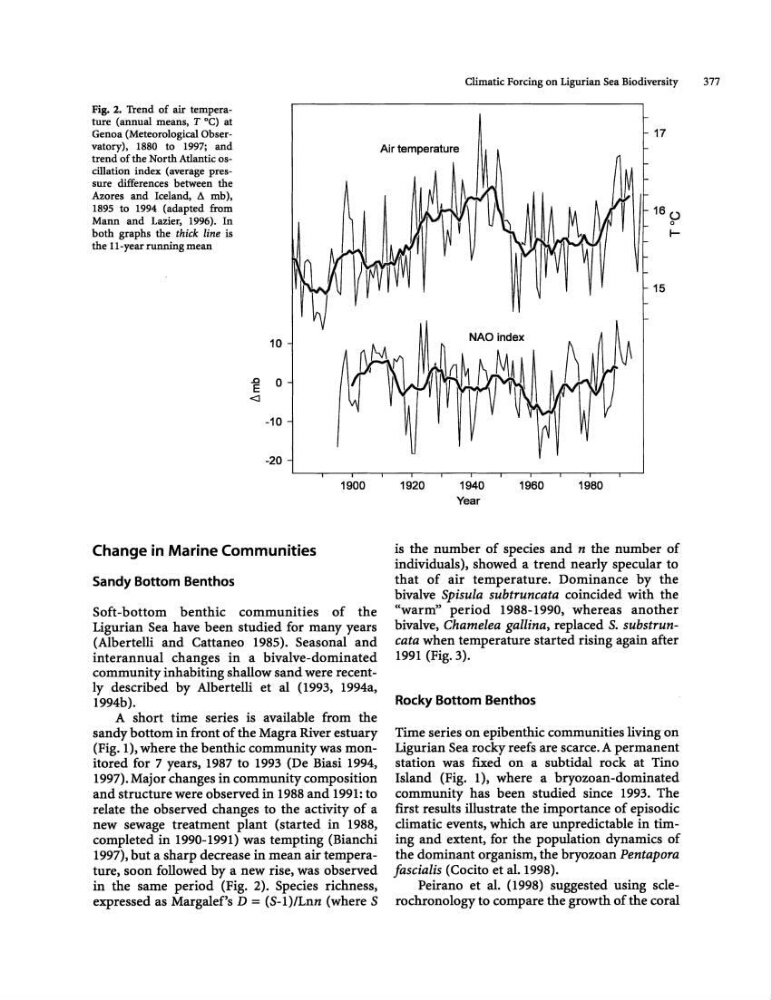
Fig. 2. Trend of air temperature (annual means, T DC) at
Genoa (Meteorological Observatory), 1880 to 1997; and
trend of the North Atlantic oscillation index. (average pressure differences between the
Azores and Iceland, !1 mb).
1895 to 1994 (adapted from
Mann and Lazier, 1996). In
both graphs the thick line is
the II-year running mean
..a
E
<:I
10
0
-10
-20
Change in Marine Communities
Sandy Bottom Benthos
1900
Soft-bottom benthic communities of the
Ligurian Sea have been studied for many years
(Albertelli and Cattaneo 1985). Seasonal and
interannual changes in a bivalve-dominated
community inhabiting shallow sand were recently described by Albertelli et al (1993, 1994a,
1994b).
A short time series is available from the
sandy bottom in front of the Magra River estuary
(Fig. I}, where the benthic community was monitored for 7 years, 1987 to 1993 (De Biasi 1994,
1997). Major changes in community composition
and structure were observed in 1988 and 1991: to
relate the observed changes to the activity of a
new sewage treatment plant (started in 1988,
completed in 1990-1991) was tempting (Bianchi
1997), but a sharp decrease in mean air temperature, soon followed by a new rise, was observed
in the same period (Fig. 2). Species richness,
expressed as Margalef's D = (S-I)/Lnn (where S
Climatic Forcing on Ligurian Sea Biodiversity
377
Air temperature
NAO index
1920
1940
Year
1960
17
15
1980
is the number of species and n the number of
individuals), showed a trend nearly specular to
that of air temperature. Dominance by the
bivalve Spisula subtruncata coincided with the
"warm" period 1988-1990, whereas another
bivalve, Chamelea gallina. replaced S. substruncata when temperature started rising again after
1991 (Fig. 3).
Rocky Bottom Benthos
Time series on epibenthic communities living on
Ligurian Sea rocky reefs are scarce. A permanent
station was fixed on a subtidal rock at Tino
Island (Fig. 1), where a bryozoan-dominated
community has been studied since 1993. The
fIrst results illustrate the importance of episodic
climatic events, which are unpredictable in timing and extent, for the population dynamics of
the dominant organism, the bryozoan Pentapora
fascialis (Cocito et al. 1998).
Peirano et al. (1998) suggested using sclerochronology to compare the growth of the coral
Genoa (Meteorological Observatory), 1880 to 1997; and
trend of the North Atlantic oscillation index. (average pressure differences between the
Azores and Iceland, !1 mb).
1895 to 1994 (adapted from
Mann and Lazier, 1996). In
both graphs the thick line is
the II-year running mean
..a
E
<:I
10
0
-10
-20
Change in Marine Communities
Sandy Bottom Benthos
1900
Soft-bottom benthic communities of the
Ligurian Sea have been studied for many years
(Albertelli and Cattaneo 1985). Seasonal and
interannual changes in a bivalve-dominated
community inhabiting shallow sand were recently described by Albertelli et al (1993, 1994a,
1994b).
A short time series is available from the
sandy bottom in front of the Magra River estuary
(Fig. I}, where the benthic community was monitored for 7 years, 1987 to 1993 (De Biasi 1994,
1997). Major changes in community composition
and structure were observed in 1988 and 1991: to
relate the observed changes to the activity of a
new sewage treatment plant (started in 1988,
completed in 1990-1991) was tempting (Bianchi
1997), but a sharp decrease in mean air temperature, soon followed by a new rise, was observed
in the same period (Fig. 2). Species richness,
expressed as Margalef's D = (S-I)/Lnn (where S
Climatic Forcing on Ligurian Sea Biodiversity
377
Air temperature
NAO index
1920
1940
Year
1960
17
15
1980
is the number of species and n the number of
individuals), showed a trend nearly specular to
that of air temperature. Dominance by the
bivalve Spisula subtruncata coincided with the
"warm" period 1988-1990, whereas another
bivalve, Chamelea gallina. replaced S. substruncata when temperature started rising again after
1991 (Fig. 3).
Rocky Bottom Benthos
Time series on epibenthic communities living on
Ligurian Sea rocky reefs are scarce. A permanent
station was fixed on a subtidal rock at Tino
Island (Fig. 1), where a bryozoan-dominated
community has been studied since 1993. The
fIrst results illustrate the importance of episodic
climatic events, which are unpredictable in timing and extent, for the population dynamics of
the dominant organism, the bryozoan Pentapora
fascialis (Cocito et al. 1998).
Peirano et al. (1998) suggested using sclerochronology to compare the growth of the coral