

376
C. Morri and C.N. Bianchi
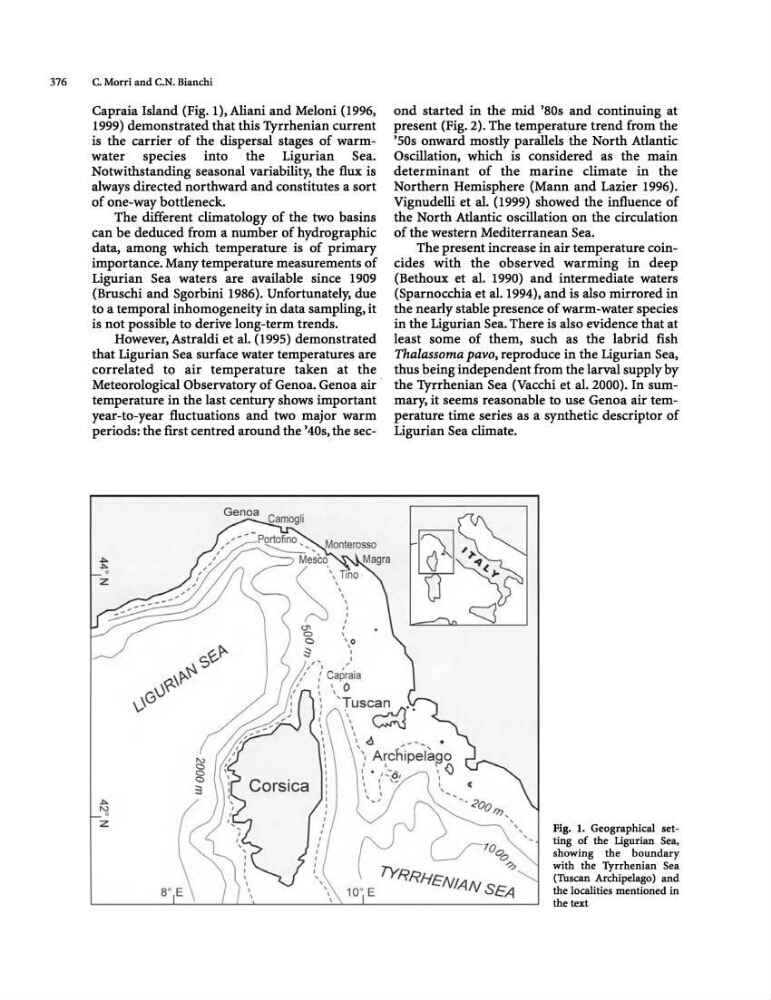
Capraia Island {Fig. 1),Aliani and Meloni (1996,
1999) demonstrated that this Tyrrhenian current
is the carrier of the dispersal stages of warmwater species into the Ligurian Sea.
Notwithstanding seasonal variability, the flux is
always directed northward and constitutes a sort
of one-way bottleneck.
The different climatology of the two basins
can be deduced from a number of hydrographic
data, among which temperature is of primary
importance. Many temperature measurements of
Ligurian Sea waters are available since 1909
(Bruschi and Sgorbini 1986). Unfortunately, due
to a temporal inhomogeneity in data sampling, it
is not possible to derive long-term trends.
However, Astraldi et al. (1995) demonstrated
that Ligurian Sea surface water temperatures are
correlated to air temperature taken at the
Meteorological Observatory of Genoa. Genoa air "
temperature in the last century shows important
year-to-year fluctuations and two major warm
periods: the first centred around the '40s, the sec"""
N o
z
ond started in the mid '80s and continuing at
present (Fig. 2). The temperature trend from the
'50s onward mostly parallels the North Atlantic
Oscillation, which is considered as the main
determinant of the marine climate in the
Northern Hemisphere (Mann and Lazier 1996).
Vignudelli et al. (1999) showed the influence of
the North Atlantic oscillation on the circulation
of the western Mediterranean Sea.
The present increase in air temperature coincides with the observed warming in deep
(Bethoux et al. 1990) and intermediate waters
(Sparnocchia et al. 1994), and is also mirrored in
the nearly stable presence of warm-water species
in the Ligurian Sea. There is also evidence that at
least some of them, such as the labrid fish
Thalassarna pava, reproduce in the Ligurian Sea,
thus being independent from the larval supply by
the Tyrrhenian Sea (Vacchi et al. 2000). In summary, it seems reasonable to use Genoa air temperature time series as a synthetic descriptor of
Ligurian Sea climate.
Fig. 1. Geographical setting of the Ligurian Sea,
showing the boundary
with the Tyrrhenian Sea
(Tuscan Archipelago) and
the localities mentioned in
the text
C. Morri and C.N. Bianchi
Capraia Island {Fig. 1),Aliani and Meloni (1996,
1999) demonstrated that this Tyrrhenian current
is the carrier of the dispersal stages of warmwater species into the Ligurian Sea.
Notwithstanding seasonal variability, the flux is
always directed northward and constitutes a sort
of one-way bottleneck.
The different climatology of the two basins
can be deduced from a number of hydrographic
data, among which temperature is of primary
importance. Many temperature measurements of
Ligurian Sea waters are available since 1909
(Bruschi and Sgorbini 1986). Unfortunately, due
to a temporal inhomogeneity in data sampling, it
is not possible to derive long-term trends.
However, Astraldi et al. (1995) demonstrated
that Ligurian Sea surface water temperatures are
correlated to air temperature taken at the
Meteorological Observatory of Genoa. Genoa air "
temperature in the last century shows important
year-to-year fluctuations and two major warm
periods: the first centred around the '40s, the sec"""
N o
z
ond started in the mid '80s and continuing at
present (Fig. 2). The temperature trend from the
'50s onward mostly parallels the North Atlantic
Oscillation, which is considered as the main
determinant of the marine climate in the
Northern Hemisphere (Mann and Lazier 1996).
Vignudelli et al. (1999) showed the influence of
the North Atlantic oscillation on the circulation
of the western Mediterranean Sea.
The present increase in air temperature coincides with the observed warming in deep
(Bethoux et al. 1990) and intermediate waters
(Sparnocchia et al. 1994), and is also mirrored in
the nearly stable presence of warm-water species
in the Ligurian Sea. There is also evidence that at
least some of them, such as the labrid fish
Thalassarna pava, reproduce in the Ligurian Sea,
thus being independent from the larval supply by
the Tyrrhenian Sea (Vacchi et al. 2000). In summary, it seems reasonable to use Genoa air temperature time series as a synthetic descriptor of
Ligurian Sea climate.
Fig. 1. Geographical setting of the Ligurian Sea,
showing the boundary
with the Tyrrhenian Sea
(Tuscan Archipelago) and
the localities mentioned in
the text