

Change and Diversity: the Mediterranean Deep Corals from the Miocene to the Present
365
time the tectonic activity along the Gibraltar
Strait changed the depth of the threshold. The
circulation of the basin assumed its present configuration, characterized by a homeotherm
structure of the Mediterranean deep waters. The
basin is filled by the Thermosphere (Benson et
al. 1991); only some of the Atlantic deep species
are able to live there. During the glacial and
inter-glacial phases the temperature of the
Thermosphere changes with oscillations of some
degrees around the actual value of 13,SoC.
Such events are well documented by the deep
corals which, at different times, lived along the
continental slopes and in the abyssal plains of
the basin. According to Delibrias and Taviani
(1984), the C14 datings implemented on specimens of some coral fossil species of the Late
Pleistocene, document an age of life between
30.000 and 15.000 years, during the phase of the
glacial maximum. The ecology of Madrepora
oculata Linne, 1758, Caryophyllia sarsiae
Zibrowius, 1974 and Desmophyllum cristagalli
Milne Edwards and Haime, 1848, species broadly
diffused during the glacial phases, justifies the
age attributed by the C14 datings. The optimal
temperature of life of Caryophyllia sarsiae is
around lO-11 °C, and probably such values are
also valid for the others two taxa (Di Geronimo
1979; Zibrowius 1980). A production of colder
deep water, during the glacial phases, could have
only lowered to such values the temperature of
the Mediterranean Thermosphere, the thermohaline circulation of the basin being unchanged.
When, during the warm climatic phases of the
Late Pleistocene, the temperature of the
Thermosphere rises, also the deep Scleractinia,
more resistant, start to decline, reducing their
geographic distribution to the few favourable
zones. The decline of the Scleractinia is the same
to that of other bathyal and abyssal taxa, making
the bottom of the Mediterranean an area of low
diversity and density.
Conclusion
The reconstruction of the chemical and physical
characteristics of the deep waters of the
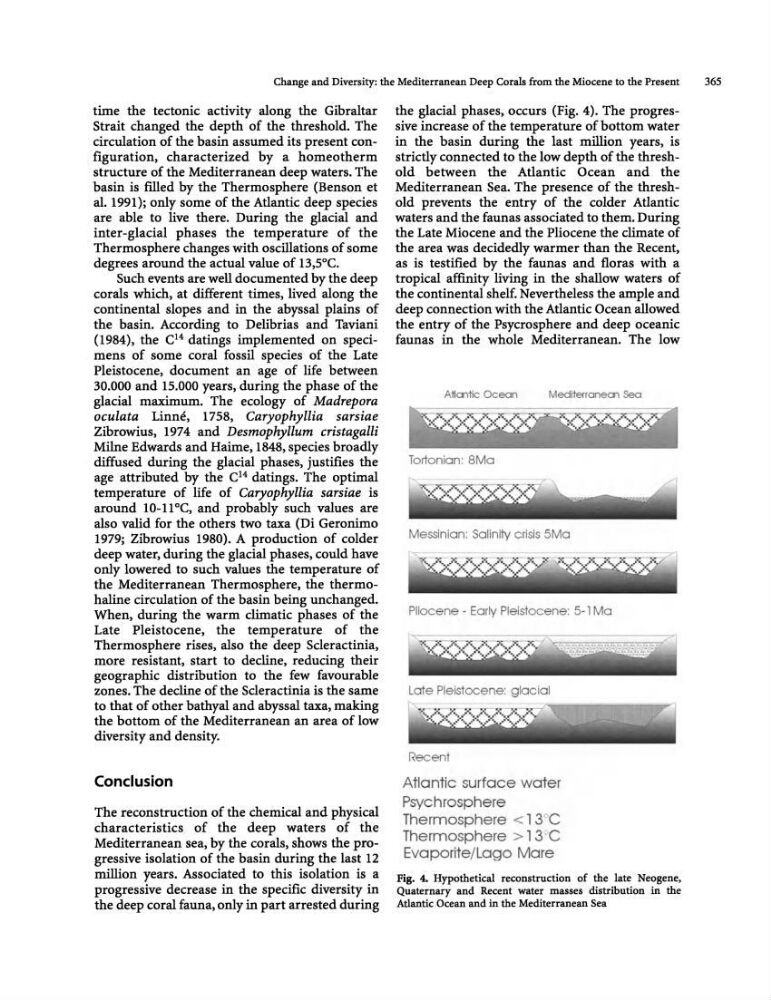
Mediterranean sea, by the corals, shows the progressive isolation of the basin during the last 12
million years. Associated to this isolation is a
progressive decrease in the specific diversity in
the deep coral fauna, only in part arrested during
the glacial phases, occurs (Fig. 4). The progressive increase of the temperature of bottom water
in the basin during the last million years, is
strictly connected to the low depth of the threshold between the Atlantic Ocean and the
Mediterranean Sea. The presence of the threshold prevents the entry of the colder Atlantic
waters and the faunas associated to them. During
the Late Miocene and the Pliocene the climate of
the area was decidedly warmer than the Recent,
as is testified by the faunas and floras with a
tropical affinity living in the shallow waters of
the continental shelf. Nevertheless the ample and
deep connection with the Atlantic Ocean allowed
the entry of the Psycrosphere and deep oceanic
faunas in the whole Mediterranean. The low
Al1Cl1tic Ocean
Mediterranern Sea
Tor1onian : SMa
Messinian: Salinity crisis 5Ma
Pliocene - Early Pleistocene: 5- 1 Ma
Late Pleistocene: glacial
Recent
Atlantic surface water
Psychrosphere
Thermosphere < 13° C
Thermosphere > 13°C
Evaporite/Lago Mare
Fig. 4. Hypothetical reconstruction of the late Neogene.
Quaternary and Recent water masses distribution in the
Atlantic Ocean and in the Mediterranean Sea
365
time the tectonic activity along the Gibraltar
Strait changed the depth of the threshold. The
circulation of the basin assumed its present configuration, characterized by a homeotherm
structure of the Mediterranean deep waters. The
basin is filled by the Thermosphere (Benson et
al. 1991); only some of the Atlantic deep species
are able to live there. During the glacial and
inter-glacial phases the temperature of the
Thermosphere changes with oscillations of some
degrees around the actual value of 13,SoC.
Such events are well documented by the deep
corals which, at different times, lived along the
continental slopes and in the abyssal plains of
the basin. According to Delibrias and Taviani
(1984), the C14 datings implemented on specimens of some coral fossil species of the Late
Pleistocene, document an age of life between
30.000 and 15.000 years, during the phase of the
glacial maximum. The ecology of Madrepora
oculata Linne, 1758, Caryophyllia sarsiae
Zibrowius, 1974 and Desmophyllum cristagalli
Milne Edwards and Haime, 1848, species broadly
diffused during the glacial phases, justifies the
age attributed by the C14 datings. The optimal
temperature of life of Caryophyllia sarsiae is
around lO-11 °C, and probably such values are
also valid for the others two taxa (Di Geronimo
1979; Zibrowius 1980). A production of colder
deep water, during the glacial phases, could have
only lowered to such values the temperature of
the Mediterranean Thermosphere, the thermohaline circulation of the basin being unchanged.
When, during the warm climatic phases of the
Late Pleistocene, the temperature of the
Thermosphere rises, also the deep Scleractinia,
more resistant, start to decline, reducing their
geographic distribution to the few favourable
zones. The decline of the Scleractinia is the same
to that of other bathyal and abyssal taxa, making
the bottom of the Mediterranean an area of low
diversity and density.
Conclusion
The reconstruction of the chemical and physical
characteristics of the deep waters of the
Mediterranean sea, by the corals, shows the progressive isolation of the basin during the last 12
million years. Associated to this isolation is a
progressive decrease in the specific diversity in
the deep coral fauna, only in part arrested during
the glacial phases, occurs (Fig. 4). The progressive increase of the temperature of bottom water
in the basin during the last million years, is
strictly connected to the low depth of the threshold between the Atlantic Ocean and the
Mediterranean Sea. The presence of the threshold prevents the entry of the colder Atlantic
waters and the faunas associated to them. During
the Late Miocene and the Pliocene the climate of
the area was decidedly warmer than the Recent,
as is testified by the faunas and floras with a
tropical affinity living in the shallow waters of
the continental shelf. Nevertheless the ample and
deep connection with the Atlantic Ocean allowed
the entry of the Psycrosphere and deep oceanic
faunas in the whole Mediterranean. The low
Al1Cl1tic Ocean
Mediterranern Sea
Tor1onian : SMa
Messinian: Salinity crisis 5Ma
Pliocene - Early Pleistocene: 5- 1 Ma
Late Pleistocene: glacial
Recent
Atlantic surface water
Psychrosphere
Thermosphere < 13° C
Thermosphere > 13°C
Evaporite/Lago Mare
Fig. 4. Hypothetical reconstruction of the late Neogene.
Quaternary and Recent water masses distribution in the
Atlantic Ocean and in the Mediterranean Sea