

CHAPTER 46
Meiofaunal Biodiversity on Hydrothermal Seepage off Panarea
(Aeolian Islands, Tyrrhenian Sea)
M.A. Colangelo l , F. Bertasil, P. Dall'Olio 3 , and V.H. CeccherelHl
ABSTRACT
Meiofauna biodiversity was investigated at two sites in the submerged crater off Panarea
(Aeolian Islands), characterised by different degree of hydrothermal seepage. At the first site, a
gasohydrothermal seepage of a carbon dioxide and sulphide (mean 1.96 vol% HlS) was
observed. The second site was characterised by a few centimetres deep layer of white colloidal
sulphur deposits. At each site, two stations were sampled with high (H) and moderate (M) seepage respectively, while a third station (C) with no hydrotermal activity was selected as control.
Meiobenthic organisms were counted, sorted by taxa and copepods classified to species level. A
very low number of all meiobenthic organisms was observed in the two stations with colloidal
sulphur deposits. Copepods resulted to be the dominant taxon in both sites. Multivariate analyses showed significant differences in the copepod community structure both between sites and
among stations within sites. Diversity indexes displayed significantly lower values at the two
control stations. The coarse grain size can be invoked to explain copepod dominance. But intermediate disturbance due to gas bubbling seems to playa role in promoting copepod biodiversity. However sites of high deposition of colloidal sulphur, by clogging interstitial spaces, seem
to create a prohibitive environment for meiobenthos.
Introduction
38' 39'
•
N
,
38'38'
/ )
IS' 06'
1S'or
Despite shallow water hydrothermal venting
phenomena are widespread along marine coastal
environments, their effects on benthic faunal
composition remain far from being fully understood. Only a few studies reported informations
on species assemblages and community structure of meiofauna in these particular ecosystems
(Fricke et a1.1989; Dando et al.1995; Kamenev et
al. 1993; Thiermann et aI. 1994, 1997). The island
of Panarea belongs to the Aeolian archipelago,
consisting of seven main islands lying on the
Sicilian-Calabrian continental slope. East of the
Panarea island there is a wide hydrothermal area
("caldera") in the centre of a submerged volcanic
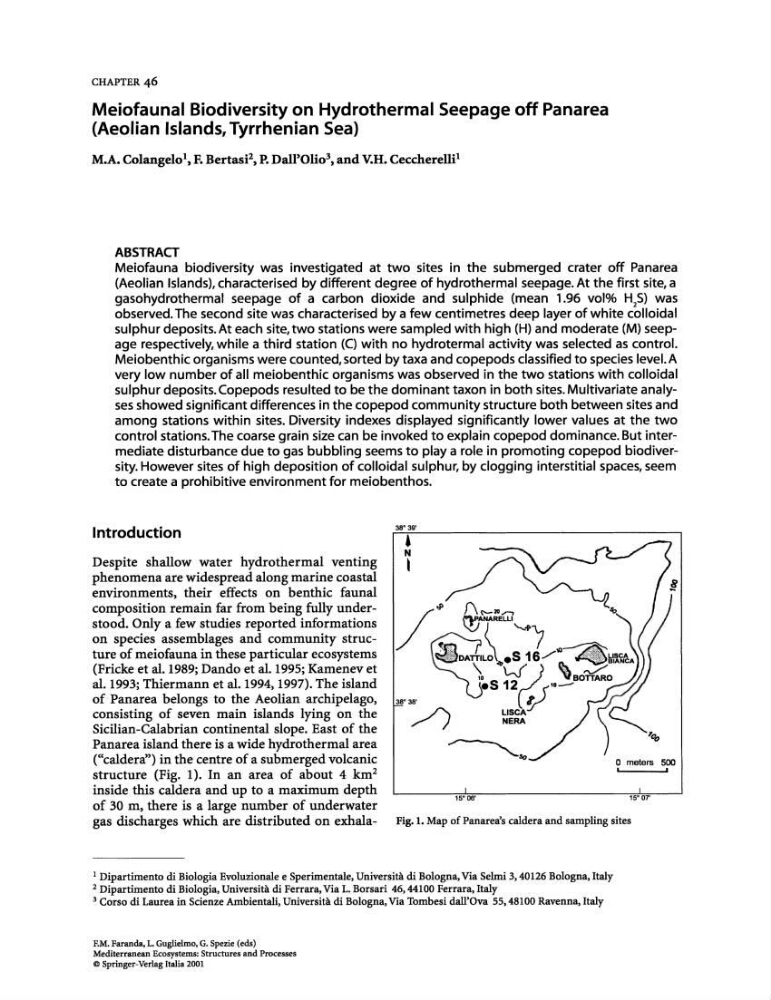
structure (Fig. 1). In an area of about 4 km 2
inside this caldera and up to a maximum depth
of 30 m, there is a large number of underwater
gas discharges which are distributed on exhala- Fig. 1. Map of Panarea's caldera and sampling sites
I Dipartimento di Biologia Evoluzionale e Sperimentale, Universita di Bologna, Via Selmi 3,40126 Bologna, Italy
2 Dipartimento di Biologia, Universita eli Ferrara, Via 1. Borsari 46,44100 Ferrara, Italy
3 Corso eli Laurea in Scienze Ambientali, Universita eli Bologna, Via Tombesi dall'Ova 55,48100 Ravenna, Italy
F.M. Faranda, L. Guglielmo, G. Sperle (eds)
Mediterranean Ecosystems, Structures and Processes
© Springer-Verlag ltalia 2001
500 ,
Meiofaunal Biodiversity on Hydrothermal Seepage off Panarea
(Aeolian Islands, Tyrrhenian Sea)
M.A. Colangelo l , F. Bertasil, P. Dall'Olio 3 , and V.H. CeccherelHl
ABSTRACT
Meiofauna biodiversity was investigated at two sites in the submerged crater off Panarea
(Aeolian Islands), characterised by different degree of hydrothermal seepage. At the first site, a
gasohydrothermal seepage of a carbon dioxide and sulphide (mean 1.96 vol% HlS) was
observed. The second site was characterised by a few centimetres deep layer of white colloidal
sulphur deposits. At each site, two stations were sampled with high (H) and moderate (M) seepage respectively, while a third station (C) with no hydrotermal activity was selected as control.
Meiobenthic organisms were counted, sorted by taxa and copepods classified to species level. A
very low number of all meiobenthic organisms was observed in the two stations with colloidal
sulphur deposits. Copepods resulted to be the dominant taxon in both sites. Multivariate analyses showed significant differences in the copepod community structure both between sites and
among stations within sites. Diversity indexes displayed significantly lower values at the two
control stations. The coarse grain size can be invoked to explain copepod dominance. But intermediate disturbance due to gas bubbling seems to playa role in promoting copepod biodiversity. However sites of high deposition of colloidal sulphur, by clogging interstitial spaces, seem
to create a prohibitive environment for meiobenthos.
Introduction
38' 39'
•
N
,
38'38'
/ )
IS' 06'
1S'or
Despite shallow water hydrothermal venting
phenomena are widespread along marine coastal
environments, their effects on benthic faunal
composition remain far from being fully understood. Only a few studies reported informations
on species assemblages and community structure of meiofauna in these particular ecosystems
(Fricke et a1.1989; Dando et al.1995; Kamenev et
al. 1993; Thiermann et aI. 1994, 1997). The island
of Panarea belongs to the Aeolian archipelago,
consisting of seven main islands lying on the
Sicilian-Calabrian continental slope. East of the
Panarea island there is a wide hydrothermal area
("caldera") in the centre of a submerged volcanic
structure (Fig. 1). In an area of about 4 km 2
inside this caldera and up to a maximum depth
of 30 m, there is a large number of underwater
gas discharges which are distributed on exhala- Fig. 1. Map of Panarea's caldera and sampling sites
I Dipartimento di Biologia Evoluzionale e Sperimentale, Universita di Bologna, Via Selmi 3,40126 Bologna, Italy
2 Dipartimento di Biologia, Universita eli Ferrara, Via 1. Borsari 46,44100 Ferrara, Italy
3 Corso eli Laurea in Scienze Ambientali, Universita eli Bologna, Via Tombesi dall'Ova 55,48100 Ravenna, Italy
F.M. Faranda, L. Guglielmo, G. Sperle (eds)
Mediterranean Ecosystems, Structures and Processes
© Springer-Verlag ltalia 2001
500 ,