

348
E. Cecere et al.
May and October 1997 from rocky stations located along five transects perpendicular to the
shore from the intertidal level up to 12 m. At
greater depths the bottom was soft and without
vegetation. Collected material was preserved in
4% formaldehyde in seawater. Voucher specimens are kept in the Herbarium of the Istituto
Talassografico of Taranto.
The floristic list compiled using data from
the literature was updated from both a taxonomic and a nomenclatural point of view to make it
comparable to that of the present study. For each
class, the proportion of each family was calculated as a part of the total list comprising the taxa
present on both lists, those previously reported
and not found in the present study and those
newly recorded.
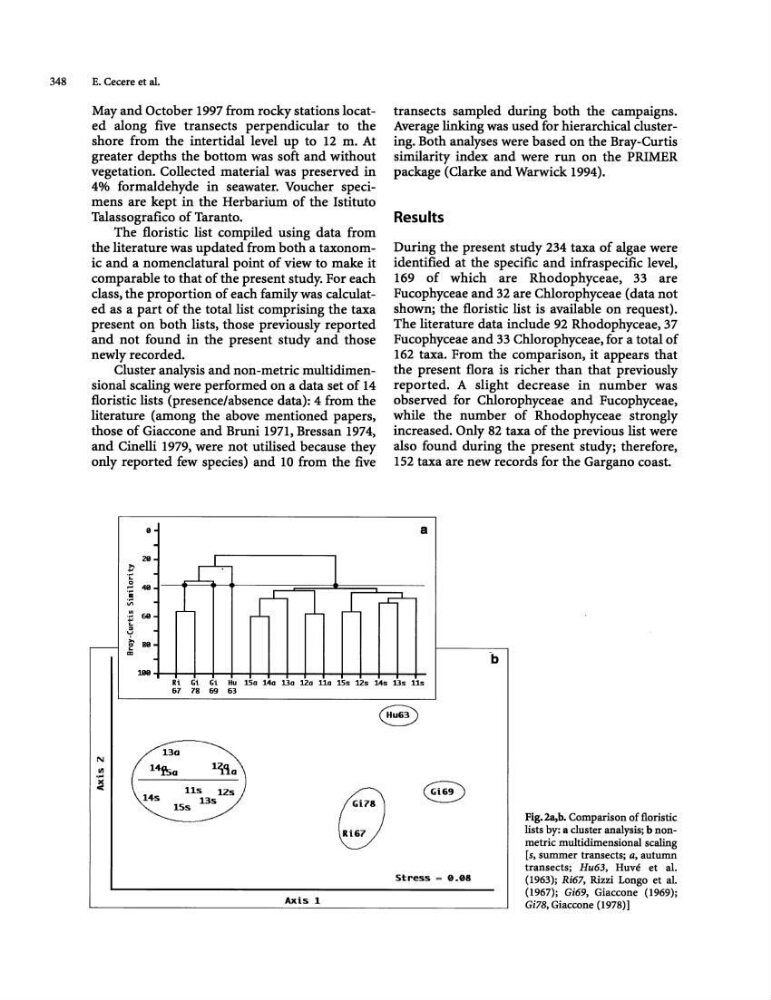
Cluster analysis and non-metric multidimensional scaling were performed on a data set of 14
floristic lists (presence/absence data): 4 from the
literature (among the above mentioned papers,
those of Giaccone and Bruni 1971, Bressan 1974,
and Cinelli 1979, were not utilised because they
only reported few species) and 10 from the five
0
20
.t'
''- . .
a 40
...
''E
,,..
II!
'" 611
,,. .. . .
"
'r'
~
.. !l8
""
109
transects sampled during both the campaigns.
Average linking was used for hierarchical clustering. Both analyses were based on the Bray-Curtis
similarity index and were run on the PRIMER
package (Clarke and Warwick 1994).
Results
During the present study 234 taxa of algae were
identified at the specific and infraspecific level.
169 of which are Rhodophyceae, 33 are
Fucophyceae and 32 are Chlorophyceae (data not
shown; the floristic list is available on request).
The literature data include 92 Rhodophyceae,37
Fucophyceae and 33 Chlorophyceae, for a total of
162 taxa. From the comparison, it appears that
the present flora is richer than that previously
reported. A slight decrease in number was
observed for Chlorophyceae and Fucophyceae,
while the number of Rhodophyceae strongly
increased. Only 82 taxa of the previous list were
also found during the present study; therefore,
152 taxa are new records for the Gargano coast.
a
-b
Rt Gi Gi. Hu 150 140 130 120 110 15s 12s 14s 13s Us
67 78 69 63
115 lZs
135
ISs
Axis 1
A
~
Stress = 0.08
Fig.2a,b. Comparison of floristic
lists by: a cluster analysis; b nonmetric multidimensional scaling
[5, summer transects; a, autumn
transects; Hu63, Huve et al.
(1963); Ri67, Rizzi Longo et al.
(1967); Gi69, Giaccone (1969);
Gi78, Giaccone (1978)]
E. Cecere et al.
May and October 1997 from rocky stations located along five transects perpendicular to the
shore from the intertidal level up to 12 m. At
greater depths the bottom was soft and without
vegetation. Collected material was preserved in
4% formaldehyde in seawater. Voucher specimens are kept in the Herbarium of the Istituto
Talassografico of Taranto.
The floristic list compiled using data from
the literature was updated from both a taxonomic and a nomenclatural point of view to make it
comparable to that of the present study. For each
class, the proportion of each family was calculated as a part of the total list comprising the taxa
present on both lists, those previously reported
and not found in the present study and those
newly recorded.
Cluster analysis and non-metric multidimensional scaling were performed on a data set of 14
floristic lists (presence/absence data): 4 from the
literature (among the above mentioned papers,
those of Giaccone and Bruni 1971, Bressan 1974,
and Cinelli 1979, were not utilised because they
only reported few species) and 10 from the five
0
20
.t'
''- . .
a 40
...
''E
,,..
II!
'" 611
,,. .. . .
"
'r'
~
.. !l8
""
109
transects sampled during both the campaigns.
Average linking was used for hierarchical clustering. Both analyses were based on the Bray-Curtis
similarity index and were run on the PRIMER
package (Clarke and Warwick 1994).
Results
During the present study 234 taxa of algae were
identified at the specific and infraspecific level.
169 of which are Rhodophyceae, 33 are
Fucophyceae and 32 are Chlorophyceae (data not
shown; the floristic list is available on request).
The literature data include 92 Rhodophyceae,37
Fucophyceae and 33 Chlorophyceae, for a total of
162 taxa. From the comparison, it appears that
the present flora is richer than that previously
reported. A slight decrease in number was
observed for Chlorophyceae and Fucophyceae,
while the number of Rhodophyceae strongly
increased. Only 82 taxa of the previous list were
also found during the present study; therefore,
152 taxa are new records for the Gargano coast.
a
-b
Rt Gi Gi. Hu 150 140 130 120 110 15s 12s 14s 13s Us
67 78 69 63
115 lZs
135
ISs
Axis 1
A
~
Stress = 0.08
Fig.2a,b. Comparison of floristic
lists by: a cluster analysis; b nonmetric multidimensional scaling
[5, summer transects; a, autumn
transects; Hu63, Huve et al.
(1963); Ri67, Rizzi Longo et al.
(1967); Gi69, Giaccone (1969);
Gi78, Giaccone (1978)]