

Scytosiphonaceae, cho,rda:rii • • •
Spermatochnaceae
Cystoseiraceae
Biodiversity of the Gargano Coast
349
miaceae
Gelidiaceae, Rhodymeniaceae
Corallinaceae
Ectoca rpaceae
Cladophoraceae
••••• 1 Bryopsidaceae
Codiaceae, Valoniaceae
Ulvaceae 1lIl ••••••
-20
-15
-10
-5
o
5
10
15
20
Family proportion (0J0)
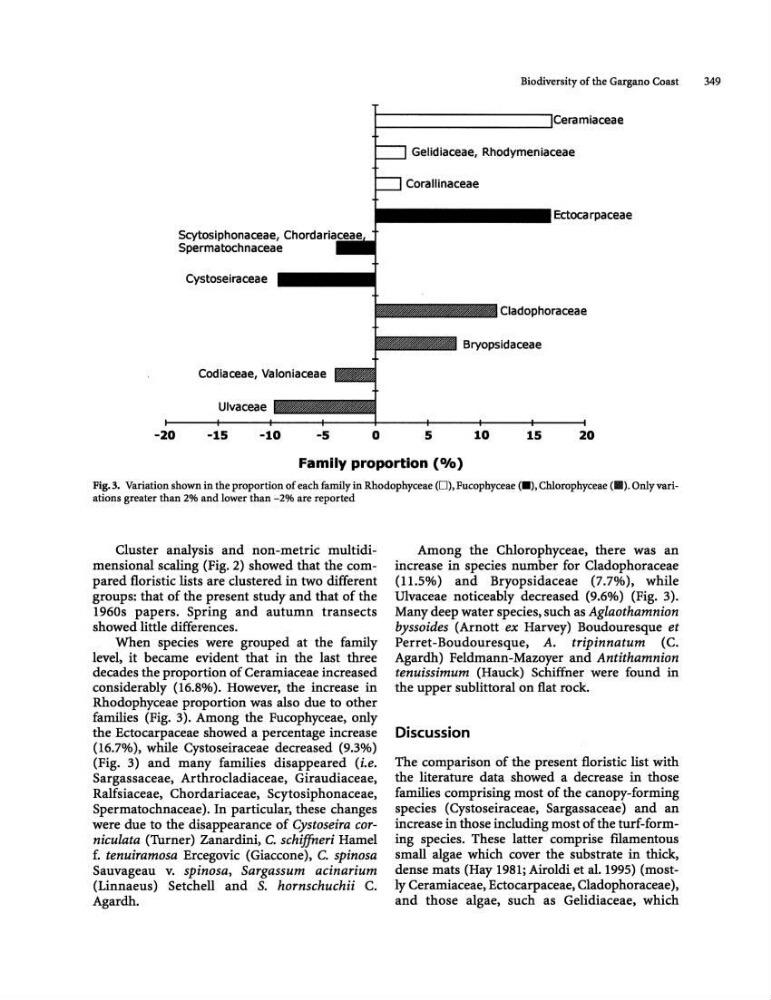
Fig.3. Variation shown in the proportion of each family in Rhodophyceae (D), Fucophyceae (.), Chlorophyceae (II). Onlyvariations greater than 2% and lower than -2% are reported
Cluster analysis and non-metric multidimensional scaling (Fig. 2) showed that the compared floristic lists are clustered in two different
groups: that of the present study and that of the
1960s papers. Spring and autumn transects
showed little differences.
When species were grouped at the family
level, it became evident that in the last three
decades the proportion of Ceramiaceae increased
considerably (16.8%). However, the increase in
Rhodophyceae proportion was also due to other
families (Fig. 3). Among the Fucophyceae, only
the Ectocarpaceae showed a percentage increase
(16.7%), while Cystoseiraceae decreased (9.3%)
(Fig. 3) and many families disappeared (i.e.
Sargassaceae, Arthrodadiaceae, Giraudiaceae,
Ralfsiaceae. Chordariaceae, Scytosiphonaceae,
Spermatochnaceae). In particular, these changes
were due to the disappearance of Cystoseira corniculata (Turner) Zanardini, C. schiffneri Hamel
f. tenuiramosa Ercegovic (Giaccone), C. spinosa
Sauvageau v. spinosa, Sargassum acinarium
(Linnaeus) Setchell and S. hornschuchii C.
Agardh.
Among the Chlorophyceae, there was an
increase in species number for Cladophoraceae
(11.5%) and Bryopsidaceae (7.7%), while
Ulvaceae noticeably decreased (9.6%) (Fig. 3).
Many deep water species, such as Aglaothamnion
byssoides (Arnott ex Harvey) Boudouresque et
Perret-Boudouresque, A. tripinnatum (C.
Agardh) Feldmann-Mazoyer and Antithamnion
tenuissimum (Hauck) Schiffner were found in
the upper sublittoral on flat rock.
Discussion
The comparison of the present floristic list with
the literature data showed a decrease in those
families comprising most of the canopy-forming
species (Cystoseiraceae, Sargassaceae) and an
increase in those including most of the turf-forming species. These latter comprise filamentous
small algae which cover the substrate in thick,
dense mats (Hay 1981; Airoldi et al. 1995) (mostly Ceramiaceae, Ectocarpaceae. Cladophoraceae),
and those algae. such as Gelidiaceae. which
Spermatochnaceae
Cystoseiraceae
Biodiversity of the Gargano Coast
349
miaceae
Gelidiaceae, Rhodymeniaceae
Corallinaceae
Ectoca rpaceae
Cladophoraceae
••••• 1 Bryopsidaceae
Codiaceae, Valoniaceae
Ulvaceae 1lIl ••••••
-20
-15
-10
-5
o
5
10
15
20
Family proportion (0J0)
Fig.3. Variation shown in the proportion of each family in Rhodophyceae (D), Fucophyceae (.), Chlorophyceae (II). Onlyvariations greater than 2% and lower than -2% are reported
Cluster analysis and non-metric multidimensional scaling (Fig. 2) showed that the compared floristic lists are clustered in two different
groups: that of the present study and that of the
1960s papers. Spring and autumn transects
showed little differences.
When species were grouped at the family
level, it became evident that in the last three
decades the proportion of Ceramiaceae increased
considerably (16.8%). However, the increase in
Rhodophyceae proportion was also due to other
families (Fig. 3). Among the Fucophyceae, only
the Ectocarpaceae showed a percentage increase
(16.7%), while Cystoseiraceae decreased (9.3%)
(Fig. 3) and many families disappeared (i.e.
Sargassaceae, Arthrodadiaceae, Giraudiaceae,
Ralfsiaceae. Chordariaceae, Scytosiphonaceae,
Spermatochnaceae). In particular, these changes
were due to the disappearance of Cystoseira corniculata (Turner) Zanardini, C. schiffneri Hamel
f. tenuiramosa Ercegovic (Giaccone), C. spinosa
Sauvageau v. spinosa, Sargassum acinarium
(Linnaeus) Setchell and S. hornschuchii C.
Agardh.
Among the Chlorophyceae, there was an
increase in species number for Cladophoraceae
(11.5%) and Bryopsidaceae (7.7%), while
Ulvaceae noticeably decreased (9.6%) (Fig. 3).
Many deep water species, such as Aglaothamnion
byssoides (Arnott ex Harvey) Boudouresque et
Perret-Boudouresque, A. tripinnatum (C.
Agardh) Feldmann-Mazoyer and Antithamnion
tenuissimum (Hauck) Schiffner were found in
the upper sublittoral on flat rock.
Discussion
The comparison of the present floristic list with
the literature data showed a decrease in those
families comprising most of the canopy-forming
species (Cystoseiraceae, Sargassaceae) and an
increase in those including most of the turf-forming species. These latter comprise filamentous
small algae which cover the substrate in thick,
dense mats (Hay 1981; Airoldi et al. 1995) (mostly Ceramiaceae, Ectocarpaceae. Cladophoraceae),
and those algae. such as Gelidiaceae. which