

CHAPTER 45
Changes in Seaweed Biodiversity of the Gargano Coast
(Adriatic Sea, Mediterranean Sea)
E. Cecere, G. Fanelli, A. Petrocelli, and O.D. Saracino
ABSTRACT
Benthic algal flora has been investigated along the Gargano coast (Adriatic Sea, Mediterranean
Sea). The results were compared with those of previous researches carried out in the same area
in 1960s in order to detect possible changes in species composition. Two hundred and thirtyfour taxa have been identified. The literature data reported 162 taxa but only 82 of them were
also found during the present study. In genera" a decrease in "canopy-forming" species and an
increase in "turf-forming" ones were observed. The decrease in Ulvaceae and the presence of
sciaphilous taxa at low depths were also recorded. The present species composition might be
related both to a reduction in light penetration and to an increase in sediment deposition.
Introduction
The present paper is a part of PRISMA 2, a multidisciplinary project aimed at the evaluation of
the environmental conditions of the Adriatic
Sea. Benthic algal flora composition has often
been used as an indicator of environmental conditions (Levine 1984). In fact, algal assemblages
can change in structure and composition in
response to both occasional stress and long term
modification of environmental conditions and
record the interactions between biotic and abiotic factors. As the seaweed composition of the
Gargano coast was previously studied in the sixties (Huve et al. 1963; Rizzi Longo et aI. 1967;
Giaccone 1969; Giaccone and Bruni 1971;
Bressan 1974; Giaccone 1978; Cinelli 1979), a
comparison of the acquired floristic lists with
the literature data was carried out in order to
detect any possible differences.
Materials and Methods
The Gargano Promontory is located between the
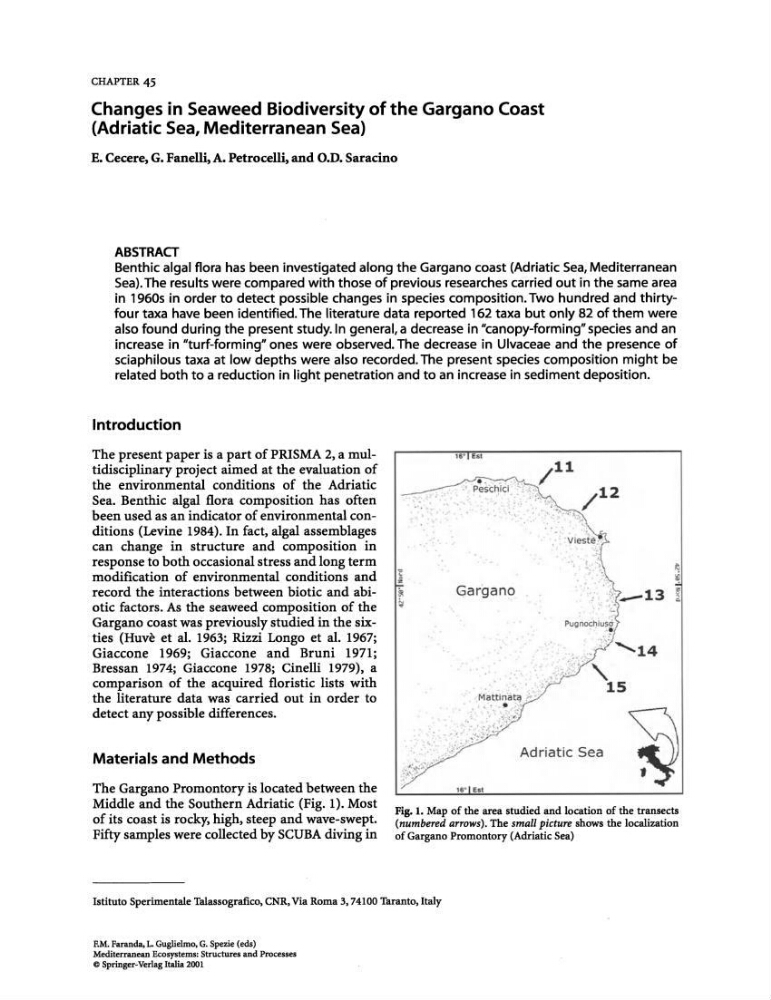
Middle and the Southern Adriatic (Fig. 1). Most
of its coast is rocky, high. steep and wave-swept.
Fifty samples were collected by SCUBA diving in
Gargano
,"
puonocl)iu~~
.... ·~\: '14
"."
".
15
, .'
.'
. .. ... 1 .' .(!.~ . .
. - ~ ~~" ... ~
: ·1 ... ·
Adriatic Sea
l ti' Est
Fig. I. Map of the area studied and location of the transects
(numbered arrows). The small picture shows the localization
of Gargano Promontory (Adriatic Sea)
Istituto Sperimentale Talassografico, CNR, Via Roma 3, 74100 Thranto, Italy
F.M. Faranda, L. Guglielmo, G. Sperle (eds)
Mediterranean Ecosystems: Structures and Processes
@ Springer-Verlag Italia 2001
Changes in Seaweed Biodiversity of the Gargano Coast
(Adriatic Sea, Mediterranean Sea)
E. Cecere, G. Fanelli, A. Petrocelli, and O.D. Saracino
ABSTRACT
Benthic algal flora has been investigated along the Gargano coast (Adriatic Sea, Mediterranean
Sea). The results were compared with those of previous researches carried out in the same area
in 1960s in order to detect possible changes in species composition. Two hundred and thirtyfour taxa have been identified. The literature data reported 162 taxa but only 82 of them were
also found during the present study. In genera" a decrease in "canopy-forming" species and an
increase in "turf-forming" ones were observed. The decrease in Ulvaceae and the presence of
sciaphilous taxa at low depths were also recorded. The present species composition might be
related both to a reduction in light penetration and to an increase in sediment deposition.
Introduction
The present paper is a part of PRISMA 2, a multidisciplinary project aimed at the evaluation of
the environmental conditions of the Adriatic
Sea. Benthic algal flora composition has often
been used as an indicator of environmental conditions (Levine 1984). In fact, algal assemblages
can change in structure and composition in
response to both occasional stress and long term
modification of environmental conditions and
record the interactions between biotic and abiotic factors. As the seaweed composition of the
Gargano coast was previously studied in the sixties (Huve et al. 1963; Rizzi Longo et aI. 1967;
Giaccone 1969; Giaccone and Bruni 1971;
Bressan 1974; Giaccone 1978; Cinelli 1979), a
comparison of the acquired floristic lists with
the literature data was carried out in order to
detect any possible differences.
Materials and Methods
The Gargano Promontory is located between the
Middle and the Southern Adriatic (Fig. 1). Most
of its coast is rocky, high. steep and wave-swept.
Fifty samples were collected by SCUBA diving in
Gargano
,"
puonocl)iu~~
.... ·~\: '14
"."
".
15
, .'
.'
. .. ... 1 .' .(!.~ . .
. - ~ ~~" ... ~
: ·1 ... ·
Adriatic Sea
l ti' Est
Fig. I. Map of the area studied and location of the transects
(numbered arrows). The small picture shows the localization
of Gargano Promontory (Adriatic Sea)
Istituto Sperimentale Talassografico, CNR, Via Roma 3, 74100 Thranto, Italy
F.M. Faranda, L. Guglielmo, G. Sperle (eds)
Mediterranean Ecosystems: Structures and Processes
@ Springer-Verlag Italia 2001