

Physical and Geochemical Transports Along the Ancona Coastal Area
13
number of particles were found near the bottom
and this is clearly shown for TPM in Fig. 2.
Spectral analysis on the samples showed a main
mode centred on 3 pm (92% of the 36 samples)
and a secondary mode centred on 20-50 }lm. The
period before the sampling was characterized by
good weather conditions and negligible local
river out flow; therefore this condition has permitted the sedimentation for the particles of
high dimension permitting the suspension in the
water column only for the smaller particles
(average dimension: 4.48 pm); the low concentrations measured in his period are the direct
consequence of this situation. In September concentration of suspended matter was higher than
in August with an average value of 4.2 mgll and
with the highest values close to 15.0 mg!I. The
percentage of inorganic matter is about 43% with
an increase of 17% compared with the samples
collected in August. The increase of the inorganic fraction is caused by the input of land origin;
this aspect, together with the increase of the particulate average size (5.83 }lm), has contributed
to double the TPM concentration in the water
column. As for the nitrate concentrations this
increase was mainly found in the coastal stations
located near Ancona. The determination of particle numbers showed values similar to those
found in August with an average value of 44.500
particles! cm 3 • Also the spectral characteristics in
suspended matter confIrmed a main mode centred on 3 p.m (75% of the 24 samples) and a secondary mode between 20 and 40 p.m.
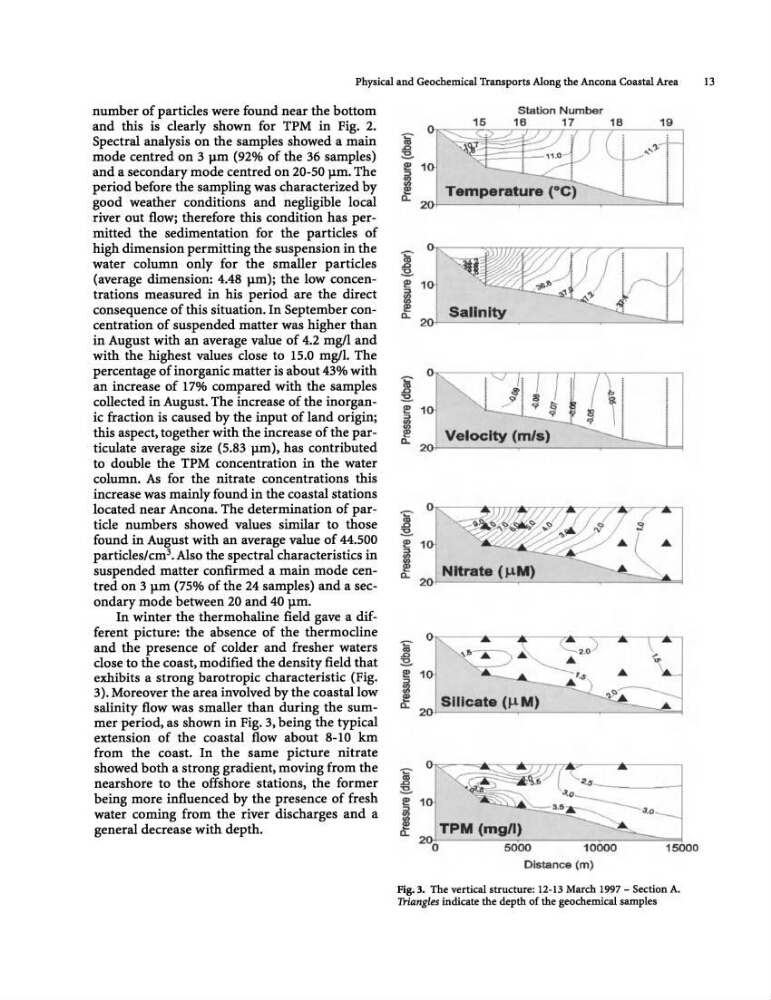
In winter the thermohaline field gave a different picture: the absence of the thermocline
and the presence of colder and fresher waters
close to the coast, modified the density field that
exhibits a strong barotropic characteristic (Fig.
3). Moreover the area involved by the coastal low
salinity flow was smaller than during the summer period, as shown in Fig. 3, being the typical
extension of the coastal flow about 8-lO km
from the coast. In the same picture nitrate
showed both a strong gradient, moving from the
nearshore to the offshore stations, the former
being more influenced by the presence of fresh
water coming from the river discharges and a
general decrease with depth.
Station Number
15
16
17
18
19
~ .0
:s.
~ 1
~
£
Temperature (OC)
2
e 1
i
~ 2~_ S _ a_ ll _ n_ lty ~~ ______ ~ ____ ~~
'i' .0
:E.
e 1
::::>
~
Velocity (m/s)
~ 2or----------r---------~------~~
j
:s.
e 1
~ Nitrate (J..l.M)
~ 2~~~~~~~~------~--~~~~
lii
.0
:s.
~ 1
~
~ 2 Silicate (J..l. M)
TPM (mgn)
2 0
5000
10000
15000
Distance (m)
Fig.3. The vertical structure: 12-13 March 1997 - Section A.
mangles indicate the depth of the geochemical samples
13
number of particles were found near the bottom
and this is clearly shown for TPM in Fig. 2.
Spectral analysis on the samples showed a main
mode centred on 3 pm (92% of the 36 samples)
and a secondary mode centred on 20-50 }lm. The
period before the sampling was characterized by
good weather conditions and negligible local
river out flow; therefore this condition has permitted the sedimentation for the particles of
high dimension permitting the suspension in the
water column only for the smaller particles
(average dimension: 4.48 pm); the low concentrations measured in his period are the direct
consequence of this situation. In September concentration of suspended matter was higher than
in August with an average value of 4.2 mgll and
with the highest values close to 15.0 mg!I. The
percentage of inorganic matter is about 43% with
an increase of 17% compared with the samples
collected in August. The increase of the inorganic fraction is caused by the input of land origin;
this aspect, together with the increase of the particulate average size (5.83 }lm), has contributed
to double the TPM concentration in the water
column. As for the nitrate concentrations this
increase was mainly found in the coastal stations
located near Ancona. The determination of particle numbers showed values similar to those
found in August with an average value of 44.500
particles! cm 3 • Also the spectral characteristics in
suspended matter confIrmed a main mode centred on 3 p.m (75% of the 24 samples) and a secondary mode between 20 and 40 p.m.
In winter the thermohaline field gave a different picture: the absence of the thermocline
and the presence of colder and fresher waters
close to the coast, modified the density field that
exhibits a strong barotropic characteristic (Fig.
3). Moreover the area involved by the coastal low
salinity flow was smaller than during the summer period, as shown in Fig. 3, being the typical
extension of the coastal flow about 8-lO km
from the coast. In the same picture nitrate
showed both a strong gradient, moving from the
nearshore to the offshore stations, the former
being more influenced by the presence of fresh
water coming from the river discharges and a
general decrease with depth.
Station Number
15
16
17
18
19
~ .0
:s.
~ 1
~
£
Temperature (OC)
2
e 1
i
~ 2~_ S _ a_ ll _ n_ lty ~~ ______ ~ ____ ~~
'i' .0
:E.
e 1
::::>
~
Velocity (m/s)
~ 2or----------r---------~------~~
j
:s.
e 1
~ Nitrate (J..l.M)
~ 2~~~~~~~~------~--~~~~
lii
.0
:s.
~ 1
~
~ 2 Silicate (J..l. M)
TPM (mgn)
2 0
5000
10000
15000
Distance (m)
Fig.3. The vertical structure: 12-13 March 1997 - Section A.
mangles indicate the depth of the geochemical samples