

Materials and Methods
Marine phanerogams were sampled seasonally
from February to November 1997 in two different areas located in the Southern and Northern
Adriatic Sea, namely north of Otranto harbour
(40 0 1O'N, 18°29'E) for P. oceanica and outside
Grado lagoon (45°41'N, 13°28'E) for C. nodosa
and Z. marina. At Otranto, P. oceanica was sampled at 6.5 m depth, where the water temperature
varied from lSOC (winter) to 25°C (summer),
while salinity was about 38%0. The water temperature and salinity varied from S.9°C (winter) to
24.4°C (summer), and from 28%0 to 34%0,
respectively. At the meadow C. nodosa settled at
1.5 m depth farther away from the Grado lagoon
than Z. marina. This latter was settled at 0.5 m
depth near the entrance of the lagoon, where the
water temperature and salinity ranged from
8.8°C (winter) to 24.4°C (summer), and from
25%0 to 33%0, respectively.
Samples for phenological analyses and biomass estimates were collected following the procedures reported by Mazzella et al. (1998). The
above-ground (leaves) and below-ground (old
sheaths, rhizomes and roots) compartments of
plants were considered separately.
Total carbon and nitrogen contents of plant
compartments, epiphyte and vagile fauna were
obtained by means of a CHN analyser; results are
reported as percentage of dry weight.
Results
Plant Phenology
In P. oceanica, a mean shoot density of 707.9 ±
65.2 shoots m- 2 was measured. The shoot density is considered to be a constant parameter
through the year in this plant (Mazzella and Buia
1989). In C. nodosa, the shoot density varied
from 977.5 ± 158.3 (winter) to 1657.9 ± 85.3
(summer) shoots m- 2 and in Z. marina from
277.8 ± 44.6 (winter) to 773.7 ± 90.5 (summer)
shoots m- 2 •
Higher seasonal variations of the leaf length
were observed in C. nodosa and Z. marina than
in P. oceanica, with maxima occurring in springsummer (Fig. 1).
The Leaf Area Index (Fig. 2) was highest in P.
oceanica, followed by Z. marina and, in turn, C.
nodosa. This parameter varied according to seaSeasonal Trends in Adriatic Seagrass Communities
291
son in C. nodosa and Z. marina, while in P. oceanica it was high and constant in all seasons but
winter.
Biomass Partitioning
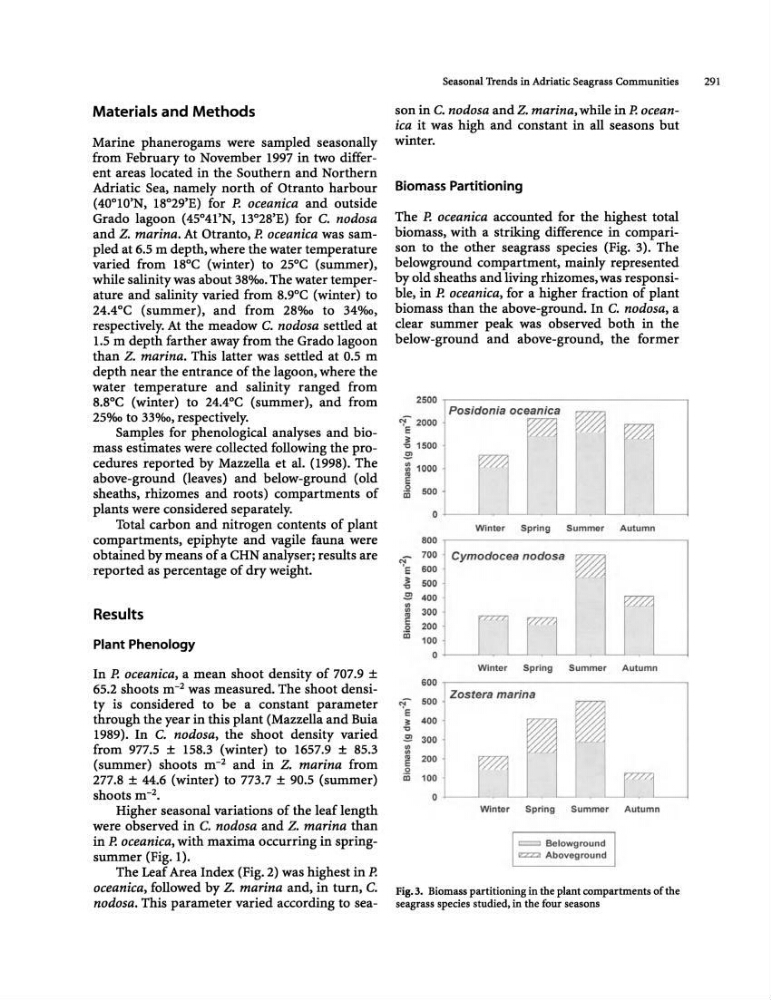
The P. oceanica accounted for the highest total
biomass, with a striking difference in comparison to the other seagrass species (Fig. 3). The
belowground compartment, mainly represented
by old sheaths and living rhizomes, was responsible, in P. oceanica, for a higher fraction of plant
biomass than the above-ground. In C. nodosa, a
clear summer peak was observed both in the
below-ground and above-ground, the former
2500 r - - - - - - - - - - - - - - - - - ,
~ 2000
~ 1500
::: 1000
... e
iii 500
Posidonia oceanica
Winter
Spring
Summer
Autumn
800 , - - - - - - - - - - - - - - - - - - ,
~
700
Cymodocea nodosa
e 600
~ 500
P2 400
!II
g: 300
~ 200
iii 100
Winter
Spring
Summer
Autumn
600 - r - - - - - - - - - - - - - - - - - ,
~500
e
;t 400
"C
.!:! 300
:z
~ 200
o
iii 100
Zostera marina
O +--...L
Winter
Spring
Summer
Autumn
= Belowground
~ Aboveground
Fig.3. Biomass partitioning in the plant compartments of the
seagrass species studied, in the four seasons
Marine phanerogams were sampled seasonally
from February to November 1997 in two different areas located in the Southern and Northern
Adriatic Sea, namely north of Otranto harbour
(40 0 1O'N, 18°29'E) for P. oceanica and outside
Grado lagoon (45°41'N, 13°28'E) for C. nodosa
and Z. marina. At Otranto, P. oceanica was sampled at 6.5 m depth, where the water temperature
varied from lSOC (winter) to 25°C (summer),
while salinity was about 38%0. The water temperature and salinity varied from S.9°C (winter) to
24.4°C (summer), and from 28%0 to 34%0,
respectively. At the meadow C. nodosa settled at
1.5 m depth farther away from the Grado lagoon
than Z. marina. This latter was settled at 0.5 m
depth near the entrance of the lagoon, where the
water temperature and salinity ranged from
8.8°C (winter) to 24.4°C (summer), and from
25%0 to 33%0, respectively.
Samples for phenological analyses and biomass estimates were collected following the procedures reported by Mazzella et al. (1998). The
above-ground (leaves) and below-ground (old
sheaths, rhizomes and roots) compartments of
plants were considered separately.
Total carbon and nitrogen contents of plant
compartments, epiphyte and vagile fauna were
obtained by means of a CHN analyser; results are
reported as percentage of dry weight.
Results
Plant Phenology
In P. oceanica, a mean shoot density of 707.9 ±
65.2 shoots m- 2 was measured. The shoot density is considered to be a constant parameter
through the year in this plant (Mazzella and Buia
1989). In C. nodosa, the shoot density varied
from 977.5 ± 158.3 (winter) to 1657.9 ± 85.3
(summer) shoots m- 2 and in Z. marina from
277.8 ± 44.6 (winter) to 773.7 ± 90.5 (summer)
shoots m- 2 •
Higher seasonal variations of the leaf length
were observed in C. nodosa and Z. marina than
in P. oceanica, with maxima occurring in springsummer (Fig. 1).
The Leaf Area Index (Fig. 2) was highest in P.
oceanica, followed by Z. marina and, in turn, C.
nodosa. This parameter varied according to seaSeasonal Trends in Adriatic Seagrass Communities
291
son in C. nodosa and Z. marina, while in P. oceanica it was high and constant in all seasons but
winter.
Biomass Partitioning
The P. oceanica accounted for the highest total
biomass, with a striking difference in comparison to the other seagrass species (Fig. 3). The
belowground compartment, mainly represented
by old sheaths and living rhizomes, was responsible, in P. oceanica, for a higher fraction of plant
biomass than the above-ground. In C. nodosa, a
clear summer peak was observed both in the
below-ground and above-ground, the former
2500 r - - - - - - - - - - - - - - - - - ,
~ 2000
~ 1500
::: 1000
... e
iii 500
Posidonia oceanica
Winter
Spring
Summer
Autumn
800 , - - - - - - - - - - - - - - - - - - ,
~
700
Cymodocea nodosa
e 600
~ 500
P2 400
!II
g: 300
~ 200
iii 100
Winter
Spring
Summer
Autumn
600 - r - - - - - - - - - - - - - - - - - ,
~500
e
;t 400
"C
.!:! 300
:z
~ 200
o
iii 100
Zostera marina
O +--...L
Winter
Spring
Summer
Autumn
= Belowground
~ Aboveground
Fig.3. Biomass partitioning in the plant compartments of the
seagrass species studied, in the four seasons