

292
P. Guidetti et al.
accounting for the highest biomass in all seasons.
Contributions of the two plant compartments to
the total biomass in Z. marina were much more
balanced, since they accounted for a comparable
fraction in all seasons.
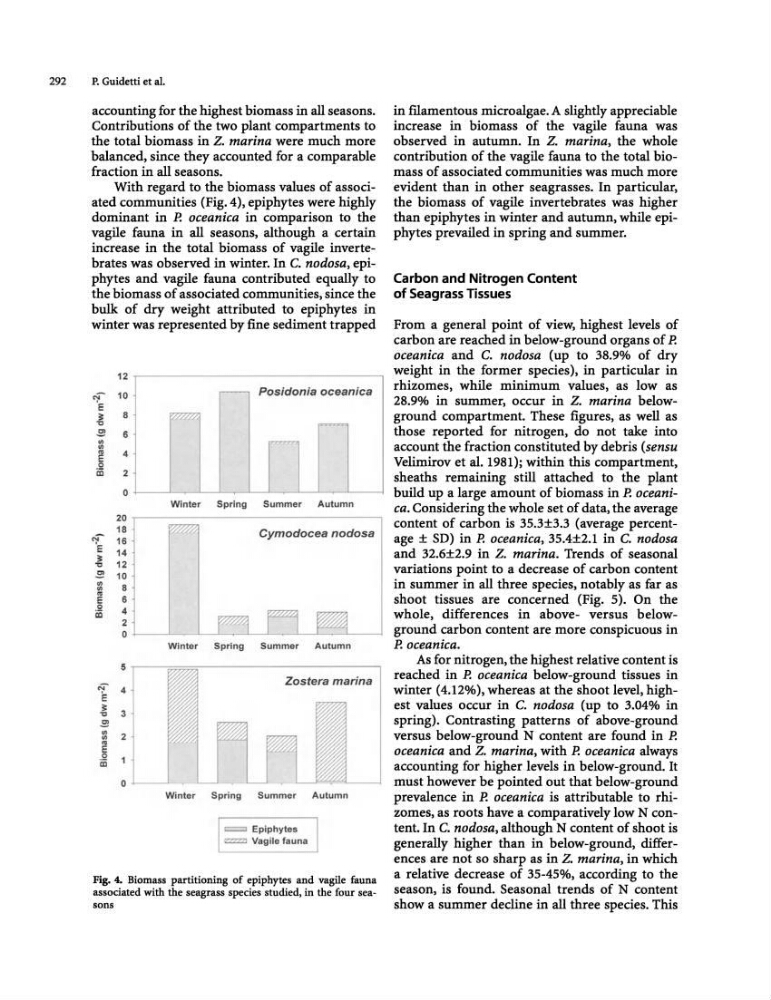
With regard to the biomass values of associated communities (Fig. 4), epiphytes were highly
dominant in R oceanica in comparison to the
vagile fauna in all seasons, although a certain
increase in the total biomass of vagile invertebrates was observed in winter. In C. nodosa. epiphytes and vagile fauna contributed equally to
the biomass of associated communities, since the
bulk of dry weight attributed to epiphytes in
winter was represented by fine sediment trapped
~
E
;1:
"C
$
., ., .. E 0
iii
~E
;1:
"C
$
.,
.,
II!
E
0
i:i5
N
E
~
"C
E!
., ., .. E 0
iii
12
10
8
6
4
2
0
20
18
16
14
12
10
8
6
4
2
0
5
4
3
2
0
-
Posidonia oceanica
~
~
~
W inter
Spring
Summer
Autumn
Cymodocea nodosa
Winter
Spring
Summer
Autumn
Zostera marina
Winter
Spring
Summer
Autumn
= Epiphytes
= Vagile fauna
Fig. 4. Biomass partitioning of epiphytes and vagile fauna
associated with the seagrass species studied, in the four seasons
in filamentous microalgae. A slightly appreciable
increase in biomass of the vagile fauna was
observed in autumn. In Z. marina, the whole
contribution of the vagile fauna to the total biomass of associated communities was much more
evident than in other seagrasses. In particular.
the biomass of vagile invertebrates was higher
than epiphytes in winter and autumn, while epiphytes prevailed in spring and summer.
Carbon and Nitrogen Content
of Seagrass Tissues
From a general point of view, highest levels of
carbon are reached in below-ground organs of R
oceanica and C. nodosa (up to 38.9% of dry
weight in the former species), in particular in
rhizomes, while minimum values, as low as
28.9% in summer, occur in Z. marina belowground compartment. These figures, as well as
those reported for nitrogen, do not take into
account the fraction constituted by debris (sensu
Velimirov et al. 1981); within this compartment,
sheaths remaining still attached to the plant
build up a large amount of biomass in P. oceanica. Considering the whole set of data, the average
content of carbon is 35.3±3.3 (average percentage ± SO) in P. oceanica, 35.4±2.1 in C. nodosa
and 32.6±2.9 in Z. marina. Trends of seasonal
variations point to a decrease of carbon content
in summer in all three species, notably as far as
shoot tissues are concerned (Fig. 5). On the
whole, differences in above- versus belowground carbon content are more conspicuous in
P. oceanica.
As for nitrogen, the highest relative content is
reached in R oceanica below-ground tissues in
winter (4.12%), whereas at the shoot level, highest values occur in C. nodosa (up to 3.04% in
spring). Contrasting patterns of above-ground
versus below-ground N content are found in R
oceanica and Z. marina, with P. oceanica always
accounting for higher levels in below-ground. It
must however be pointed out that below-ground
prevalence in P. oceanica is attributable to rhizomes, as roots have a comparatively low N content. In C. nodosa, although N content of shoot is
generally higher than in below-ground, differences are not so sharp as in Z. marina, in which
a relative decrease of 35-45%, according to the
season, is found. Seasonal trends of N content
show a summer decline in all three species. This
P. Guidetti et al.
accounting for the highest biomass in all seasons.
Contributions of the two plant compartments to
the total biomass in Z. marina were much more
balanced, since they accounted for a comparable
fraction in all seasons.
With regard to the biomass values of associated communities (Fig. 4), epiphytes were highly
dominant in R oceanica in comparison to the
vagile fauna in all seasons, although a certain
increase in the total biomass of vagile invertebrates was observed in winter. In C. nodosa. epiphytes and vagile fauna contributed equally to
the biomass of associated communities, since the
bulk of dry weight attributed to epiphytes in
winter was represented by fine sediment trapped
~
E
;1:
"C
$
., ., .. E 0
iii
~E
;1:
"C
$
.,
.,
II!
E
0
i:i5
N
E
~
"C
E!
., ., .. E 0
iii
12
10
8
6
4
2
0
20
18
16
14
12
10
8
6
4
2
0
5
4
3
2
0
-
Posidonia oceanica
~
~
~
W inter
Spring
Summer
Autumn
Cymodocea nodosa
Winter
Spring
Summer
Autumn
Zostera marina
Winter
Spring
Summer
Autumn
= Epiphytes
= Vagile fauna
Fig. 4. Biomass partitioning of epiphytes and vagile fauna
associated with the seagrass species studied, in the four seasons
in filamentous microalgae. A slightly appreciable
increase in biomass of the vagile fauna was
observed in autumn. In Z. marina, the whole
contribution of the vagile fauna to the total biomass of associated communities was much more
evident than in other seagrasses. In particular.
the biomass of vagile invertebrates was higher
than epiphytes in winter and autumn, while epiphytes prevailed in spring and summer.
Carbon and Nitrogen Content
of Seagrass Tissues
From a general point of view, highest levels of
carbon are reached in below-ground organs of R
oceanica and C. nodosa (up to 38.9% of dry
weight in the former species), in particular in
rhizomes, while minimum values, as low as
28.9% in summer, occur in Z. marina belowground compartment. These figures, as well as
those reported for nitrogen, do not take into
account the fraction constituted by debris (sensu
Velimirov et al. 1981); within this compartment,
sheaths remaining still attached to the plant
build up a large amount of biomass in P. oceanica. Considering the whole set of data, the average
content of carbon is 35.3±3.3 (average percentage ± SO) in P. oceanica, 35.4±2.1 in C. nodosa
and 32.6±2.9 in Z. marina. Trends of seasonal
variations point to a decrease of carbon content
in summer in all three species, notably as far as
shoot tissues are concerned (Fig. 5). On the
whole, differences in above- versus belowground carbon content are more conspicuous in
P. oceanica.
As for nitrogen, the highest relative content is
reached in R oceanica below-ground tissues in
winter (4.12%), whereas at the shoot level, highest values occur in C. nodosa (up to 3.04% in
spring). Contrasting patterns of above-ground
versus below-ground N content are found in R
oceanica and Z. marina, with P. oceanica always
accounting for higher levels in below-ground. It
must however be pointed out that below-ground
prevalence in P. oceanica is attributable to rhizomes, as roots have a comparatively low N content. In C. nodosa, although N content of shoot is
generally higher than in below-ground, differences are not so sharp as in Z. marina, in which
a relative decrease of 35-45%, according to the
season, is found. Seasonal trends of N content
show a summer decline in all three species. This