

in direct relation to variation in feeding. During
their growth, young squid gradually captured
prey of diverse zoological groups and of increasing size, as the structure of the ever more-armed
tentacle suggests. As their capturing apparatus
became gradually perfected. the young squid
began feeding on copepods, euphausiids,
amphipods and eventually fishes. Medium-sized
pelagic cephalopods (Onychoteuthidae,
Ommastrephidae) fed mainly on prey items that
were proportional to their dimensions, always
concentrating on fishes. In the adult stage, reproductive animals exhibited, in some of the species
studied, a high percentage of empty stomachs,
which leads to the inference that feeding stops at
the time of reproduction (Legand et al. 1972).
Breiby et al. (1984) analysed the feeding habits of
Todarodes sagittatus (Ommastrephidae) and
found variations in the composition of the diet
related to ontogeny. The stomach contents had a
broth-like consistency, which precluded the division of the food remains for analysis of the volume and mass of the various prey categories.
Prey items were identified from "key" fragments
of skeletal tissue such as jaw elements, parapodia, otoliths and shell remains. The recovered
otoliths were compared directly with a reference
sample taken from fishes common to the study
area. The authors noted a general trend toward a
decrease of crustaceans in the diet and an
increase of fishes as the squids increased in size.
The size of the prey items ranged from a few millimetres for the calanoid copepods to more than
Percentage
of occurrence
(%)
40
30
20
10
o
<23
Energy Flux in the South Tyrrhenian Deep-sea Ecosystem
203
15 cm for some fishes, among which were
mesopelagic species like Maurolicus muelleri.
With regard to the South Tyrrhenian Sea, a
study was recently carried out, based on the
annual sampling of Todarodes sagittatus, in the
hydrographic area adjacent to the Straits of
Messina (Marabello 1994; Marabello et al. 1996).
The purpose of the study was to investigate the
trophic relations between cephalopods and
mesopelagic fishes. The results have provided
further confirmation of the hypothesis of a close
trophic coupling between cephalopods and
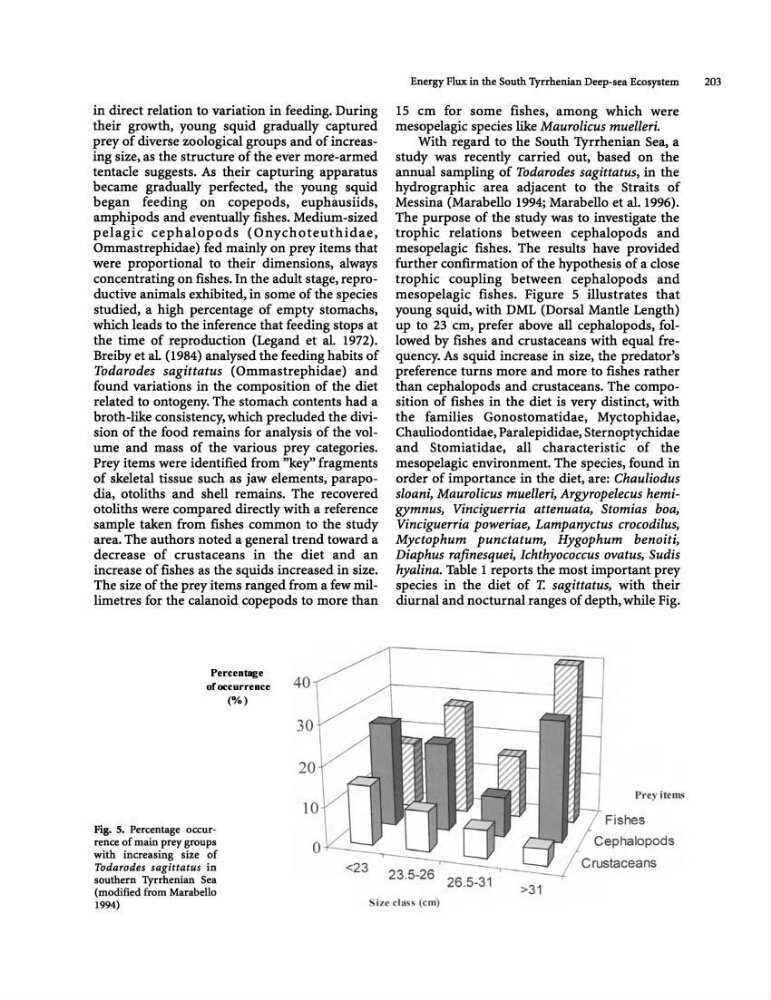
mesopelagic fishes. Figure 5 illustrates that
young squid, with DML (Dorsal Mantle Length)
up to 23 cm, prefer above all cephalopods, followed by fishes and crustaceans with equal frequency. As squid increase in size, the predator'S
preference turns more and more to fishes rather
than cephalopods and crustaceans. The composition of fishes in the diet is very distinct, with
the families Gonostomatidae, Myctophidae,
Chauliodontidae, Paralepididae, Sternoptychidae
and Stomiatidae, all characteristic of the
mesopelagic environment. The species, found in
order of importance in the diet, are: Chauliodus
sloani, Maurolicus muelleri, Argyropelecus hem igymnus, Vinciguerria attenuata, Stomias boa,
Vinciguerria poweriae, Lampanyctus crocodilus,
Myctophum punctatum, Hygophum benoiti,
Diaphus rafinesquei, Ichthyococcus ovatus, Sudis
hyalina_ Table 1 reports the most important prey
species in the diet of T. sagittatus, with their
diurnal and nocturnal ranges of depth, while Fig.
>31
Prey items
Fishes
Cephalopods
Crustaceans
Fig. s. Percentage occurrence of main prey groups
with increasing size of
Todarodes sagittatus in
southern Tyrrhenian Sea
(modified from Marabello
1994)
Size class (em)
their growth, young squid gradually captured
prey of diverse zoological groups and of increasing size, as the structure of the ever more-armed
tentacle suggests. As their capturing apparatus
became gradually perfected. the young squid
began feeding on copepods, euphausiids,
amphipods and eventually fishes. Medium-sized
pelagic cephalopods (Onychoteuthidae,
Ommastrephidae) fed mainly on prey items that
were proportional to their dimensions, always
concentrating on fishes. In the adult stage, reproductive animals exhibited, in some of the species
studied, a high percentage of empty stomachs,
which leads to the inference that feeding stops at
the time of reproduction (Legand et al. 1972).
Breiby et al. (1984) analysed the feeding habits of
Todarodes sagittatus (Ommastrephidae) and
found variations in the composition of the diet
related to ontogeny. The stomach contents had a
broth-like consistency, which precluded the division of the food remains for analysis of the volume and mass of the various prey categories.
Prey items were identified from "key" fragments
of skeletal tissue such as jaw elements, parapodia, otoliths and shell remains. The recovered
otoliths were compared directly with a reference
sample taken from fishes common to the study
area. The authors noted a general trend toward a
decrease of crustaceans in the diet and an
increase of fishes as the squids increased in size.
The size of the prey items ranged from a few millimetres for the calanoid copepods to more than
Percentage
of occurrence
(%)
40
30
20
10
o
<23
Energy Flux in the South Tyrrhenian Deep-sea Ecosystem
203
15 cm for some fishes, among which were
mesopelagic species like Maurolicus muelleri.
With regard to the South Tyrrhenian Sea, a
study was recently carried out, based on the
annual sampling of Todarodes sagittatus, in the
hydrographic area adjacent to the Straits of
Messina (Marabello 1994; Marabello et al. 1996).
The purpose of the study was to investigate the
trophic relations between cephalopods and
mesopelagic fishes. The results have provided
further confirmation of the hypothesis of a close
trophic coupling between cephalopods and
mesopelagic fishes. Figure 5 illustrates that
young squid, with DML (Dorsal Mantle Length)
up to 23 cm, prefer above all cephalopods, followed by fishes and crustaceans with equal frequency. As squid increase in size, the predator'S
preference turns more and more to fishes rather
than cephalopods and crustaceans. The composition of fishes in the diet is very distinct, with
the families Gonostomatidae, Myctophidae,
Chauliodontidae, Paralepididae, Sternoptychidae
and Stomiatidae, all characteristic of the
mesopelagic environment. The species, found in
order of importance in the diet, are: Chauliodus
sloani, Maurolicus muelleri, Argyropelecus hem igymnus, Vinciguerria attenuata, Stomias boa,
Vinciguerria poweriae, Lampanyctus crocodilus,
Myctophum punctatum, Hygophum benoiti,
Diaphus rafinesquei, Ichthyococcus ovatus, Sudis
hyalina_ Table 1 reports the most important prey
species in the diet of T. sagittatus, with their
diurnal and nocturnal ranges of depth, while Fig.
>31
Prey items
Fishes
Cephalopods
Crustaceans
Fig. s. Percentage occurrence of main prey groups
with increasing size of
Todarodes sagittatus in
southern Tyrrhenian Sea
(modified from Marabello
1994)
Size class (em)