

202
A. Granata et al.
Fish size (r".. -54 )
o
Fish size (r= -32 )
+
b
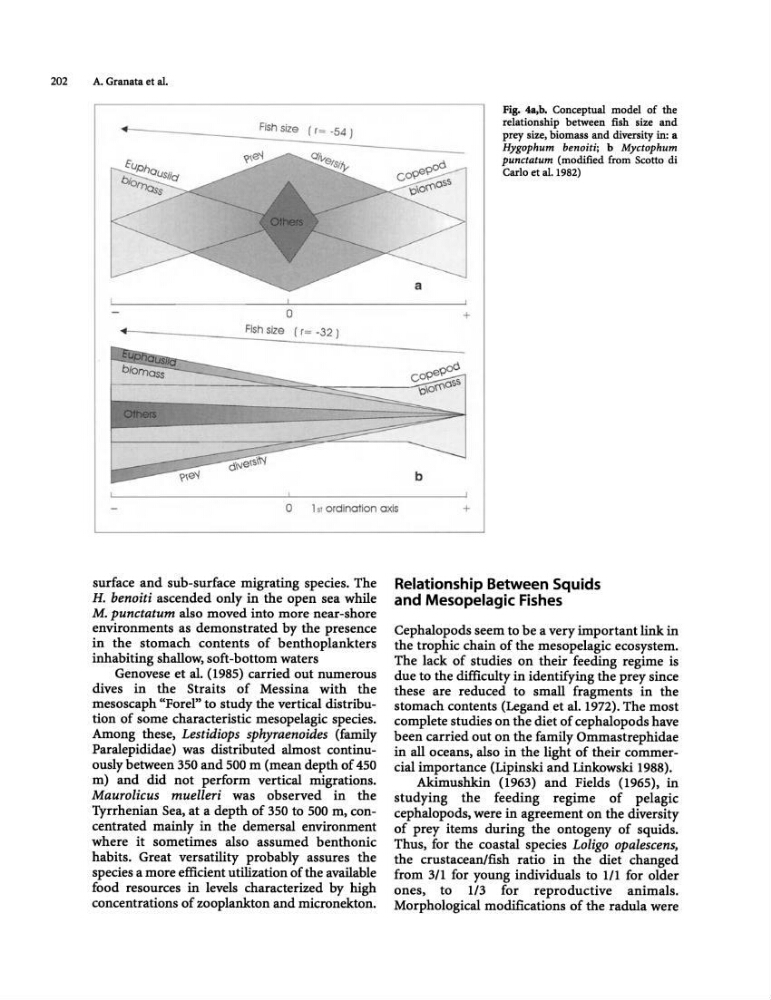
Fig. 4a,b. Conceptual model of the
relationship between fish size and
prey size, biomass and diversity in: a
Hygophum benoiti; b Myctophum
punctatum (modified from Scotto di
Carlo et al.1982)
o 1 st ordination axis
+
surface and sub-surface migrating species. The
H. benoiti ascended only in the open sea while
M. punctatum also moved into more near-shore
environments as demonstrated by the presence
in the stomach contents of benthoplankters
inhabiting shallow, soft-bottom waters
Genovese et al. (1985) carried out numerous
dives in the Straits of Messina with the
mesoscaph "Forel" to study the vertical distribution of some characteristic mesopelagic species.
Among these, Lestidiops sphyraenoides (family
Paralepididae) was distributed almost continuously between 350 and 500 m (mean depth of 450
m) and did not perform vertical migrations.
Maurolicus muelleri was observed in the
Tyrrhenian Sea, at a depth of 350 to 500 m, concentrated mainly in the demersal environment
where it sometimes also assumed benthonic
habits. Great versatility probably assures the
species a more efficient utilization of the available
food resources in levels characterized by high
concentrations of zooplankton and micronekton.
Relationship Between Squids
and Mesopelagic Fishes
Cephalopods seem to be a very important link in
the trophic chain of the mesopelagic ecosystem.
The lack of studies on their feeding regime is
due to the difficulty in identifying the prey since
these are reduced to small fragments in the
stomach contents (Legandet al. 1972). The most
complete studies on the diet of cephalopods have
been carried out on the family Ommastrephidae
in all oceans, also in the light of their commercial importance (Lipinski and Linkowski 1988).
Akimushkin (1963) and Fields (1965), in
studying the feeding regime of pelagic
cephalopods, were in agreement on the diversity
of prey items during the ontogeny of squids.
Thus, for the coastal species Loligo opalescens,
the crustaceanlfish ratio in the diet changed
from 3/1 for young individuals to 1/1 for older
ones, to 113 for reproductive animals.
Morphological modifications of the radula were
A. Granata et al.
Fish size (r".. -54 )
o
Fish size (r= -32 )
+
b
Fig. 4a,b. Conceptual model of the
relationship between fish size and
prey size, biomass and diversity in: a
Hygophum benoiti; b Myctophum
punctatum (modified from Scotto di
Carlo et al.1982)
o 1 st ordination axis
+
surface and sub-surface migrating species. The
H. benoiti ascended only in the open sea while
M. punctatum also moved into more near-shore
environments as demonstrated by the presence
in the stomach contents of benthoplankters
inhabiting shallow, soft-bottom waters
Genovese et al. (1985) carried out numerous
dives in the Straits of Messina with the
mesoscaph "Forel" to study the vertical distribution of some characteristic mesopelagic species.
Among these, Lestidiops sphyraenoides (family
Paralepididae) was distributed almost continuously between 350 and 500 m (mean depth of 450
m) and did not perform vertical migrations.
Maurolicus muelleri was observed in the
Tyrrhenian Sea, at a depth of 350 to 500 m, concentrated mainly in the demersal environment
where it sometimes also assumed benthonic
habits. Great versatility probably assures the
species a more efficient utilization of the available
food resources in levels characterized by high
concentrations of zooplankton and micronekton.
Relationship Between Squids
and Mesopelagic Fishes
Cephalopods seem to be a very important link in
the trophic chain of the mesopelagic ecosystem.
The lack of studies on their feeding regime is
due to the difficulty in identifying the prey since
these are reduced to small fragments in the
stomach contents (Legandet al. 1972). The most
complete studies on the diet of cephalopods have
been carried out on the family Ommastrephidae
in all oceans, also in the light of their commercial importance (Lipinski and Linkowski 1988).
Akimushkin (1963) and Fields (1965), in
studying the feeding regime of pelagic
cephalopods, were in agreement on the diversity
of prey items during the ontogeny of squids.
Thus, for the coastal species Loligo opalescens,
the crustaceanlfish ratio in the diet changed
from 3/1 for young individuals to 1/1 for older
ones, to 113 for reproductive animals.
Morphological modifications of the radula were