

204
A. Granata et aI.
4
3.8
3.6
3.4
3.2
3
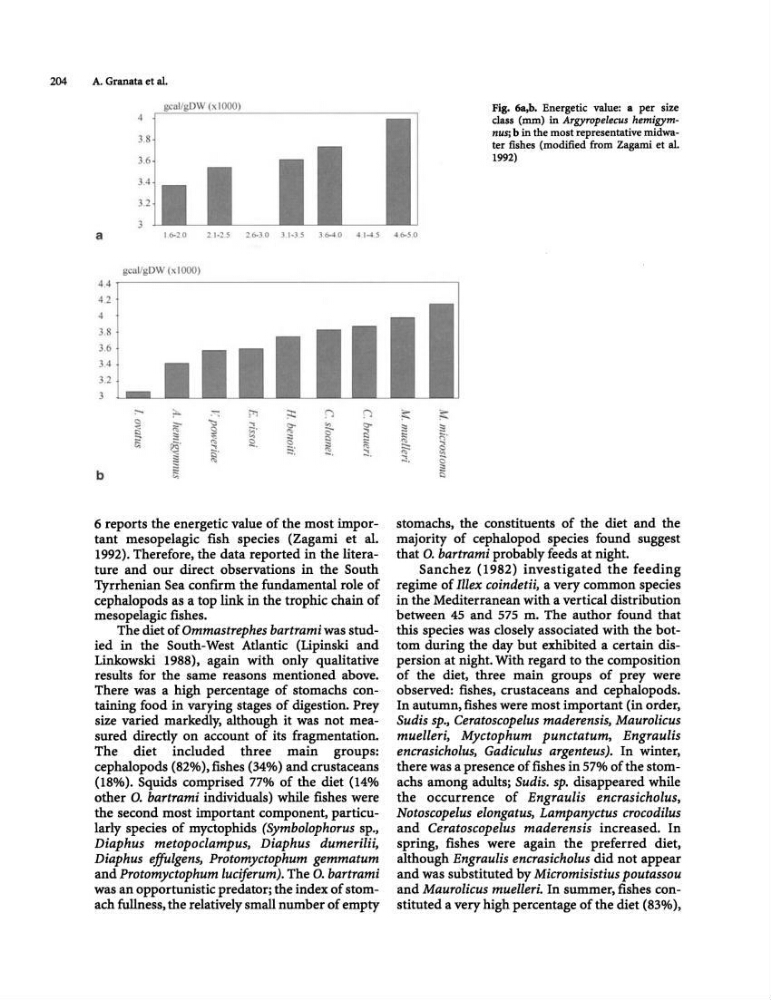
Fig. 6a,b. Energetic value: a per size
class (mm) in Argyropelecus hemigymnus; b in the most representative midwater fishes (modified from Zagami et aI.
1992)
a
16-20
2 1·25
26-30
3 1·35
3640
4 1 ·45
46·50
gcalfgDW (x 1000)
4.4 . , - - - - - - - - - - - - - - - - - - - - - - - ,
4.2
4
3.8
3.6
3.4
3.2
3
b
:--.
0
~
~
c;;
~
~
~
'"
~
~
.;;
~.
....
is·
~
'"
:::
'"
~
::t:
n
...
'"
0t:;.
'"
c
....
'"
:::s
::
Q.
t:l
<;)
~.
~
::::;:
-.
~.
6 reports the energetic value of the most important mesopelagic fish species (Zagami et aI.
1992). Therefore, the data reported in the literature and our direct observations in the South
Tyrrhenian Sea confirm the fundamental role of
cephalopods as a top link in the trophic chain of
mesopelagic fishes.
The diet of Ommastrephes bartrami was studied in the South-West Atlantic (Lipinski and
Linkowski 1988), again with only qualitative
results for the same reasons mentioned above.
There was a high percentage of stomachs containing food in varying stages of digestion. Prey
size varied markedly, although it was not measured directly on account of its fragmentation.
The diet included three main groups:
cephalopods (82%), fishes (34%) and crustaceans
(18%). Squids comprised 77% of the diet (14%
other O. bartrami individuals) while fishes were
the second most important component, particularly species of myctophids (Symbolophorus sp.,
Diaphus metopoclampus, Diaphus dumerilii,
Diaphus effulgens, Protomyctophum gemma tum
and Protomyctophum luciferum). The O. bartrami
was an opportunistic predator; the index of stomach fullness, the relatively small number of empty
~
~
;:;
;:;
::;
o·
'"
~
-- ~
~.
C
;:;
t:l
stomachs, the constituents of the diet and the
majority of cephalopod species found suggest
that O. bartrami probably feeds at night.
Sanchez (1982) investigated the feeding
regime of Illex coindetii, a very common species
in the Mediterranean with a vertical distribution
between 45 and 575 m. The author found that
this species was closely associated with the bottom during the day but exhibited a certain dispersion at night. With regard to the composition
of the diet, three main groups of prey were
observed: fishes, crustaceans and cephalopods.
In autumn, fishes were most important (in order,
Sudis sp., Ceratoscopelus maderensis, Maurolicus
muelleri, Myctophum punctatum, Engraulis
encrasicholus, Gadiculus argenteus). In winter,
there was a presence of fishes in 57% of the stomachs among adults; Sud is. sp. disappeared while
the occurrence of Engraulis encrasicholus,
Notoscopelus elongatus, Lampanyctus crocodilus
and Ceratoscopelus maderensis increased. In
spring, fishes were again the preferred diet,
although Engraulis encrasicholus did not appear
and was substituted by Micromisistius poutassou
and Maurolicus muelleri. In summer, fishes constituted a very high percentage of the diet (83%),
A. Granata et aI.
4
3.8
3.6
3.4
3.2
3
Fig. 6a,b. Energetic value: a per size
class (mm) in Argyropelecus hemigymnus; b in the most representative midwater fishes (modified from Zagami et aI.
1992)
a
16-20
2 1·25
26-30
3 1·35
3640
4 1 ·45
46·50
gcalfgDW (x 1000)
4.4 . , - - - - - - - - - - - - - - - - - - - - - - - ,
4.2
4
3.8
3.6
3.4
3.2
3
b
:--.
0
~
~
c;;
~
~
~
'"
~
~
.;;
~.
....
is·
~
'"
:::
'"
~
::t:
n
...
'"
0t:;.
'"
c
....
'"
:::s
::
Q.
t:l
<;)
~.
~
::::;:
-.
~.
6 reports the energetic value of the most important mesopelagic fish species (Zagami et aI.
1992). Therefore, the data reported in the literature and our direct observations in the South
Tyrrhenian Sea confirm the fundamental role of
cephalopods as a top link in the trophic chain of
mesopelagic fishes.
The diet of Ommastrephes bartrami was studied in the South-West Atlantic (Lipinski and
Linkowski 1988), again with only qualitative
results for the same reasons mentioned above.
There was a high percentage of stomachs containing food in varying stages of digestion. Prey
size varied markedly, although it was not measured directly on account of its fragmentation.
The diet included three main groups:
cephalopods (82%), fishes (34%) and crustaceans
(18%). Squids comprised 77% of the diet (14%
other O. bartrami individuals) while fishes were
the second most important component, particularly species of myctophids (Symbolophorus sp.,
Diaphus metopoclampus, Diaphus dumerilii,
Diaphus effulgens, Protomyctophum gemma tum
and Protomyctophum luciferum). The O. bartrami
was an opportunistic predator; the index of stomach fullness, the relatively small number of empty
~
~
;:;
;:;
::;
o·
'"
~
-- ~
~.
C
;:;
t:l
stomachs, the constituents of the diet and the
majority of cephalopod species found suggest
that O. bartrami probably feeds at night.
Sanchez (1982) investigated the feeding
regime of Illex coindetii, a very common species
in the Mediterranean with a vertical distribution
between 45 and 575 m. The author found that
this species was closely associated with the bottom during the day but exhibited a certain dispersion at night. With regard to the composition
of the diet, three main groups of prey were
observed: fishes, crustaceans and cephalopods.
In autumn, fishes were most important (in order,
Sudis sp., Ceratoscopelus maderensis, Maurolicus
muelleri, Myctophum punctatum, Engraulis
encrasicholus, Gadiculus argenteus). In winter,
there was a presence of fishes in 57% of the stomachs among adults; Sud is. sp. disappeared while
the occurrence of Engraulis encrasicholus,
Notoscopelus elongatus, Lampanyctus crocodilus
and Ceratoscopelus maderensis increased. In
spring, fishes were again the preferred diet,
although Engraulis encrasicholus did not appear
and was substituted by Micromisistius poutassou
and Maurolicus muelleri. In summer, fishes constituted a very high percentage of the diet (83%),