

Results
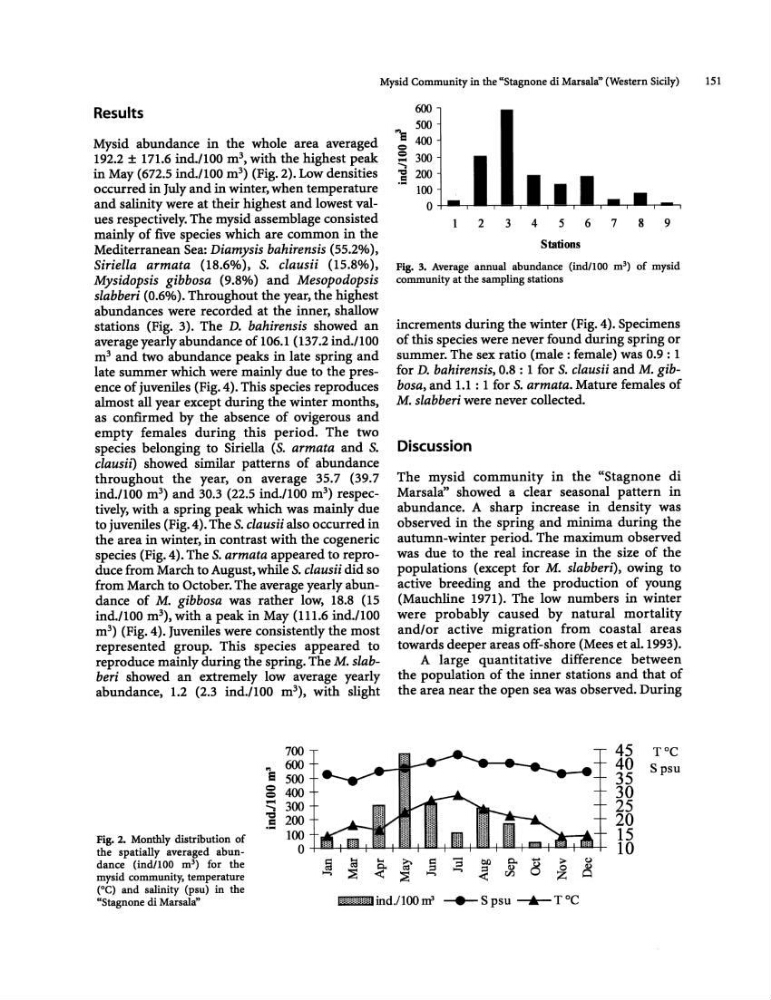
Mysid abundance in the whole area averaged
192.2 ± 171.6 ind./100 m 3 , with the highest peak
in May (672.5 ind.IIOO m 3 ) (Fig. 2). Low densities
occurred in July and in winter, when temperature
and salinity were at their highest and lowest values respectively. The mysid assemblage consisted
mainly of five species which are common in the
Mediterranean Sea: Diamysis bahirensis (S5.2%),
Siriella armata (18.6%), S. clausii (15.8%),
Mysidopsis gibbosa (9.8%) and Mesopodopsis
slabberi (0.6%). Throughout the year, the highest
abundances were recorded at the inner, shallow
stations (Fig. 3). The D. bahirensis showed an
average yearly abundance of 106.1 (137.2 ind.IlOO
m 3 and two abundance peaks in late spring and
late summer which were mainly due to the presence of juveniles (Fig. 4). This species reproduces
almost all year except during the winter months,
as confirmed by the absence of ovigerous and
empty females during this period. The two
species belonging to Siriella (S. armata and S.
clausii) showed similar patterns of abundance
throughout the year, on average 35.7 (39.7
ind.1100 m 3 ) and 30.3 (22.5 ind.1100 m 3 ) respectively, with a spring peak which was mainly due
to juveniles (Fig. 4). The S. clausii also occurred in
the area in winter, in contrast with the cogeneric
species (Fig. 4). The S. armata appeared to reproduce from March to August, while S. clausii did so
from March to October. The average yearly abundance of M. gibbosa was rather low, 18.8 (15
ind./lOO m 3 ), with a peak in May (111.6 ind./lOO
m 3 ) (Fig. 4). Juveniles were consistently the most
represented group. This species appeared to
reproduce mainly during the spring. The M. slabberi showed an extremely low average yearly
abundance, 1.2 (2.3 ind./lOO m 3 ), with slight
700
.. 600
e 500
g400
- 300
] 200
100
Mysid Community in the "Stagnone di Marsala" (Western Sicily)
151
"'a
'=
'=
... -. 'C
.S
600
500
400
300
200
100
0
2 3 4
5 6 7
8
9
Stations
Fig. 3. Average annual abundance (ind/loo m 3 ) of mysid
community at the sampling stations
increments during the winter (Fig. 4). Specimens
of this species were never found during spring or
summer. The sex ratio (male: female) was 0.9: 1
for D. bahirensis, 0.8 : 1 for S. clausii and M. gibbosa, and 1.1 : 1 for S. armata. Mature females of
M. slabberi were never collected.
Discussion
The mysid community in the "Stagnone di
Marsala" showed a dear seasonal pattern in
abundance. A sharp increase in density was
observed in the spring and minima during the
autumn-winter period. The maximum observed
was due to the real increase in the size of the
populations (except for M. slabberi), owing to
active breeding and the production of young
(Mauchline 1971). The low numbers in winter
were probably caused by natural mortality
andlor active migration from coastal areas
towards deeper areas off-shore (Mees et al.1993).
A large quantitative difference between
the population of the inner stations and that of
the area near the open sea was observed. During
Toe
Spsu
Fig. 2. Monthly distribution of
the spatially averaged abundance (ind/IOO m 3 ) for the
mysid community, temperature
("C) and salinity (psu) in the
"Stagnone ill Marsala"
O~~~~~~~~~~~~~~~~~~~
45
40
35
30
25
20
15
10
mm$mil@!silind.llOO IIi' --.- S psu ---A- Toe
Mysid abundance in the whole area averaged
192.2 ± 171.6 ind./100 m 3 , with the highest peak
in May (672.5 ind.IIOO m 3 ) (Fig. 2). Low densities
occurred in July and in winter, when temperature
and salinity were at their highest and lowest values respectively. The mysid assemblage consisted
mainly of five species which are common in the
Mediterranean Sea: Diamysis bahirensis (S5.2%),
Siriella armata (18.6%), S. clausii (15.8%),
Mysidopsis gibbosa (9.8%) and Mesopodopsis
slabberi (0.6%). Throughout the year, the highest
abundances were recorded at the inner, shallow
stations (Fig. 3). The D. bahirensis showed an
average yearly abundance of 106.1 (137.2 ind.IlOO
m 3 and two abundance peaks in late spring and
late summer which were mainly due to the presence of juveniles (Fig. 4). This species reproduces
almost all year except during the winter months,
as confirmed by the absence of ovigerous and
empty females during this period. The two
species belonging to Siriella (S. armata and S.
clausii) showed similar patterns of abundance
throughout the year, on average 35.7 (39.7
ind.1100 m 3 ) and 30.3 (22.5 ind.1100 m 3 ) respectively, with a spring peak which was mainly due
to juveniles (Fig. 4). The S. clausii also occurred in
the area in winter, in contrast with the cogeneric
species (Fig. 4). The S. armata appeared to reproduce from March to August, while S. clausii did so
from March to October. The average yearly abundance of M. gibbosa was rather low, 18.8 (15
ind./lOO m 3 ), with a peak in May (111.6 ind./lOO
m 3 ) (Fig. 4). Juveniles were consistently the most
represented group. This species appeared to
reproduce mainly during the spring. The M. slabberi showed an extremely low average yearly
abundance, 1.2 (2.3 ind./lOO m 3 ), with slight
700
.. 600
e 500
g400
- 300
] 200
100
Mysid Community in the "Stagnone di Marsala" (Western Sicily)
151
"'a
'=
'=
... -. 'C
.S
600
500
400
300
200
100
0
2 3 4
5 6 7
8
9
Stations
Fig. 3. Average annual abundance (ind/loo m 3 ) of mysid
community at the sampling stations
increments during the winter (Fig. 4). Specimens
of this species were never found during spring or
summer. The sex ratio (male: female) was 0.9: 1
for D. bahirensis, 0.8 : 1 for S. clausii and M. gibbosa, and 1.1 : 1 for S. armata. Mature females of
M. slabberi were never collected.
Discussion
The mysid community in the "Stagnone di
Marsala" showed a dear seasonal pattern in
abundance. A sharp increase in density was
observed in the spring and minima during the
autumn-winter period. The maximum observed
was due to the real increase in the size of the
populations (except for M. slabberi), owing to
active breeding and the production of young
(Mauchline 1971). The low numbers in winter
were probably caused by natural mortality
andlor active migration from coastal areas
towards deeper areas off-shore (Mees et al.1993).
A large quantitative difference between
the population of the inner stations and that of
the area near the open sea was observed. During
Toe
Spsu
Fig. 2. Monthly distribution of
the spatially averaged abundance (ind/IOO m 3 ) for the
mysid community, temperature
("C) and salinity (psu) in the
"Stagnone ill Marsala"
O~~~~~~~~~~~~~~~~~~~
45
40
35
30
25
20
15
10
mm$mil@!silind.llOO IIi' --.- S psu ---A- Toe