

150
M. Campolmi et al.
Materials and Methods
The "Stagnone di Marsala" (37°52'N 12°28'E) is a
shallow coastal sound on the western coast of
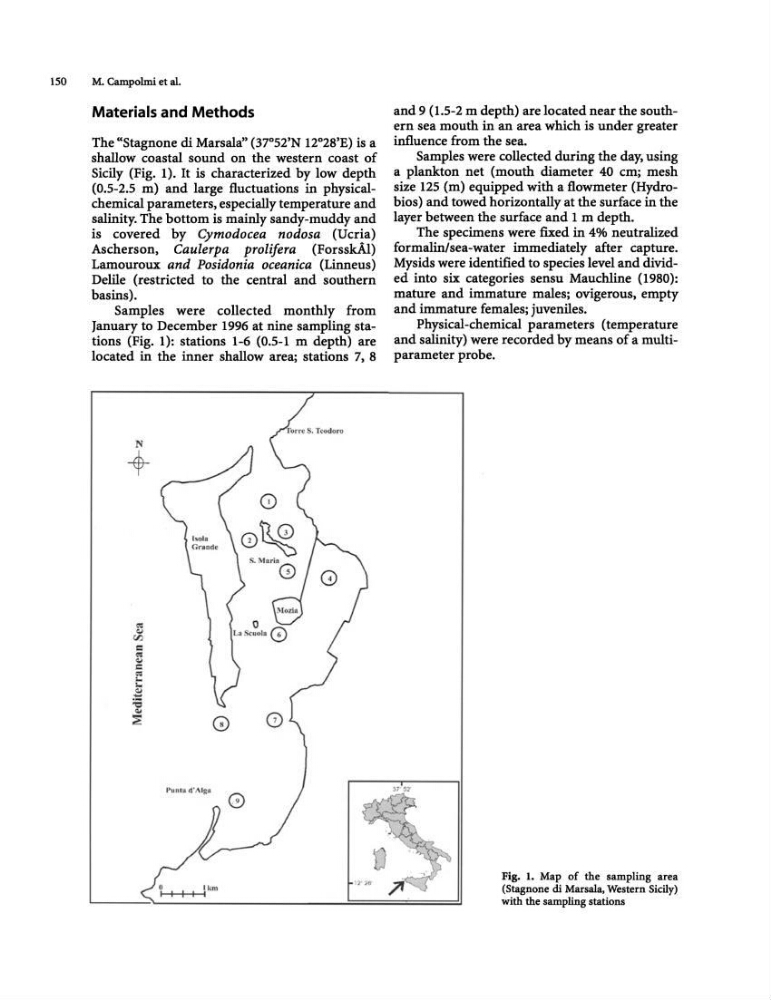
Sicily (Fig. 1). It is characterized by low depth
(0.5-2.5 m) and large fluctuations in physicalchemical parameters, especially temperature and
salinity. The bottom is mainly sandy-muddy and
is covered by Cymodocea nodosa (Ucria)
Ascherson, Caulerpa prolifera (ForsskAi)
Lamouroux and Posidonia oceanica (Linneus)
Delile (restricted to the central and southern
basins).
Samples were collected monthly from
January to December 1996 at nine sampling stations (Fig. 1): stations 1-6 (0.5-1 m depth) are
located in the inner shallow area; stations 7, 8
N
-+o
0~
~ . Marin
G)
PUJ1ta d'l\lga
and 9 (1.5-2 m depth) are located near the southern sea mouth in an area which is under greater
influence from the sea.
Samples were collected during the day, using
a plankton net (mouth diameter 40 cm; mesh
size 125 (m) equipped with a flowmeter (Hydrobios) and towed horizontally at the surface in the
layer between the surface and 1 m depth.
The specimens were fixed in 4% neutralized
formalin/sea-water immediately after capture.
Mysids were identified to species level and divided into six categories sensu Mauchline (1980):
mature and immature males; ovigerous, empty
and immature females; juveniles.
Physical-chemical parameters (temperature
and salinity) were recorded by means of a multiparameter probe.
Fig. 1. Map of the sampling area
(Stagnone di Marsala, Western Sicily)
with the sampling stations
M. Campolmi et al.
Materials and Methods
The "Stagnone di Marsala" (37°52'N 12°28'E) is a
shallow coastal sound on the western coast of
Sicily (Fig. 1). It is characterized by low depth
(0.5-2.5 m) and large fluctuations in physicalchemical parameters, especially temperature and
salinity. The bottom is mainly sandy-muddy and
is covered by Cymodocea nodosa (Ucria)
Ascherson, Caulerpa prolifera (ForsskAi)
Lamouroux and Posidonia oceanica (Linneus)
Delile (restricted to the central and southern
basins).
Samples were collected monthly from
January to December 1996 at nine sampling stations (Fig. 1): stations 1-6 (0.5-1 m depth) are
located in the inner shallow area; stations 7, 8
N
-+o
0~
~ . Marin
G)
PUJ1ta d'l\lga
and 9 (1.5-2 m depth) are located near the southern sea mouth in an area which is under greater
influence from the sea.
Samples were collected during the day, using
a plankton net (mouth diameter 40 cm; mesh
size 125 (m) equipped with a flowmeter (Hydrobios) and towed horizontally at the surface in the
layer between the surface and 1 m depth.
The specimens were fixed in 4% neutralized
formalin/sea-water immediately after capture.
Mysids were identified to species level and divided into six categories sensu Mauchline (1980):
mature and immature males; ovigerous, empty
and immature females; juveniles.
Physical-chemical parameters (temperature
and salinity) were recorded by means of a multiparameter probe.
Fig. 1. Map of the sampling area
(Stagnone di Marsala, Western Sicily)
with the sampling stations