

152
M. Campolmi et al.
350
lOO
Z50
-5 200
8
~ 150
100
so
100
90
80
70
oPI
s 60
g 50
-=
40
30
20
10
0
-
Sop 0", Nov o.c
-
(N.:.sopodopnt dobMn I
-e
8
S .5
- -
8
"
]
,.0
140
120
100
90
60
40
20
O~~~~~~~~~~~~==~~~
120
100
~O
60
40
20
0
Jan Mar ~ M.y JIiJ\ Jut Aug Sop 0<1 Nov 0.,
OJ
* M(i)
• (e)
IMys~ap'HS'glbb(Jsa I
Wl II M(m)
FCi)
• FCo)
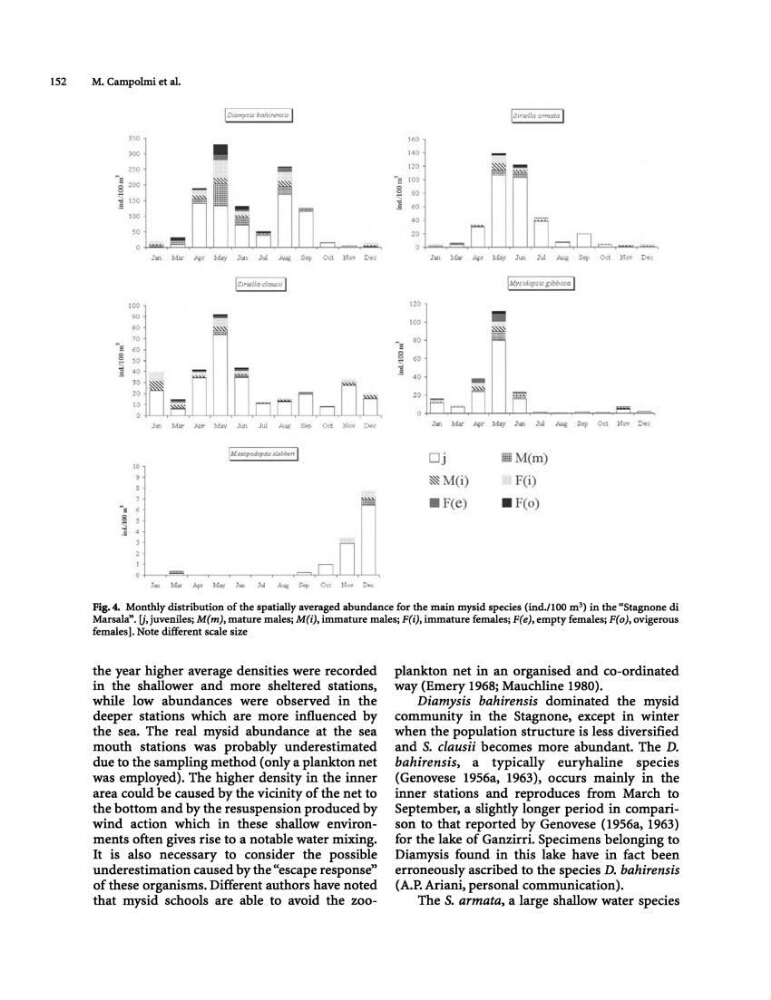
Fig.4. Monthly distribution of the spatially averaged abundance for the main mysid species (ind./IOO m 3 ) in the "Stagnone di
Marsala". U. juveniles; M(m), mature males; M(i), immature males; F(i), immature females; F(e), empty females; F( 0), ovigerous
females]. Note different scale size
the year higher average densities were recorded
in the shallower and more sheltered stations,
while low abundances were observed in the
deeper stations which are more influenced by
the sea. The real mysid abundance at the sea
mouth stations was probably underestimated
due to the sampling method (only a plankton net
was employed). The higher density in the inner
area could be caused by the vicinity of the net to
the bottom and by the resuspension produced by
wind action which in these shallow environments often gives rise to a notable water mixing.
It is also necessary to consider the possible
underestimation caused by the "escape response"
of these organisms. Different authors have noted
that mysid schools are able to avoid the zooplankton net in an organised and co-ordinated
way (Emery 1968; Mauchline 1980).
Diamysis bahirensis dominated the mysid
community in the Stagnone, except in winter
when the population structure is less diversified
and S. clausii becomes more abundant. The D.
bahirensis, a typically euryhaline species
(Genovese 1956a, 1963), occurs mainly in the
inner stations and reproduces from March to
September, a slightly longer period in comparison to that reported by Genovese (1956a, 1963)
for the lake of Ganzirri. Specimens belonging to
Diamysis found in this lake have in fact been
erroneously ascribed to the species D. bahirensis
(A.P. Ariani, personal communication).
The S. armata, a large shallow water species
M. Campolmi et al.
350
lOO
Z50
-5 200
8
~ 150
100
so
100
90
80
70
oPI
s 60
g 50
-=
40
30
20
10
0
-
Sop 0", Nov o.c
-
(N.:.sopodopnt dobMn I
-e
8
S .5
- -
8
"
]
,.0
140
120
100
90
60
40
20
O~~~~~~~~~~~~==~~~
120
100
~O
60
40
20
0
Jan Mar ~ M.y JIiJ\ Jut Aug Sop 0<1 Nov 0.,
OJ
* M(i)
• (e)
IMys~ap'HS'glbb(Jsa I
Wl II M(m)
FCi)
• FCo)
Fig.4. Monthly distribution of the spatially averaged abundance for the main mysid species (ind./IOO m 3 ) in the "Stagnone di
Marsala". U. juveniles; M(m), mature males; M(i), immature males; F(i), immature females; F(e), empty females; F( 0), ovigerous
females]. Note different scale size
the year higher average densities were recorded
in the shallower and more sheltered stations,
while low abundances were observed in the
deeper stations which are more influenced by
the sea. The real mysid abundance at the sea
mouth stations was probably underestimated
due to the sampling method (only a plankton net
was employed). The higher density in the inner
area could be caused by the vicinity of the net to
the bottom and by the resuspension produced by
wind action which in these shallow environments often gives rise to a notable water mixing.
It is also necessary to consider the possible
underestimation caused by the "escape response"
of these organisms. Different authors have noted
that mysid schools are able to avoid the zooplankton net in an organised and co-ordinated
way (Emery 1968; Mauchline 1980).
Diamysis bahirensis dominated the mysid
community in the Stagnone, except in winter
when the population structure is less diversified
and S. clausii becomes more abundant. The D.
bahirensis, a typically euryhaline species
(Genovese 1956a, 1963), occurs mainly in the
inner stations and reproduces from March to
September, a slightly longer period in comparison to that reported by Genovese (1956a, 1963)
for the lake of Ganzirri. Specimens belonging to
Diamysis found in this lake have in fact been
erroneously ascribed to the species D. bahirensis
(A.P. Ariani, personal communication).
The S. armata, a large shallow water species