

Diversity and Vertical Migration of Euphausiids (Straits of Messina)
135
Species Composition and Abundance
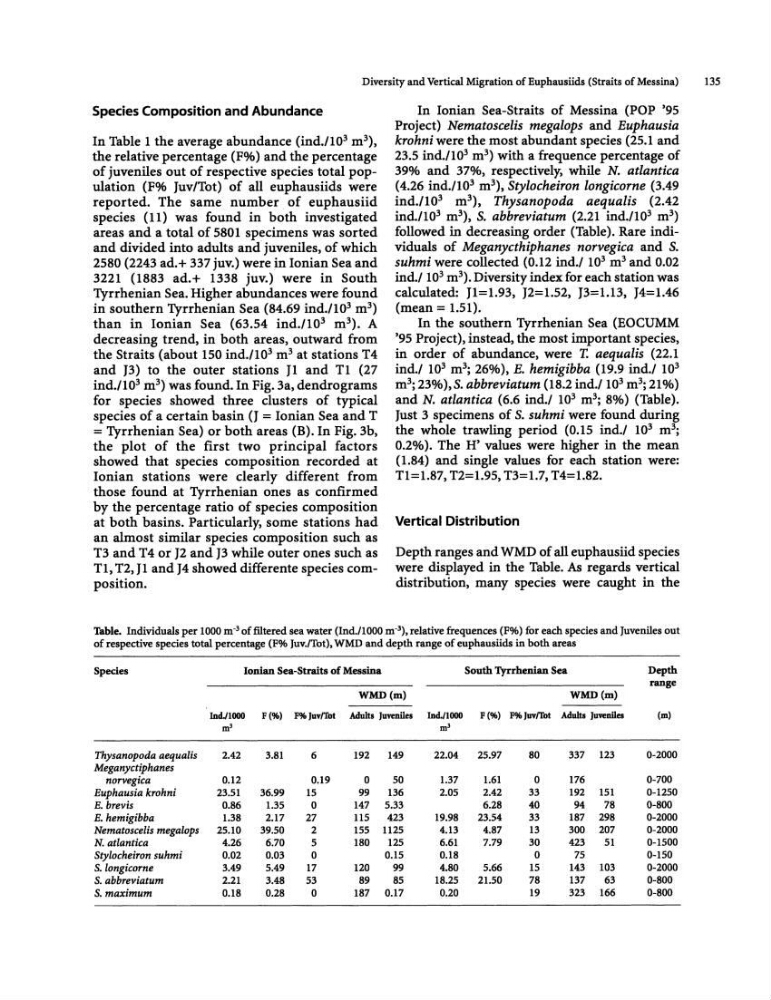
In Table 1 the average abundance (ind.110 3 m 3 ),
the relative percentage (F%) and the percentage
of juveniles out of respective species total population (F% Juv!Tot) of all euphausiids were
reported. The same number. of euphausiid
species (11) was found in both investigated
areas and a total of 5801 specimens was sorted
and divided into adults and juveniles, of which
2580 (2243 ad.+ 337 juv.) were in Ionian Sea and
3221 (1883 ad.+ 1338 juv.) were in South
Tyrrhenian Sea. Higher abundances were found
in southern Tyrrhenian Sea (84.69 ind.110 3 m 3 )
than in Ionian Sea (63.54 ind.110 3 m 3 ). A
decreasing trend, in both areas, outward from
the Straits (about 150 ind./l0 3 m 3 at stations T4
and J3) to the outer stations Jl and Tl (27
ind./10 3 m 3 ) was found. In Fig. 3a, dendrograms
for species showed three dusters of typical
species of a certain basin (J = Ionian Sea and T
= Tyrrhenian Sea) or both areas (B). In Fig. 3b,
the plot of the first two principal factors
showed that species composition recorded at
Ionian stations were clearly different from
those found at Tyrrhenian ones as confirmed
by the percentage ratio of species composition
at both basins. Particularly, some stations had
an almost similar species composition such as
T3 and T4 or J2 and J3 while outer ones such as
Tl, T2. Jl and J4 showed differente species composition.
In Ionian Sea-Straits of Messina (POP '9S
Project) Nematoscelis megalops and EuphaUSia
krohni were the most abundant species (25.1 and
23.5 ind./103 m 3 ) with a frequence percentage of
39% and 37%, respectively, while N. atlantica
(4.26 ind.1103 m 3 ), Stylocheiron longicorne (3.49
ind./103 m 3 ), Thysanopoda aequalis (2.42
ind./10 3 m 3 ), S. abbreviatum (2.21 ind.1103 m 3 )
followed in decreasing order (Table). Rare individuals of Meganycthiphanes norvegica and S.
suhmi were collected (0.12 ind./l0 3 m 3 and 0.02
ind.l 10 3 m 3 ). Diversity index for each station was
calculated: J1=1.93, }2=1.52, J3=1.13, }4=1.46
(mean = LSI).
In the southern Tyrrhenian Sea (EOCUMM
'95 Project), instead, the most important species.
in order of abundance, were T. aequalis (22.1
ind./ 10 3 m 3 ; 26%), E. hemigibba (19.9 ind./ 10 3
m 3 ; 23%),S. abbreviatum (18.2 ind./10 3 m 3 ; 21 %)
and N. atlantica (6.6 ind.! 10 3 m 3 ; 8%) (Table).
Just 3 specimens of S. suhmi were found during
the whole trawling period (0.15 ind./ 10 3 m 3 ;
0.2%). The H' values were higher in the mean
(1.84) and single values for each station were:
T1=1.87, T2=1.95, T3=1.7, T4=1.82.
Vertical Distribution
Depth ranges and WMD of all euphausiid species
were displayed in the Table. As regards vertical
distribution, many species were caught in the
Table. Individuals per 1000 m- 3 of filtered sea water (Ind.JlOOO m- 3 ), relative frequences (F%) for each species and Juveniles out
of respective species total percentage (F% Juv./Tht), WMD and depth range of euphausiids in both areas
Species
Ionian Sea-Straits of Messina
South Tyrrhenian Sea
Depth
range
WMD(m)
WMD(m)
IndJl000
F('II»
F%Juv/Tot
Adults Juveniles IndJlOOO
F('II» F%Juvl1bt AcIults Juwniles
(m)
m'
m 3
Thysanopoda aequalis
2.42
3.81
6
192
149
22.04
25.97
80
337 123
0-2000
Meganyctiphanes
norvegica
0.12
0.19
0
50
1.37
1.61
0
176
0-700
Euphausia krohni
23.51
36.99
15
99
136
2.05
2.42
33
192 151
0-1250
E. brevis
0.86
1.35
0
147 5.33
6.28
40
94
78
0-800
E. hemigibba
1.38
2.17
27
115
423
19.98
23.54
33
187 298
0-2000
Nematoscelis megalops
25.10
39.50
2
155 1125
4.13
4.87
13
300 207
0-2000
N. atlantica
4.26
6.70
5
180
125
6.61
7.79
30
423
51
0-1500
Stylocheiron 5uhmi
0.02
0.03
0
0.15
0.18
0
75
0-150
S. longicorne
3.49
5.49
17
120
99
4.80
5.66
15
143 103
0-2000
S. abbreviatum
2.21
3.48
53
89
85
18.25
21.50
78
137
63
0-800
S.maximum
0.18
0.28
0
187 0.17
0.20
19
323 166
0-800
135
Species Composition and Abundance
In Table 1 the average abundance (ind.110 3 m 3 ),
the relative percentage (F%) and the percentage
of juveniles out of respective species total population (F% Juv!Tot) of all euphausiids were
reported. The same number. of euphausiid
species (11) was found in both investigated
areas and a total of 5801 specimens was sorted
and divided into adults and juveniles, of which
2580 (2243 ad.+ 337 juv.) were in Ionian Sea and
3221 (1883 ad.+ 1338 juv.) were in South
Tyrrhenian Sea. Higher abundances were found
in southern Tyrrhenian Sea (84.69 ind.110 3 m 3 )
than in Ionian Sea (63.54 ind.110 3 m 3 ). A
decreasing trend, in both areas, outward from
the Straits (about 150 ind./l0 3 m 3 at stations T4
and J3) to the outer stations Jl and Tl (27
ind./10 3 m 3 ) was found. In Fig. 3a, dendrograms
for species showed three dusters of typical
species of a certain basin (J = Ionian Sea and T
= Tyrrhenian Sea) or both areas (B). In Fig. 3b,
the plot of the first two principal factors
showed that species composition recorded at
Ionian stations were clearly different from
those found at Tyrrhenian ones as confirmed
by the percentage ratio of species composition
at both basins. Particularly, some stations had
an almost similar species composition such as
T3 and T4 or J2 and J3 while outer ones such as
Tl, T2. Jl and J4 showed differente species composition.
In Ionian Sea-Straits of Messina (POP '9S
Project) Nematoscelis megalops and EuphaUSia
krohni were the most abundant species (25.1 and
23.5 ind./103 m 3 ) with a frequence percentage of
39% and 37%, respectively, while N. atlantica
(4.26 ind.1103 m 3 ), Stylocheiron longicorne (3.49
ind./103 m 3 ), Thysanopoda aequalis (2.42
ind./10 3 m 3 ), S. abbreviatum (2.21 ind.1103 m 3 )
followed in decreasing order (Table). Rare individuals of Meganycthiphanes norvegica and S.
suhmi were collected (0.12 ind./l0 3 m 3 and 0.02
ind.l 10 3 m 3 ). Diversity index for each station was
calculated: J1=1.93, }2=1.52, J3=1.13, }4=1.46
(mean = LSI).
In the southern Tyrrhenian Sea (EOCUMM
'95 Project), instead, the most important species.
in order of abundance, were T. aequalis (22.1
ind./ 10 3 m 3 ; 26%), E. hemigibba (19.9 ind./ 10 3
m 3 ; 23%),S. abbreviatum (18.2 ind./10 3 m 3 ; 21 %)
and N. atlantica (6.6 ind.! 10 3 m 3 ; 8%) (Table).
Just 3 specimens of S. suhmi were found during
the whole trawling period (0.15 ind./ 10 3 m 3 ;
0.2%). The H' values were higher in the mean
(1.84) and single values for each station were:
T1=1.87, T2=1.95, T3=1.7, T4=1.82.
Vertical Distribution
Depth ranges and WMD of all euphausiid species
were displayed in the Table. As regards vertical
distribution, many species were caught in the
Table. Individuals per 1000 m- 3 of filtered sea water (Ind.JlOOO m- 3 ), relative frequences (F%) for each species and Juveniles out
of respective species total percentage (F% Juv./Tht), WMD and depth range of euphausiids in both areas
Species
Ionian Sea-Straits of Messina
South Tyrrhenian Sea
Depth
range
WMD(m)
WMD(m)
IndJl000
F('II»
F%Juv/Tot
Adults Juveniles IndJlOOO
F('II» F%Juvl1bt AcIults Juwniles
(m)
m'
m 3
Thysanopoda aequalis
2.42
3.81
6
192
149
22.04
25.97
80
337 123
0-2000
Meganyctiphanes
norvegica
0.12
0.19
0
50
1.37
1.61
0
176
0-700
Euphausia krohni
23.51
36.99
15
99
136
2.05
2.42
33
192 151
0-1250
E. brevis
0.86
1.35
0
147 5.33
6.28
40
94
78
0-800
E. hemigibba
1.38
2.17
27
115
423
19.98
23.54
33
187 298
0-2000
Nematoscelis megalops
25.10
39.50
2
155 1125
4.13
4.87
13
300 207
0-2000
N. atlantica
4.26
6.70
5
180
125
6.61
7.79
30
423
51
0-1500
Stylocheiron 5uhmi
0.02
0.03
0
0.15
0.18
0
75
0-150
S. longicorne
3.49
5.49
17
120
99
4.80
5.66
15
143 103
0-2000
S. abbreviatum
2.21
3.48
53
89
85
18.25
21.50
78
137
63
0-800
S.maximum
0.18
0.28
0
187 0.17
0.20
19
323 166
0-800