

168
5 Spatial and Temporal Distribution Patterns
Their numbers were higher in the trap samples in April to June, whereas the sediment core samples recorded higher numbers in September.
Along the transect on the Swinnplate, a high number of small crabs (about
30 mm in size) was recorded with the traps in April and May at the sandflat sites.
Numbers were lower in and around the mussel bed, only larger females occurred
here in July and August. In 1995, very small shore crabs « 15 mm in size) were
more abundant in the mussel bed. Here, a total of 478 crabs was recorded with the
sediment core samples compared to only 9 crabs of this size range on the sandf1at.
400
300
100
0
0
l{)
0
l{)
C\J
";J
cry
cry
to
I
I
......
c.o
......
C\J
C\J
cry
Intertidal 1995
0
l{)
0
"'
I
I
cD
c.o cry
"'
l{)
l{)
I
......
l{)
Dmales
Dfemales
• ovigerous females
0
l{)
0
l{)
c.o
<9
r-:cD
cD
......
......
l{)
c.o
c.o
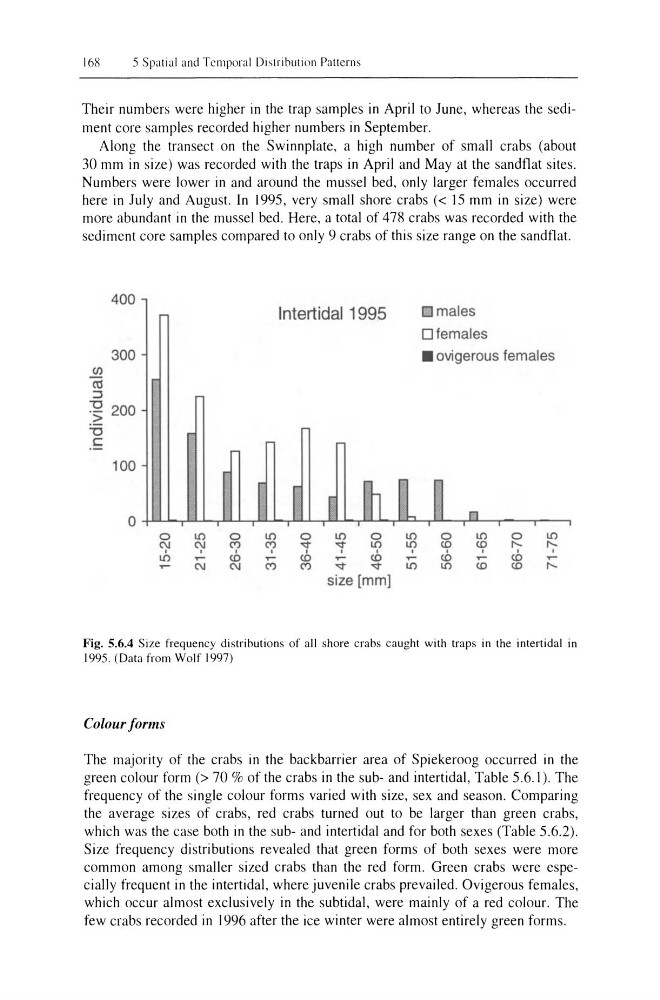
I'Fig. 5.6.4 Size frequency distrihutions of all shore crabs caught with traps in the intertidal in
1995. (Data from Wolf 1997)
Colour forms
The majority of the crabs in the backbarrier area of Spiekeroog occurred in the
green colour form (> 70 % of the crabs in the sub- and intertidal, Table 5.6.1). The
frequency of the single colour forms varied with size, sex and season. Comparing
the average sizes of crabs, red crabs turned out to be larger than green crabs,
which was the case both in the sub- and intertidal and for both sexes (Table 5.6.2).
Size frequency distributions revealed that green forms of both sexes were more
common among smaller sized crabs than the red form. Green crabs were especially frequent in the intertidal, where juvenile crabs prevailed. Ovigerous females,
which occur almost exclusively in the subtidal, were mainly of a red colour. The
few crabs recorded in 1996 after the ice winter were almost entirely green forms.
5 Spatial and Temporal Distribution Patterns
Their numbers were higher in the trap samples in April to June, whereas the sediment core samples recorded higher numbers in September.
Along the transect on the Swinnplate, a high number of small crabs (about
30 mm in size) was recorded with the traps in April and May at the sandflat sites.
Numbers were lower in and around the mussel bed, only larger females occurred
here in July and August. In 1995, very small shore crabs « 15 mm in size) were
more abundant in the mussel bed. Here, a total of 478 crabs was recorded with the
sediment core samples compared to only 9 crabs of this size range on the sandf1at.
400
300
100
0
0
l{)
0
l{)
C\J
";J
cry
cry
to
I
I
......
c.o
......
C\J
C\J
cry
Intertidal 1995
0
l{)
0
"'
I
I
cD
c.o cry
"'
l{)
l{)
I
......
l{)
Dmales
Dfemales
• ovigerous females
0
l{)
0
l{)
c.o
<9
r-:cD
cD
......
......
l{)
c.o
c.o
I'Fig. 5.6.4 Size frequency distrihutions of all shore crabs caught with traps in the intertidal in
1995. (Data from Wolf 1997)
Colour forms
The majority of the crabs in the backbarrier area of Spiekeroog occurred in the
green colour form (> 70 % of the crabs in the sub- and intertidal, Table 5.6.1). The
frequency of the single colour forms varied with size, sex and season. Comparing
the average sizes of crabs, red crabs turned out to be larger than green crabs,
which was the case both in the sub- and intertidal and for both sexes (Table 5.6.2).
Size frequency distributions revealed that green forms of both sexes were more
common among smaller sized crabs than the red form. Green crabs were especially frequent in the intertidal, where juvenile crabs prevailed. Ovigerous females,
which occur almost exclusively in the subtidal, were mainly of a red colour. The
few crabs recorded in 1996 after the ice winter were almost entirely green forms.