

67
3.3
Coastal Fishery Resources
and Tidal Flat Fauna
The tsunami subsidence and debris have obstructed
the recovery of ecosystems and fi sheries activity.
The fi shery resources, including benthos, planktons, and fauna in the coastal shallow sea areas,
tidal fl ats, and lower rivers in Miyagi Prefecture,
have been monitored to understand the recovering
processes of the coastal ecosystems.
Large amount of debris are still found in the
coastal zone near Yamamoto in Miyagi
Prefecture. Accordingly, it will be hard to catch
bivalves, such as the surf clam Pseudocardium
sachalinensis , from the sea bottom in these areas.
3.4
Feature of Aquacultural
Environment and Innovation
of Aquaculture
The massive tsunami caused extensive damage to
aquacultural facilities for fi sh and shellfi sh culture. The effi cient production of aquacultural
species, such as oysters and scallops, has been
studied for rebuilding aquacultural cultivation
systems.
A single seed experiment with oysters with a
fl oating upweller system, “FLUPSY,” has been
used for intermediate culture in Ogatsu Bay in
Miyagi Prefecture and Yamada Bay in Iwate
Prefecture. High growth and survival rates were
observed in spat oyster cultures by this
FLUPSY.
The changes in the features of bottom materials,
such as the levels of chemicals, in Onagawa Bay in
Miyagi Prefecture have been measured. The levels
of chemical contaminants, such as extracts from
the bottom sediment with organic solvents
(n-hexane or methyl alcohol) in the entrance and
the middle areas of Onagawa Bay, have decreased.
However, the changing patterns of the levels of
these extracts from the bottom sediment from
Onagawa Bay appear to be variable. The several
extracts from the bottom sediment of Onagawa
Bay with organic solvents showed an inhibitory
effect for cultured mammalian cell. Several chemical compounds, such as polycyclic aromatic hydrocarbons (PAHs), have been detected in the bottom
sediment from Onagawa Bay. But the origins and
levels of PAHs are still unknown and further studies should be needed (Yamaguchi et al. 2014 ).
3.5
Coastal Environment
and Marine Resources
in the Southern Part of Iwate
Prefecture
Periodic water quality and biological feature
changes have been observed in Okirai Bay and
Ofunato Bay in southern Iwate Prefecture. The
genetic structures of the Yezo abalone Nordotis
discus hannai , Japanese common sea cucumber
Apostichopus japonicus , and northern sea urchin
Strongylocentrotus nudus , from the perspective
of natural population genetics, have also been
determined.
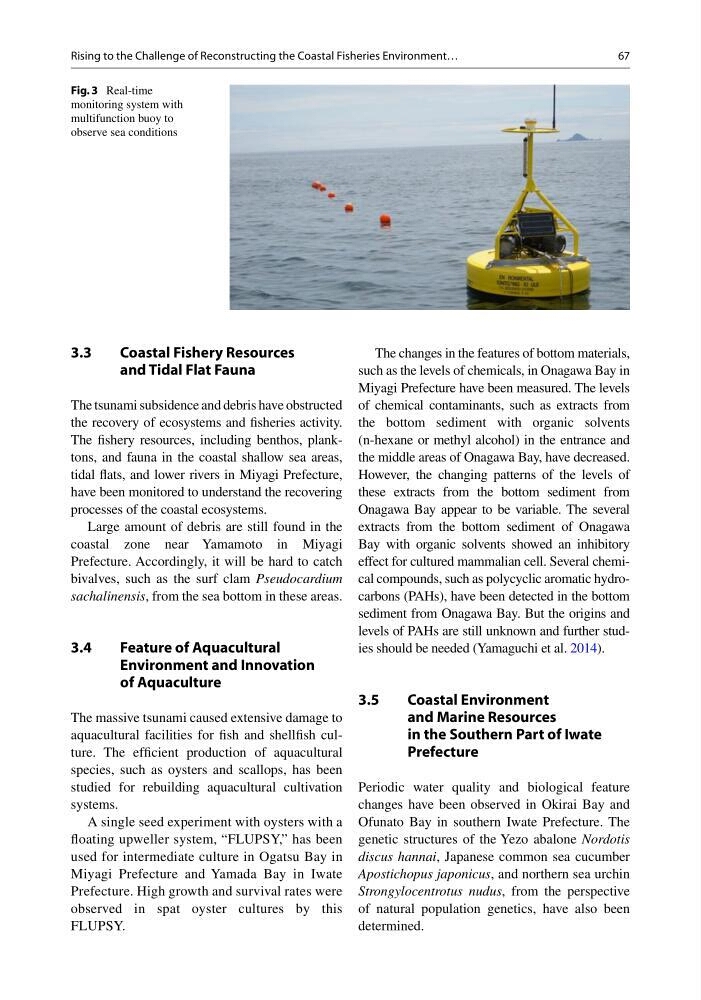
Fig. 3 Real-time
monitoring system with
multifunction buoy to
observe sea conditions
Rising to the Challenge of Reconstructing the Coastal Fisheries Environment…
3.3
Coastal Fishery Resources
and Tidal Flat Fauna
The tsunami subsidence and debris have obstructed
the recovery of ecosystems and fi sheries activity.
The fi shery resources, including benthos, planktons, and fauna in the coastal shallow sea areas,
tidal fl ats, and lower rivers in Miyagi Prefecture,
have been monitored to understand the recovering
processes of the coastal ecosystems.
Large amount of debris are still found in the
coastal zone near Yamamoto in Miyagi
Prefecture. Accordingly, it will be hard to catch
bivalves, such as the surf clam Pseudocardium
sachalinensis , from the sea bottom in these areas.
3.4
Feature of Aquacultural
Environment and Innovation
of Aquaculture
The massive tsunami caused extensive damage to
aquacultural facilities for fi sh and shellfi sh culture. The effi cient production of aquacultural
species, such as oysters and scallops, has been
studied for rebuilding aquacultural cultivation
systems.
A single seed experiment with oysters with a
fl oating upweller system, “FLUPSY,” has been
used for intermediate culture in Ogatsu Bay in
Miyagi Prefecture and Yamada Bay in Iwate
Prefecture. High growth and survival rates were
observed in spat oyster cultures by this
FLUPSY.
The changes in the features of bottom materials,
such as the levels of chemicals, in Onagawa Bay in
Miyagi Prefecture have been measured. The levels
of chemical contaminants, such as extracts from
the bottom sediment with organic solvents
(n-hexane or methyl alcohol) in the entrance and
the middle areas of Onagawa Bay, have decreased.
However, the changing patterns of the levels of
these extracts from the bottom sediment from
Onagawa Bay appear to be variable. The several
extracts from the bottom sediment of Onagawa
Bay with organic solvents showed an inhibitory
effect for cultured mammalian cell. Several chemical compounds, such as polycyclic aromatic hydrocarbons (PAHs), have been detected in the bottom
sediment from Onagawa Bay. But the origins and
levels of PAHs are still unknown and further studies should be needed (Yamaguchi et al. 2014 ).
3.5
Coastal Environment
and Marine Resources
in the Southern Part of Iwate
Prefecture
Periodic water quality and biological feature
changes have been observed in Okirai Bay and
Ofunato Bay in southern Iwate Prefecture. The
genetic structures of the Yezo abalone Nordotis
discus hannai , Japanese common sea cucumber
Apostichopus japonicus , and northern sea urchin
Strongylocentrotus nudus , from the perspective
of natural population genetics, have also been
determined.
Fig. 3 Real-time
monitoring system with
multifunction buoy to
observe sea conditions
Rising to the Challenge of Reconstructing the Coastal Fisheries Environment…