

66
3
Studies on the Elucidation
of the Environmental
Change Process
in the Fishing Environment
by Tohoku University
Tohoku University is a representative institution
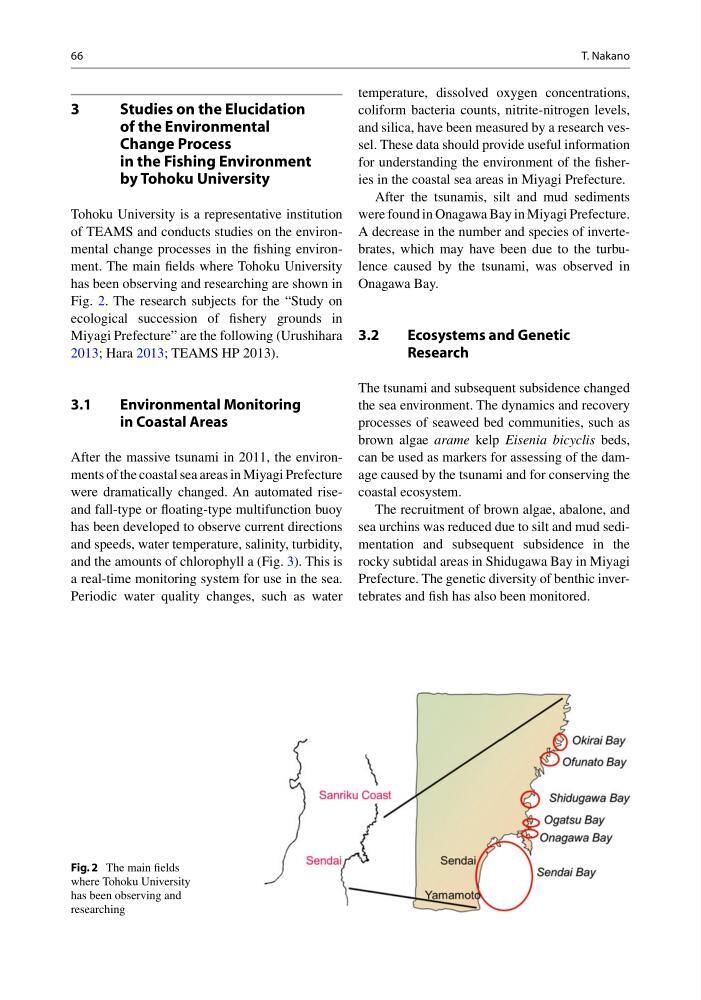
of TEAMS and conducts studies on the environmental change processes in the fi shing environment. The main fi elds where Tohoku University
has been observing and researching are shown in
Fig. 2 . The research subjects for the “Study on
ecological succession of fi shery grounds in
Miyagi Prefecture” are the following (Urushihara
2013 ; Hara 2013 ; TEAMS HP 2013).
3.1
Environmental Monitoring
in Coastal Areas
After the massive tsunami in 2011, the environments of the coastal sea areas in Miyagi Prefecture
were dramatically changed. An automated riseand fall-type or fl oating-type multifunction buoy
has been developed to observe current directions
and speeds, water temperature, salinity, turbidity,
and the amounts of chlorophyll a (Fig. 3 ). This is
a real-time monitoring system for use in the sea.
Periodic water quality changes, such as water
temperature, dissolved oxygen concentrations,
coliform bacteria counts, nitrite-nitrogen levels,
and silica, have been measured by a research vessel. These data should provide useful information
for understanding the environment of the fi sheries in the coastal sea areas in Miyagi Prefecture.
After the tsunamis, silt and mud sediments
were found in Onagawa Bay in Miyagi Prefecture.
A decrease in the number and species of invertebrates, which may have been due to the turbulence caused by the tsunami, was observed in
Onagawa Bay.
3.2
Ecosystems and Genetic
Research
The tsunami and subsequent subsidence changed
the sea environment. The dynamics and recovery
processes of seaweed bed communities, such as
brown algae arame kelp Eisenia bicyclis beds,
can be used as markers for assessing of the damage caused by the tsunami and for conserving the
coastal ecosystem.
The recruitment of brown algae, abalone, and
sea urchins was reduced due to silt and mud sedimentation and subsequent subsidence in the
rocky subtidal areas in Shidugawa Bay in Miyagi
Prefecture. The genetic diversity of benthic invertebrates and fi sh has also been monitored.
Fig. 2 The main fi elds
where Tohoku University
has been observing and
researching
T. Nakano
3
Studies on the Elucidation
of the Environmental
Change Process
in the Fishing Environment
by Tohoku University
Tohoku University is a representative institution
of TEAMS and conducts studies on the environmental change processes in the fi shing environment. The main fi elds where Tohoku University
has been observing and researching are shown in
Fig. 2 . The research subjects for the “Study on
ecological succession of fi shery grounds in
Miyagi Prefecture” are the following (Urushihara
2013 ; Hara 2013 ; TEAMS HP 2013).
3.1
Environmental Monitoring
in Coastal Areas
After the massive tsunami in 2011, the environments of the coastal sea areas in Miyagi Prefecture
were dramatically changed. An automated riseand fall-type or fl oating-type multifunction buoy
has been developed to observe current directions
and speeds, water temperature, salinity, turbidity,
and the amounts of chlorophyll a (Fig. 3 ). This is
a real-time monitoring system for use in the sea.
Periodic water quality changes, such as water
temperature, dissolved oxygen concentrations,
coliform bacteria counts, nitrite-nitrogen levels,
and silica, have been measured by a research vessel. These data should provide useful information
for understanding the environment of the fi sheries in the coastal sea areas in Miyagi Prefecture.
After the tsunamis, silt and mud sediments
were found in Onagawa Bay in Miyagi Prefecture.
A decrease in the number and species of invertebrates, which may have been due to the turbulence caused by the tsunami, was observed in
Onagawa Bay.
3.2
Ecosystems and Genetic
Research
The tsunami and subsequent subsidence changed
the sea environment. The dynamics and recovery
processes of seaweed bed communities, such as
brown algae arame kelp Eisenia bicyclis beds,
can be used as markers for assessing of the damage caused by the tsunami and for conserving the
coastal ecosystem.
The recruitment of brown algae, abalone, and
sea urchins was reduced due to silt and mud sedimentation and subsequent subsidence in the
rocky subtidal areas in Shidugawa Bay in Miyagi
Prefecture. The genetic diversity of benthic invertebrates and fi sh has also been monitored.
Fig. 2 The main fi elds
where Tohoku University
has been observing and
researching
T. Nakano