

47
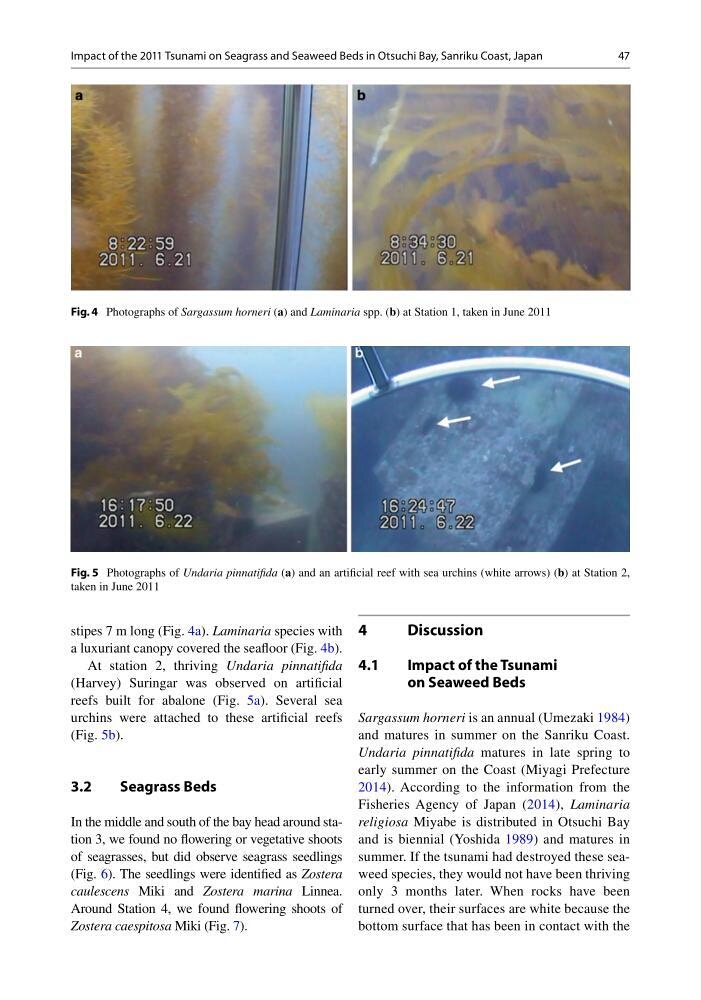
stipes 7 m long (Fig. 4a ). Laminaria species with
a luxuriant canopy covered the seafl oor (Fig. 4b ).
At station 2, thriving Undaria pinnatifi da
(Harvey) Suringar was observed on artifi cial
reefs built for abalone (Fig. 5a ). Several sea
urchins were attached to these artifi cial reefs
(Fig. 5b ).
3.2
Seagrass Beds
In the middle and south of the bay head around station 3, we found no fl owering or vegetative shoots
of seagrasses, but did observe seagrass seedlings
(Fig. 6 ). The seedlings were identifi ed as Zostera
caulescens Miki and Zostera marina Linnea.
Around Station 4, we found fl owering shoots of
Zostera caespitosa Miki (Fig. 7 ).
4
Discussion
4.1
Impact of the Tsunami
on Seaweed Beds
Sargassum horneri is an annual (Umezaki 1984 )
and matures in summer on the Sanriku Coast.
Undaria pinnatifi da matures in late spring to
early summer on the Coast (Miyagi Prefecture
2014 ). According to the information from the
Fisheries Agency of Japan ( 2014 ), Laminaria
religiosa Miyabe is distributed in Otsuchi Bay
and is biennial (Yoshida 1989 ) and matures in
summer. If the tsunami had destroyed these seaweed species, they would not have been thriving
only 3 months later. When rocks have been
turned over, their surfaces are white because the
bottom surface that has been in contact with the
Fig. 4 Photographs of Sargassum horneri ( a ) and Laminaria spp. ( b ) at Station 1, taken in June 2011
Fig. 5 Photographs of Undaria pinnatifi da ( a ) and an artifi cial reef with sea urchins (white arrows) ( b ) at Station 2,
taken in June 2011
Impact of the 2011 Tsunami on Seagrass and Seaweed Beds in Otsuchi Bay, Sanriku Coast, Japan
stipes 7 m long (Fig. 4a ). Laminaria species with
a luxuriant canopy covered the seafl oor (Fig. 4b ).
At station 2, thriving Undaria pinnatifi da
(Harvey) Suringar was observed on artifi cial
reefs built for abalone (Fig. 5a ). Several sea
urchins were attached to these artifi cial reefs
(Fig. 5b ).
3.2
Seagrass Beds
In the middle and south of the bay head around station 3, we found no fl owering or vegetative shoots
of seagrasses, but did observe seagrass seedlings
(Fig. 6 ). The seedlings were identifi ed as Zostera
caulescens Miki and Zostera marina Linnea.
Around Station 4, we found fl owering shoots of
Zostera caespitosa Miki (Fig. 7 ).
4
Discussion
4.1
Impact of the Tsunami
on Seaweed Beds
Sargassum horneri is an annual (Umezaki 1984 )
and matures in summer on the Sanriku Coast.
Undaria pinnatifi da matures in late spring to
early summer on the Coast (Miyagi Prefecture
2014 ). According to the information from the
Fisheries Agency of Japan ( 2014 ), Laminaria
religiosa Miyabe is distributed in Otsuchi Bay
and is biennial (Yoshida 1989 ) and matures in
summer. If the tsunami had destroyed these seaweed species, they would not have been thriving
only 3 months later. When rocks have been
turned over, their surfaces are white because the
bottom surface that has been in contact with the
Fig. 4 Photographs of Sargassum horneri ( a ) and Laminaria spp. ( b ) at Station 1, taken in June 2011
Fig. 5 Photographs of Undaria pinnatifi da ( a ) and an artifi cial reef with sea urchins (white arrows) ( b ) at Station 2,
taken in June 2011
Impact of the 2011 Tsunami on Seagrass and Seaweed Beds in Otsuchi Bay, Sanriku Coast, Japan