

48
seafl oor is neither covered with seaweed nor are
any animals attached. Because phytal organisms
cannot grow on the bottom surface of an artifi -
cial reef, a clean surface would suggest that the
artifi cial reef had been overturned. However, we
observed no clean surfaces in the rocks and artifi cial reefs and, hence, no evidence for their
rolling by the tsunami. Thus, we concluded that
the tsunami had no signifi cant impact on the
seaweeds around the coast of the mouth and
middle of the bay. The reasons for this are as
follows: (1) the rocks or rock plates that acted as
substrates for seaweeds were suffi ciently heavy
to remain unmoved by the tsunami; (2) the seaweeds were suffi ciently small and fl exible in
March before the onset of summer, their maturation season, to not be removed by the tsunami;
(3) since the seaweed beds were distributed
close to the deep and steep seafl oor around the
coast of the middle and mouth of the ria bays,
the tsunami had not yet formed high waves due
to the considerable water depth, which is supported by the observation of one of the students
staying at the International Centre for Coastal
Oceanography of the University of Tokyo
located on the coast near the centre of Otsuchi
Bay, who saw that the sea level rose and fell
slowly during the tsunami (Kokubu, personal
communication)—the shallower the water
depth, the higher the wave formed (Japan
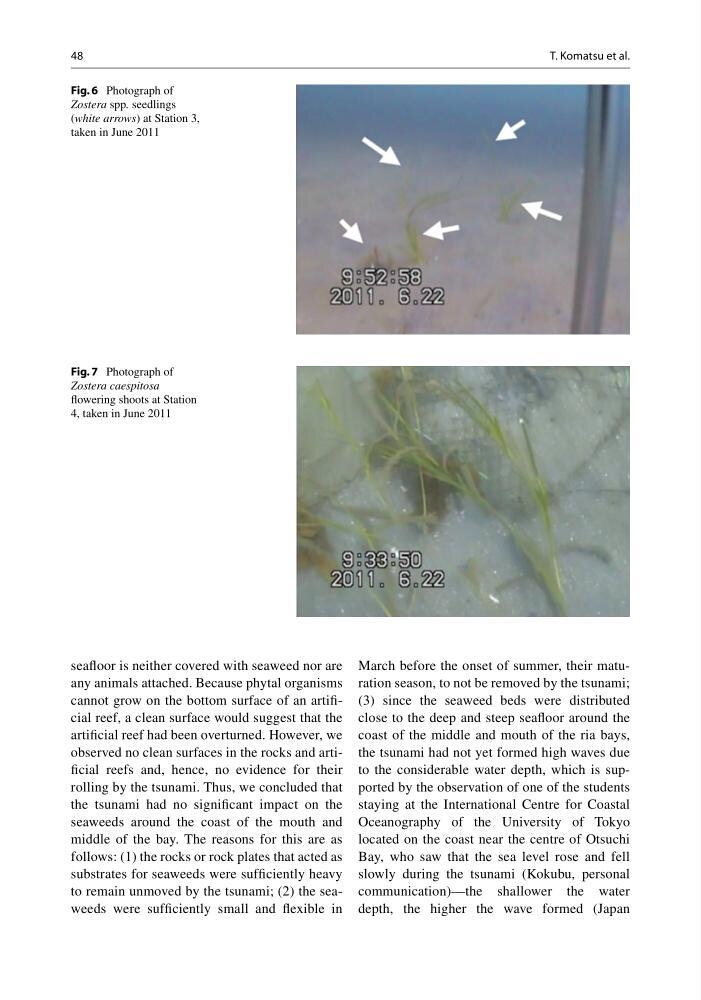
Fig. 6 Photograph of
Zostera spp . seedlings
( white arrows ) at Station 3,
taken in June 2011
Fig. 7 Photograph of
Zostera caespitosa
fl owering shoots at Station
4, taken in June 2011
T. Komatsu et al.
seafl oor is neither covered with seaweed nor are
any animals attached. Because phytal organisms
cannot grow on the bottom surface of an artifi -
cial reef, a clean surface would suggest that the
artifi cial reef had been overturned. However, we
observed no clean surfaces in the rocks and artifi cial reefs and, hence, no evidence for their
rolling by the tsunami. Thus, we concluded that
the tsunami had no signifi cant impact on the
seaweeds around the coast of the mouth and
middle of the bay. The reasons for this are as
follows: (1) the rocks or rock plates that acted as
substrates for seaweeds were suffi ciently heavy
to remain unmoved by the tsunami; (2) the seaweeds were suffi ciently small and fl exible in
March before the onset of summer, their maturation season, to not be removed by the tsunami;
(3) since the seaweed beds were distributed
close to the deep and steep seafl oor around the
coast of the middle and mouth of the ria bays,
the tsunami had not yet formed high waves due
to the considerable water depth, which is supported by the observation of one of the students
staying at the International Centre for Coastal
Oceanography of the University of Tokyo
located on the coast near the centre of Otsuchi
Bay, who saw that the sea level rose and fell
slowly during the tsunami (Kokubu, personal
communication)—the shallower the water
depth, the higher the wave formed (Japan
Fig. 6 Photograph of
Zostera spp . seedlings
( white arrows ) at Station 3,
taken in June 2011
Fig. 7 Photograph of
Zostera caespitosa
fl owering shoots at Station
4, taken in June 2011
T. Komatsu et al.