

277
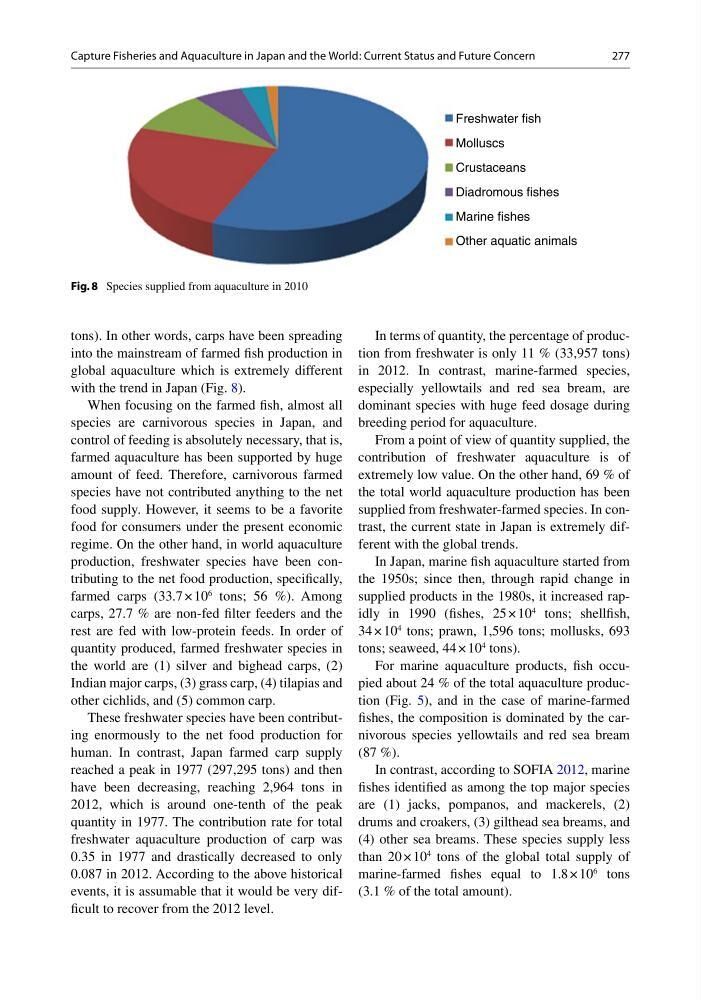
tons). In other words, carps have been spreading
into the mainstream of farmed fish production in
global aquaculture which is extremely different
with the trend in Japan (Fig. 8).
When focusing on the farmed fish, almost all
species are carnivorous species in Japan, and
control of feeding is absolutely necessary, that is,
farmed aquaculture has been supported by huge
amount of feed. Therefore, carnivorous farmed
species have not contributed anything to the net
food supply. However, it seems to be a favorite
food for consumers under the present economic
regime. On the other hand, in world aquaculture
production, freshwater species have been contributing to the net food production, specifically,
farmed carps (33.7 × 10
6
tons; 56 %). Among
carps, 27.7 % are non-fed filter feeders and the
rest are fed with low-protein feeds. In order of
quantity produced, farmed freshwater species in
the world are (1) silver and bighead carps, (2)
Indian major carps, (3) grass carp, (4) tilapias and
other cichlids, and (5) common carp.
These freshwater species have been contributing enormously to the net food production for
human. In contrast, Japan farmed carp supply
reached a peak in 1977 (297,295 tons) and then
have been decreasing, reaching 2,964 tons in
2012, which is around one-tenth of the peak
quantity in 1977. The contribution rate for total
freshwater aquaculture production of carp was
0.35 in 1977 and drastically decreased to only
0.087 in 2012. According to the above historical
events, it is assumable that it would be very difficult to recover from the 2012 level.
In terms of quantity, the percentage of production from freshwater is only 11 % (33,957 tons)
in 2012. In contrast, marine-farmed species,
especially yellowtails and red sea bream, are
dominant species with huge feed dosage during
breeding period for aquaculture.
From a point of view of quantity supplied, the
contribution of freshwater aquaculture is of
extremely low value. On the other hand, 69 % of
the total world aquaculture production has been
supplied from freshwater-farmed species. In contrast, the current state in Japan is extremely different with the global trends.
In Japan, marine fish aquaculture started from
the 1950s; since then, through rapid change in
supplied products in the 1980s, it increased rapidly in 1990 (fishes, 25 × 10
4
tons; shellfish,
34 × 10
4
tons; prawn, 1,596 tons; mollusks, 693
tons; seaweed, 44 × 10
4
tons).
For marine aquaculture products, fish occupied about 24 % of the total aquaculture production (Fig. 5), and in the case of marine-farmed
fishes, the composition is dominated by the carnivorous species yellowtails and red sea bream
(87 %).
In contrast, according to SOFIA 2012, marine
fishes identified as among the top major species
are (1) jacks, pompanos, and mackerels, (2)
drums and croakers, (3) gilthead sea breams, and
(4) other sea breams. These species supply less
than 20 × 10
4
tons of the global total supply of
marine-farmed fishes equal to 1.8 × 10
6
tons
(3.1 % of the total amount).
Freshwater fish
Molluscs
Crustaceans
Diadromous fishes
Marine fishes
Other aquatic animals
Fig. 8 Species supplied from aquaculture in 2010
Capture Fisheries and Aquaculture in Japan and the World: Current Status and Future Concern
tons). In other words, carps have been spreading
into the mainstream of farmed fish production in
global aquaculture which is extremely different
with the trend in Japan (Fig. 8).
When focusing on the farmed fish, almost all
species are carnivorous species in Japan, and
control of feeding is absolutely necessary, that is,
farmed aquaculture has been supported by huge
amount of feed. Therefore, carnivorous farmed
species have not contributed anything to the net
food supply. However, it seems to be a favorite
food for consumers under the present economic
regime. On the other hand, in world aquaculture
production, freshwater species have been contributing to the net food production, specifically,
farmed carps (33.7 × 10
6
tons; 56 %). Among
carps, 27.7 % are non-fed filter feeders and the
rest are fed with low-protein feeds. In order of
quantity produced, farmed freshwater species in
the world are (1) silver and bighead carps, (2)
Indian major carps, (3) grass carp, (4) tilapias and
other cichlids, and (5) common carp.
These freshwater species have been contributing enormously to the net food production for
human. In contrast, Japan farmed carp supply
reached a peak in 1977 (297,295 tons) and then
have been decreasing, reaching 2,964 tons in
2012, which is around one-tenth of the peak
quantity in 1977. The contribution rate for total
freshwater aquaculture production of carp was
0.35 in 1977 and drastically decreased to only
0.087 in 2012. According to the above historical
events, it is assumable that it would be very difficult to recover from the 2012 level.
In terms of quantity, the percentage of production from freshwater is only 11 % (33,957 tons)
in 2012. In contrast, marine-farmed species,
especially yellowtails and red sea bream, are
dominant species with huge feed dosage during
breeding period for aquaculture.
From a point of view of quantity supplied, the
contribution of freshwater aquaculture is of
extremely low value. On the other hand, 69 % of
the total world aquaculture production has been
supplied from freshwater-farmed species. In contrast, the current state in Japan is extremely different with the global trends.
In Japan, marine fish aquaculture started from
the 1950s; since then, through rapid change in
supplied products in the 1980s, it increased rapidly in 1990 (fishes, 25 × 10
4
tons; shellfish,
34 × 10
4
tons; prawn, 1,596 tons; mollusks, 693
tons; seaweed, 44 × 10
4
tons).
For marine aquaculture products, fish occupied about 24 % of the total aquaculture production (Fig. 5), and in the case of marine-farmed
fishes, the composition is dominated by the carnivorous species yellowtails and red sea bream
(87 %).
In contrast, according to SOFIA 2012, marine
fishes identified as among the top major species
are (1) jacks, pompanos, and mackerels, (2)
drums and croakers, (3) gilthead sea breams, and
(4) other sea breams. These species supply less
than 20 × 10
4
tons of the global total supply of
marine-farmed fishes equal to 1.8 × 10
6
tons
(3.1 % of the total amount).
Freshwater fish
Molluscs
Crustaceans
Diadromous fishes
Marine fishes
Other aquatic animals
Fig. 8 Species supplied from aquaculture in 2010
Capture Fisheries and Aquaculture in Japan and the World: Current Status and Future Concern