

276
the decade-over-decade growth rate between
1970 and 2010, the growth rate has fluctuated
between 2.7 and 1.8, showing a declining trend
during the last decade. In addition, FAO estimates the global aquaculture increasing ratio to
decrease 2.4 % between 2012 and 2021.
In 2010, in terms of quantity, the percentage
of production from freshwater indicates almost
60 %, and the share of marine aquaculture indicates a decline to just 30 %. Brackish water aquaculture yields only 7.9 %. It is reasonable to
consider that in global aquaculture production,
freshwater aquaculture exceeds other culture
environments. In Japan, the growth rate slightly
decreased (see Fig. 4), and decade-over-decade
indicates 1.8 in 2010, indicating an extremely
different situation with the global trend. In the
case of Japan, the production from aquaculture is
on a declining trend (Fig. 4). Furthermore, the
percentage of production from freshwater is only
11 % (33,957 tons); the production of freshwaterfarmed fish is extremely small and shows a
decreasing trend, while world aquaculture production has been increasing continuously. The
composition of world aquaculture production has
been dominated by carps (71.9 %, 24.2 × 10
6
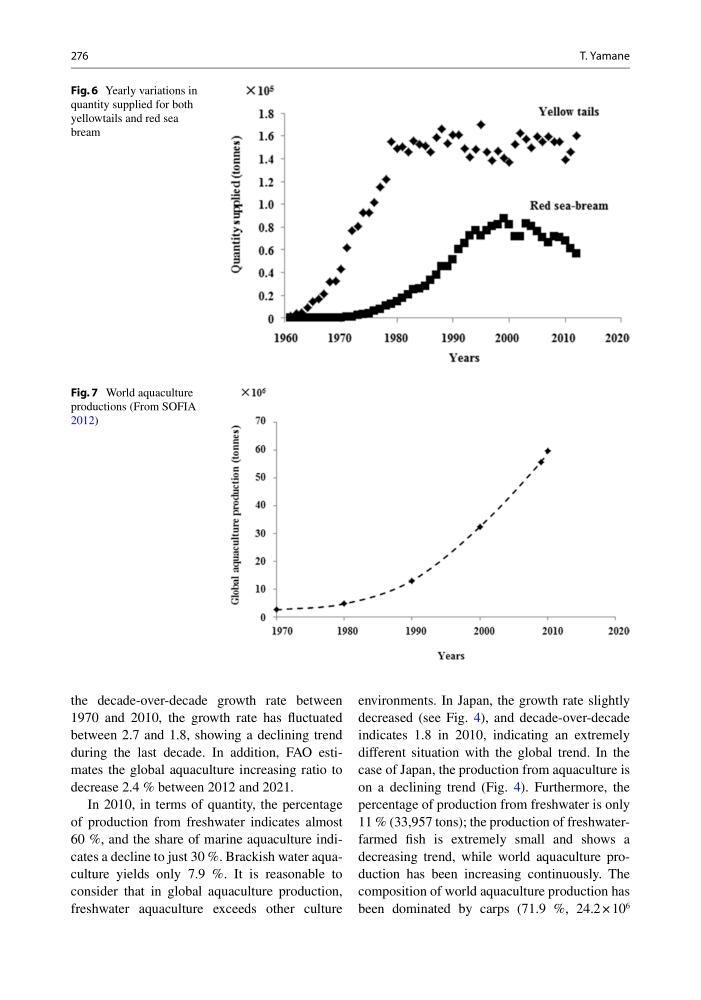
Fig. 6 Yearly variations in
quantity supplied for both
yellowtails and red sea
bream
Fig. 7 World aquaculture
productions (From SOFIA
2012)
T. Yamane
the decade-over-decade growth rate between
1970 and 2010, the growth rate has fluctuated
between 2.7 and 1.8, showing a declining trend
during the last decade. In addition, FAO estimates the global aquaculture increasing ratio to
decrease 2.4 % between 2012 and 2021.
In 2010, in terms of quantity, the percentage
of production from freshwater indicates almost
60 %, and the share of marine aquaculture indicates a decline to just 30 %. Brackish water aquaculture yields only 7.9 %. It is reasonable to
consider that in global aquaculture production,
freshwater aquaculture exceeds other culture
environments. In Japan, the growth rate slightly
decreased (see Fig. 4), and decade-over-decade
indicates 1.8 in 2010, indicating an extremely
different situation with the global trend. In the
case of Japan, the production from aquaculture is
on a declining trend (Fig. 4). Furthermore, the
percentage of production from freshwater is only
11 % (33,957 tons); the production of freshwaterfarmed fish is extremely small and shows a
decreasing trend, while world aquaculture production has been increasing continuously. The
composition of world aquaculture production has
been dominated by carps (71.9 %, 24.2 × 10
6
Fig. 6 Yearly variations in
quantity supplied for both
yellowtails and red sea
bream
Fig. 7 World aquaculture
productions (From SOFIA
2012)
T. Yamane