

278
FAO estimated that the proportion of non- fully
exploited stocks has decreased since 1974, while
the percentage of overexploited stocks increased.
Since the feed of marine-farmed species is being
supplied by huge amount of baitfish, carnivorous
farmed species production is basically controlled
by the amount of baitfish production. Baitfish
include the nonfood species. However, the nonfood species have been supplied not only as baitfish but also for other intended purposes such as
fish meal, oil, feed for others, etc.
In addition, FAO calculated that the fully
exploited stocks produce catches that are at or
very close to their maximum sustainable production with no possibility for further expansion. In
terms of quantity supplied, the production of carnivorous farmed species is closely related with
the quantity supply of baitfish stocks. However,
the state of marine stocks might be at or very
close to their maximum sustainable production.
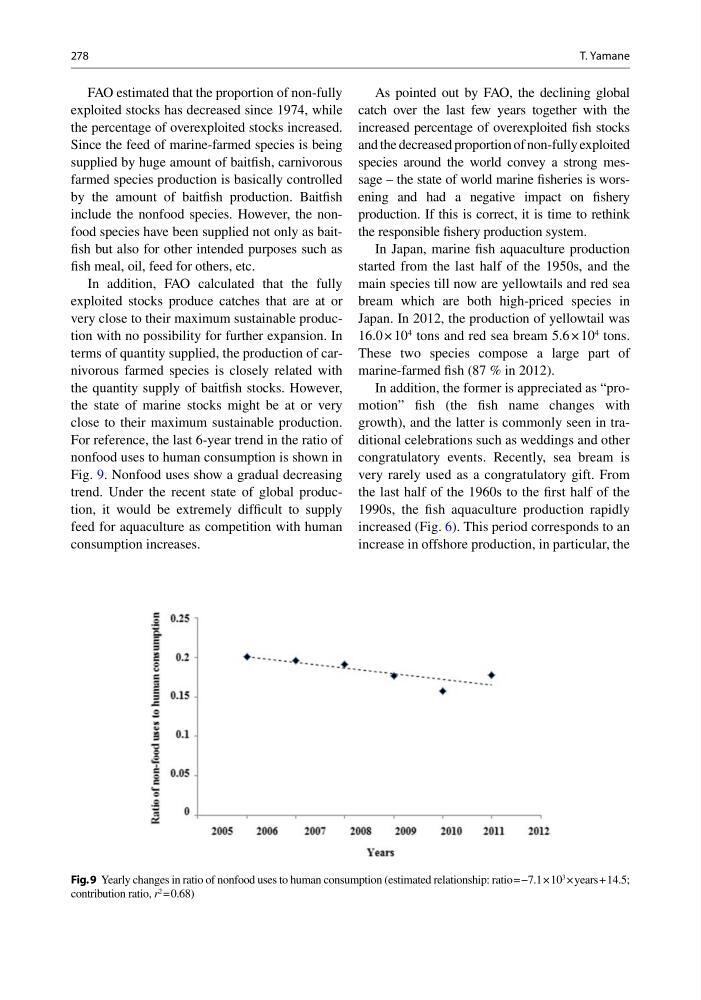
For reference, the last 6-year trend in the ratio of
nonfood uses to human consumption is shown in
Fig. 9. Nonfood uses show a gradual decreasing
trend. Under the recent state of global production, it would be extremely difficult to supply
feed for aquaculture as competition with human
consumption increases.
As pointed out by FAO, the declining global
catch over the last few years together with the
increased percentage of overexploited fish stocks
and the decreased proportion of non-fully exploited
species around the world convey a strong message – the state of world marine fisheries is worsening and had a negative impact on fishery
production. If this is correct, it is time to rethink
the responsible fishery production system.
In Japan, marine fish aquaculture production
started from the last half of the 1950s, and the
main species till now are yellowtails and red sea
bream which are both high-priced species in
Japan. In 2012, the production of yellowtail was
16.0 × 10
4
tons and red sea bream 5.6 × 10
4
tons.
These two species compose a large part of
marine-farmed fish (87 % in 2012).
In addition, the former is appreciated as “promotion” fish (the fish name changes with
growth), and the latter is commonly seen in traditional celebrations such as weddings and other
congratulatory events. Recently, sea bream is
very rarely used as a congratulatory gift. From
the last half of the 1960s to the first half of the
1990s, the fish aquaculture production rapidly
increased (Fig. 6). This period corresponds to an
increase in offshore production, in particular, the
Fig. 9 Yearly changes in ratio of nonfood uses to human consumption (estimated relationship: ratio = −7.1 × 10
3 × years + 14.5;
contribution ratio, r
2 = 0.68)
T. Yamane
FAO estimated that the proportion of non- fully
exploited stocks has decreased since 1974, while
the percentage of overexploited stocks increased.
Since the feed of marine-farmed species is being
supplied by huge amount of baitfish, carnivorous
farmed species production is basically controlled
by the amount of baitfish production. Baitfish
include the nonfood species. However, the nonfood species have been supplied not only as baitfish but also for other intended purposes such as
fish meal, oil, feed for others, etc.
In addition, FAO calculated that the fully
exploited stocks produce catches that are at or
very close to their maximum sustainable production with no possibility for further expansion. In
terms of quantity supplied, the production of carnivorous farmed species is closely related with
the quantity supply of baitfish stocks. However,
the state of marine stocks might be at or very
close to their maximum sustainable production.
For reference, the last 6-year trend in the ratio of
nonfood uses to human consumption is shown in
Fig. 9. Nonfood uses show a gradual decreasing
trend. Under the recent state of global production, it would be extremely difficult to supply
feed for aquaculture as competition with human
consumption increases.
As pointed out by FAO, the declining global
catch over the last few years together with the
increased percentage of overexploited fish stocks
and the decreased proportion of non-fully exploited
species around the world convey a strong message – the state of world marine fisheries is worsening and had a negative impact on fishery
production. If this is correct, it is time to rethink
the responsible fishery production system.
In Japan, marine fish aquaculture production
started from the last half of the 1950s, and the
main species till now are yellowtails and red sea
bream which are both high-priced species in
Japan. In 2012, the production of yellowtail was
16.0 × 10
4
tons and red sea bream 5.6 × 10
4
tons.
These two species compose a large part of
marine-farmed fish (87 % in 2012).
In addition, the former is appreciated as “promotion” fish (the fish name changes with
growth), and the latter is commonly seen in traditional celebrations such as weddings and other
congratulatory events. Recently, sea bream is
very rarely used as a congratulatory gift. From
the last half of the 1960s to the first half of the
1990s, the fish aquaculture production rapidly
increased (Fig. 6). This period corresponds to an
increase in offshore production, in particular, the
Fig. 9 Yearly changes in ratio of nonfood uses to human consumption (estimated relationship: ratio = −7.1 × 10
3 × years + 14.5;
contribution ratio, r
2 = 0.68)
T. Yamane