

263
maritime domain and hence represent gateway
between the various continental and coastal powers of the ‘Eurasian coastline’ (Rogers 2009 )
composed of 7 of the 15 biggest trading partners
of the EU (China, Japan, South Korea, India,
Taiwan, Singapore and Saudi Arabia).
If the power balance in the Asia-Pacifi c is
quickly changing, it has a direct impact on the
European side: with the rise of China and the
refocusing of American maritime assets into East
Asia, Europeans will have to more and more
assume the burden that was left to the USA after
the Second World War as clearly demonstrated
during the recent intervention related to Libya in
the Mediterranean.
2.1.2 Why ICM Counts into National
Ocean Policies?
When launching its strategy to implement the
EU Integrated Coastal Management (ICM)
Recommendation, the Commission indicated
that coastal areas are particularly in need of an
integrated territorial approach, but notwithstanding the continued need for ICM on shore,
further emphasis should be placed on the
implementation of ICM across the land-sea
boundary and in a regional sea context
(Anonymous 2007 ).
This consideration is particularly important,
while ICM is nowadays a popular concept that is
under implementation in many locations and
riparian countries of regional seas all over the
world. Moreover, in many regions like the Baltic
Sea, ICM initiatives are increasingly getting
transboundary thus, in this case, enhancing the
joint regional cooperation between the Baltic Sea
regional users (Ourcoast 2010 ). In the
Mediterranean, within the Barcelona Convention
system, it went as far as ratifying the fi rst panregional ICM Protocol. These numerous ICMrelated projects and initiatives represent a
regional potential capital provided they are given
the opportunity and the means to get networked
together. Further, in the case of the French
national maritime strategy, it has been made clear
that the ICM principles and approach should be
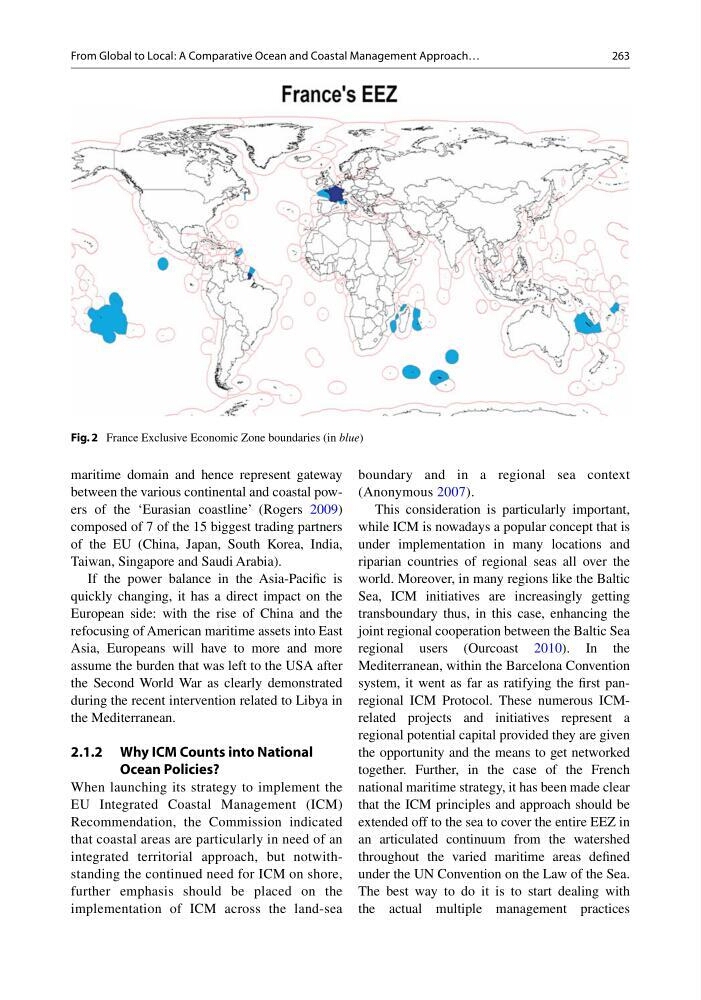
extended off to the sea to cover the entire EEZ in
an articulated continuum from the watershed
throughout the varied maritime areas defi ned
under the UN Convention on the Law of the Sea.
The best way to do it is to start dealing with
the actual multiple management practices
Fig. 2 France Exclusive Economic Zone boundaries (in blue )
From Global to Local: A Comparative Ocean and Coastal Management Approach…
maritime domain and hence represent gateway
between the various continental and coastal powers of the ‘Eurasian coastline’ (Rogers 2009 )
composed of 7 of the 15 biggest trading partners
of the EU (China, Japan, South Korea, India,
Taiwan, Singapore and Saudi Arabia).
If the power balance in the Asia-Pacifi c is
quickly changing, it has a direct impact on the
European side: with the rise of China and the
refocusing of American maritime assets into East
Asia, Europeans will have to more and more
assume the burden that was left to the USA after
the Second World War as clearly demonstrated
during the recent intervention related to Libya in
the Mediterranean.
2.1.2 Why ICM Counts into National
Ocean Policies?
When launching its strategy to implement the
EU Integrated Coastal Management (ICM)
Recommendation, the Commission indicated
that coastal areas are particularly in need of an
integrated territorial approach, but notwithstanding the continued need for ICM on shore,
further emphasis should be placed on the
implementation of ICM across the land-sea
boundary and in a regional sea context
(Anonymous 2007 ).
This consideration is particularly important,
while ICM is nowadays a popular concept that is
under implementation in many locations and
riparian countries of regional seas all over the
world. Moreover, in many regions like the Baltic
Sea, ICM initiatives are increasingly getting
transboundary thus, in this case, enhancing the
joint regional cooperation between the Baltic Sea
regional users (Ourcoast 2010 ). In the
Mediterranean, within the Barcelona Convention
system, it went as far as ratifying the fi rst panregional ICM Protocol. These numerous ICMrelated projects and initiatives represent a
regional potential capital provided they are given
the opportunity and the means to get networked
together. Further, in the case of the French
national maritime strategy, it has been made clear
that the ICM principles and approach should be
extended off to the sea to cover the entire EEZ in
an articulated continuum from the watershed
throughout the varied maritime areas defi ned
under the UN Convention on the Law of the Sea.
The best way to do it is to start dealing with
the actual multiple management practices
Fig. 2 France Exclusive Economic Zone boundaries (in blue )
From Global to Local: A Comparative Ocean and Coastal Management Approach…