

255
3
Coral Observation
and Viability Check
Most reef-building corals have fl uorescent proteins
that emit blue-green fl uorescence on UV excitation. Therefore, information on live corals can be
obtained by a fl uorescence imaging lidar survey
of the seafl oor. However, to obtain fl uorescent
images of corals, it is necessary to avoid the distortion effect by sea surface waves, and therefore
an airborne system is problematic in this respect.
Therefore, underwater lidar requires a platform
that facilitates reliable imaging, such as a glassbottom boat.
The very short exposure time (about 100 ns)
used in fl uorescence imaging lidar suppresses not
only background noise caused by sunlight but
also image blurring caused by the rapid ship
motion. The spatial distribution of live corals
along boat tracks can be obtained by setting
DGPS position data and assessing the seafl oor
substrate by analysing data from each fl uorescent
image. Figure 3 shows the observed coral distributions at Taketomi Island, Okinawa, Japan.
4
Conclusion and Perspectives
A fl uorescence imaging lidar system that utilises
a glass-bottom boat was developed, and the system’s potential to observe live coral distribution
is demonstrated. In future, coral observation at
various sites in the Japanese ocean area is planned
to monitor coral reef ecosystems and assess the
impacts of global climate change such as ocean
warming and ocean acidifi cation.
35.8
35.6
35.4
35.2
35.0
34.8
139.0
139.2
139.4
139.6
Longitude [deg]
Longitude [deg]
139.8
140.0
140.2
0.0
0.5
1.0
1.5
2.0
Signla Ratio
14:31
14:23
14:21
14:11
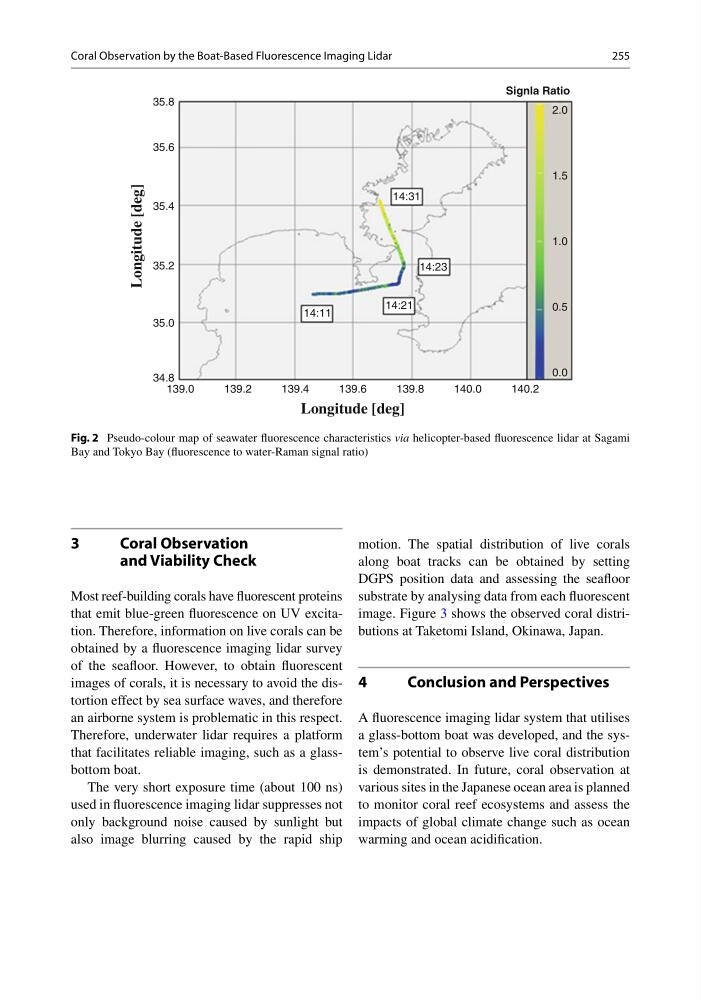
Fig. 2 Pseudo-colour map of seawater fl uorescence characteristics via helicopter-based fl uorescence lidar at Sagami
Bay and Tokyo Bay (fl uorescence to water-Raman signal ratio)
Coral Observation by the Boat-Based Fluorescence Imaging Lidar
3
Coral Observation
and Viability Check
Most reef-building corals have fl uorescent proteins
that emit blue-green fl uorescence on UV excitation. Therefore, information on live corals can be
obtained by a fl uorescence imaging lidar survey
of the seafl oor. However, to obtain fl uorescent
images of corals, it is necessary to avoid the distortion effect by sea surface waves, and therefore
an airborne system is problematic in this respect.
Therefore, underwater lidar requires a platform
that facilitates reliable imaging, such as a glassbottom boat.
The very short exposure time (about 100 ns)
used in fl uorescence imaging lidar suppresses not
only background noise caused by sunlight but
also image blurring caused by the rapid ship
motion. The spatial distribution of live corals
along boat tracks can be obtained by setting
DGPS position data and assessing the seafl oor
substrate by analysing data from each fl uorescent
image. Figure 3 shows the observed coral distributions at Taketomi Island, Okinawa, Japan.
4
Conclusion and Perspectives
A fl uorescence imaging lidar system that utilises
a glass-bottom boat was developed, and the system’s potential to observe live coral distribution
is demonstrated. In future, coral observation at
various sites in the Japanese ocean area is planned
to monitor coral reef ecosystems and assess the
impacts of global climate change such as ocean
warming and ocean acidifi cation.
35.8
35.6
35.4
35.2
35.0
34.8
139.0
139.2
139.4
139.6
Longitude [deg]
Longitude [deg]
139.8
140.0
140.2
0.0
0.5
1.0
1.5
2.0
Signla Ratio
14:31
14:23
14:21
14:11
Fig. 2 Pseudo-colour map of seawater fl uorescence characteristics via helicopter-based fl uorescence lidar at Sagami
Bay and Tokyo Bay (fl uorescence to water-Raman signal ratio)
Coral Observation by the Boat-Based Fluorescence Imaging Lidar