

256
Acknowledgements This study was funded by the
Global Environment Research Account for National
Institute, Japan. The authors express their appreciation to
all those who participated in this study and thank the
Ministry of Land, Infrastructure, Transport and Tourism
of Japan (MLIT) and the Ministry of the Environment of
Japan (MOE) for permitting publication of this paper.
References
Hedley JD, Mumby PJ (2002) Biological and remote
sensing perspectives of pigmentation in coral reef
organisms. Adv Mar Biol 43:277–317
Okamoto M, Sato T, Morita S (2000) Basic coral distribution data for long term monitoring at Sekisei Lagoon.
In: OCEANS 2000 MTS/IEEE conference and exhibition, vol 2, pp 1383–1387
Sasano M, Hitomi K, Yamanouchi H (2008) The fl uorescence lidar for monitoring of oil spill. J Vis Soc Jpn
28:9–14. (in Japanese)
Yamano H, Sugihara K, Nomura K (2011) Rapid poleward range expansion of tropical reef corals in
response to rising sea surface temperatures. Geophys
Res Lett 38:L04601
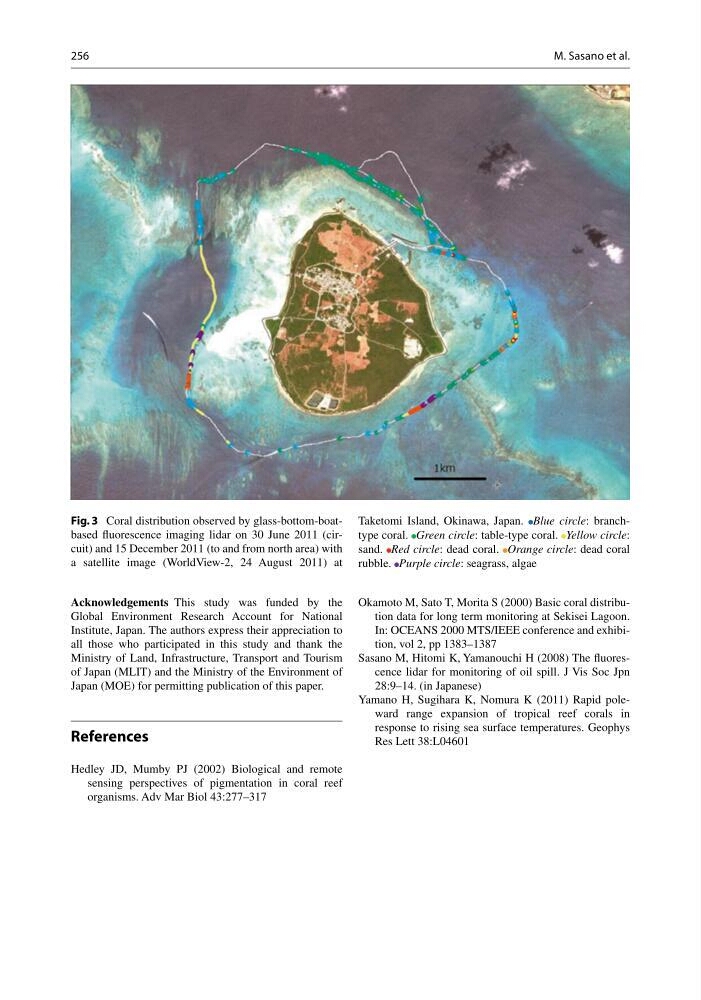
Fig. 3 Coral distribution observed by glass-bottom-boatbased fl uorescence imaging lidar on 30 June 2011 (circuit) and 15 December 2011 (to and from north area) with
a satellite image (WorldView-2, 24 August 2011) at
Taketomi Island, Okinawa, Japan. Blue circle : branchtype coral. Green circle : table-type coral. Yellow circle :
sand. Red circle : dead coral. Orange circle : dead coral
rubble. Purple circle : seagrass, algae
M. Sasano et al.
Acknowledgements This study was funded by the
Global Environment Research Account for National
Institute, Japan. The authors express their appreciation to
all those who participated in this study and thank the
Ministry of Land, Infrastructure, Transport and Tourism
of Japan (MLIT) and the Ministry of the Environment of
Japan (MOE) for permitting publication of this paper.
References
Hedley JD, Mumby PJ (2002) Biological and remote
sensing perspectives of pigmentation in coral reef
organisms. Adv Mar Biol 43:277–317
Okamoto M, Sato T, Morita S (2000) Basic coral distribution data for long term monitoring at Sekisei Lagoon.
In: OCEANS 2000 MTS/IEEE conference and exhibition, vol 2, pp 1383–1387
Sasano M, Hitomi K, Yamanouchi H (2008) The fl uorescence lidar for monitoring of oil spill. J Vis Soc Jpn
28:9–14. (in Japanese)
Yamano H, Sugihara K, Nomura K (2011) Rapid poleward range expansion of tropical reef corals in
response to rising sea surface temperatures. Geophys
Res Lett 38:L04601
Fig. 3 Coral distribution observed by glass-bottom-boatbased fl uorescence imaging lidar on 30 June 2011 (circuit) and 15 December 2011 (to and from north area) with
a satellite image (WorldView-2, 24 August 2011) at
Taketomi Island, Okinawa, Japan. Blue circle : branchtype coral. Green circle : table-type coral. Yellow circle :
sand. Red circle : dead coral. Orange circle : dead coral
rubble. Purple circle : seagrass, algae
M. Sasano et al.