

248
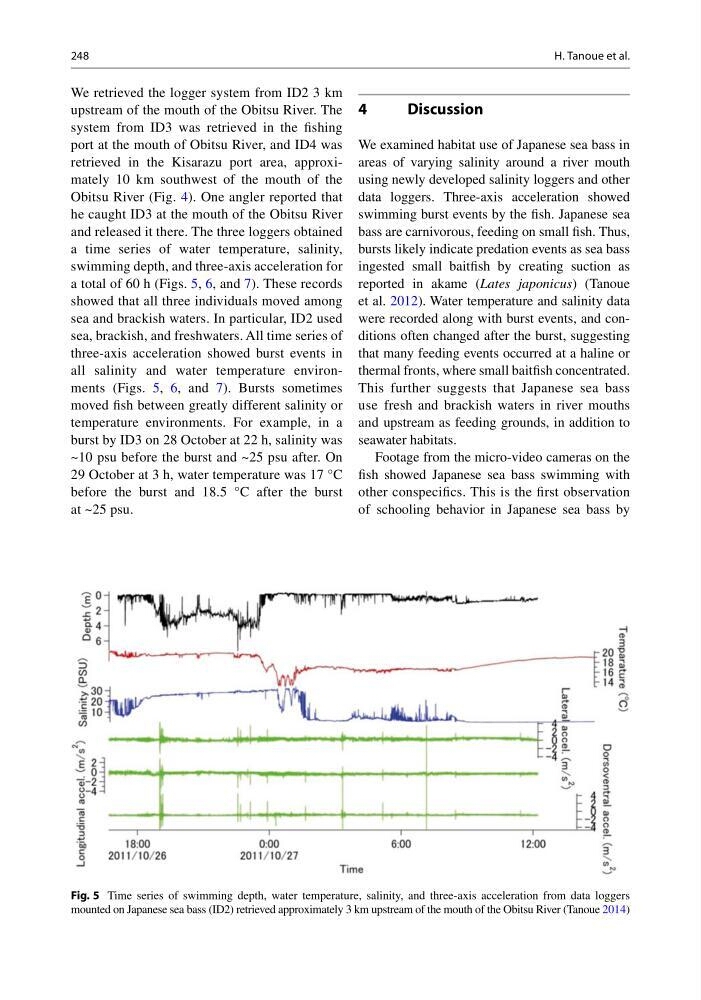
We retrieved the logger system from ID2 3 km
upstream of the mouth of the Obitsu River. The
system from ID3 was retrieved in the fi shing
port at the mouth of Obitsu River, and ID4 was
retrieved in the Kisarazu port area, approximately 10 km southwest of the mouth of the
Obitsu River (Fig. 4 ). One angler reported that
he caught ID3 at the mouth of the Obitsu River
and released it there. The three loggers obtained
a time series of water temperature, salinity,
swimming depth, and three-axis acceleration for
a total of 60 h (Figs. 5 , 6 , and 7 ). These records
showed that all three individuals moved among
sea and brackish waters. In particular, ID2 used
sea, brackish, and freshwaters. All time series of
three-axis acceleration showed burst events in
all salinity and water temperature environments (Figs. 5 , 6 , and 7 ). Bursts sometimes
moved fi sh between greatly different salinity or
temperature environments. For example, in a
burst by ID3 on 28 October at 22 h, salinity was
~10 psu before the burst and ~25 psu after. On
29 October at 3 h, water temperature was 17 °C
before the burst and 18.5 °C after the burst
at ~25 psu.
4
Discussion
We examined habitat use of Japanese sea bass in
areas of varying salinity around a river mouth
using newly developed salinity loggers and other
data loggers. Three-axis acceleration showed
swimming burst events by the fi sh. Japanese sea
bass are carnivorous, feeding on small fi sh. Thus,
bursts likely indicate predation events as sea bass
ingested small baitfi sh by creating suction as
reported in akame ( Lates japonicus ) (Tanoue
et al. 2012 ). Water temperature and salinity data
were recorded along with burst events, and conditions often changed after the burst, suggesting
that many feeding events occurred at a haline or
thermal fronts, where small baitfi sh concentrated.
This further suggests that Japanese sea bass
use fresh and brackish waters in river mouths
and upstream as feeding grounds, in addition to
seawater habitats.
Footage from the micro-video cameras on the
fi sh showed Japanese sea bass swimming with
other conspecifi cs. This is the fi rst observation
of schooling behavior in Japanese sea bass by
Fig. 5 Time series of swimming depth, water temperature, salinity, and three-axis acceleration from data loggers
mounted on Japanese sea bass (ID2) retrieved approximately 3 km upstream of the mouth of the Obitsu River (Tanoue 2014 )
H. Tanoue et al.
We retrieved the logger system from ID2 3 km
upstream of the mouth of the Obitsu River. The
system from ID3 was retrieved in the fi shing
port at the mouth of Obitsu River, and ID4 was
retrieved in the Kisarazu port area, approximately 10 km southwest of the mouth of the
Obitsu River (Fig. 4 ). One angler reported that
he caught ID3 at the mouth of the Obitsu River
and released it there. The three loggers obtained
a time series of water temperature, salinity,
swimming depth, and three-axis acceleration for
a total of 60 h (Figs. 5 , 6 , and 7 ). These records
showed that all three individuals moved among
sea and brackish waters. In particular, ID2 used
sea, brackish, and freshwaters. All time series of
three-axis acceleration showed burst events in
all salinity and water temperature environments (Figs. 5 , 6 , and 7 ). Bursts sometimes
moved fi sh between greatly different salinity or
temperature environments. For example, in a
burst by ID3 on 28 October at 22 h, salinity was
~10 psu before the burst and ~25 psu after. On
29 October at 3 h, water temperature was 17 °C
before the burst and 18.5 °C after the burst
at ~25 psu.
4
Discussion
We examined habitat use of Japanese sea bass in
areas of varying salinity around a river mouth
using newly developed salinity loggers and other
data loggers. Three-axis acceleration showed
swimming burst events by the fi sh. Japanese sea
bass are carnivorous, feeding on small fi sh. Thus,
bursts likely indicate predation events as sea bass
ingested small baitfi sh by creating suction as
reported in akame ( Lates japonicus ) (Tanoue
et al. 2012 ). Water temperature and salinity data
were recorded along with burst events, and conditions often changed after the burst, suggesting
that many feeding events occurred at a haline or
thermal fronts, where small baitfi sh concentrated.
This further suggests that Japanese sea bass
use fresh and brackish waters in river mouths
and upstream as feeding grounds, in addition to
seawater habitats.
Footage from the micro-video cameras on the
fi sh showed Japanese sea bass swimming with
other conspecifi cs. This is the fi rst observation
of schooling behavior in Japanese sea bass by
Fig. 5 Time series of swimming depth, water temperature, salinity, and three-axis acceleration from data loggers
mounted on Japanese sea bass (ID2) retrieved approximately 3 km upstream of the mouth of the Obitsu River (Tanoue 2014 )
H. Tanoue et al.