

249
fi sh- borne cameras in brackish waters and the sea
(Fig. 3 ). The camera also fi lmed an angler fi shing
from the riverbank above the fi sh. The cameras
allowed observation of the Japanese sea bass in
the middle layer of the river, more clearly detecting the behavioral ecology of the fi sh than other
methods.
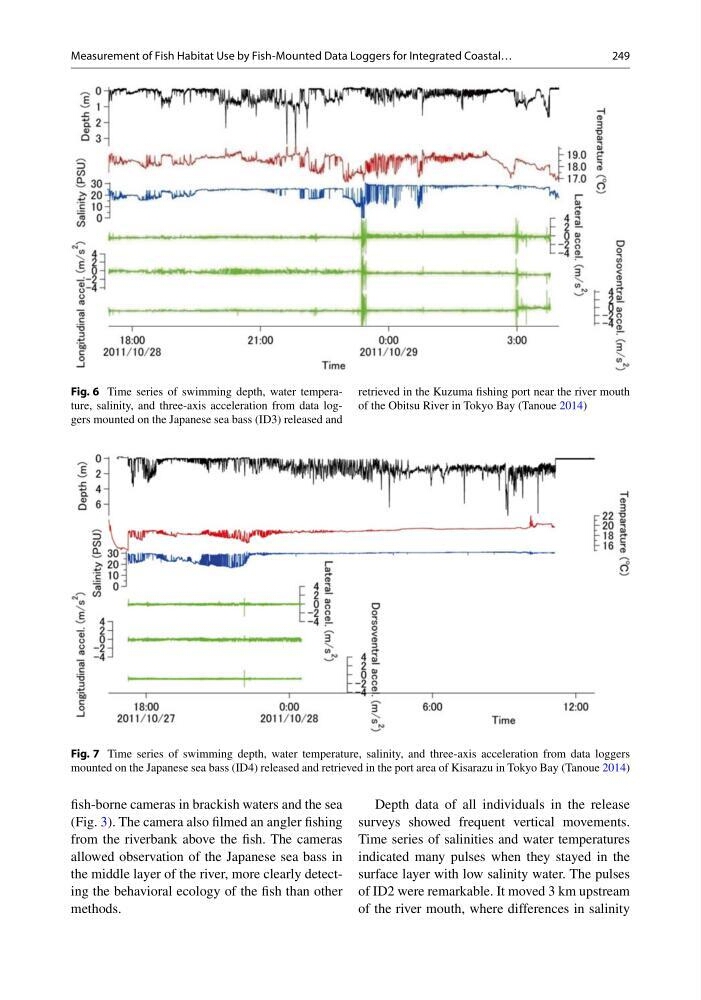
Depth data of all individuals in the release
surveys showed frequent vertical movements.
Time series of salinities and water temperatures
indicated many pulses when they stayed in the
surface layer with low salinity water. The pulses
of ID2 were remarkable. It moved 3 km upstream
of the river mouth, where differences in salinity
Fig. 6 Time series of swimming depth, water temperature, salinity, and three-axis acceleration from data loggers mounted on the Japanese sea bass (ID3) released and
retrieved in the Kuzuma fi shing port near the river mouth
of the Obitsu River in Tokyo Bay (Tanoue 2014 )
Fig. 7 Time series of swimming depth, water temperature, salinity, and three-axis acceleration from data loggers
mounted on the Japanese sea bass (ID4) released and retrieved in the port area of Kisarazu in Tokyo Bay (Tanoue 2014 )
Measurement of Fish Habitat Use by Fish-Mounted Data Loggers for Integrated Coastal…
fi sh- borne cameras in brackish waters and the sea
(Fig. 3 ). The camera also fi lmed an angler fi shing
from the riverbank above the fi sh. The cameras
allowed observation of the Japanese sea bass in
the middle layer of the river, more clearly detecting the behavioral ecology of the fi sh than other
methods.
Depth data of all individuals in the release
surveys showed frequent vertical movements.
Time series of salinities and water temperatures
indicated many pulses when they stayed in the
surface layer with low salinity water. The pulses
of ID2 were remarkable. It moved 3 km upstream
of the river mouth, where differences in salinity
Fig. 6 Time series of swimming depth, water temperature, salinity, and three-axis acceleration from data loggers mounted on the Japanese sea bass (ID3) released and
retrieved in the Kuzuma fi shing port near the river mouth
of the Obitsu River in Tokyo Bay (Tanoue 2014 )
Fig. 7 Time series of swimming depth, water temperature, salinity, and three-axis acceleration from data loggers
mounted on the Japanese sea bass (ID4) released and retrieved in the port area of Kisarazu in Tokyo Bay (Tanoue 2014 )
Measurement of Fish Habitat Use by Fish-Mounted Data Loggers for Integrated Coastal…