

178
This study therefore focuses on ecosystem
and socioeconomic features which are linked to
fishing activities, restricted to professional fishing owing to data availability.
2.2.1 Marxan with Zones
Features to protect are:
• Abundance distributions (mean over 1990–
2012) of two of the main targeted species
(those accounted in the fleet dynamics model),
common sole (Solea solea, Fig. 2a) and plaice
(Pleuronectes platessa, Fig. 2b) assessed from
the Channel Ground Fish Surveys (CGFS)
data.
• Eighteen benthic habitats, on which towed
gears can have a negative impact. Data used
are those from Delavenne et al. (2012).
• Thirteen pelagic habitats, which contain communities that can be affected by most pelagic
gears. The typology used is the one defined by
Delavenne et al. (2013).
Among feature types, only exploited species
distributions are planned to be dynamically
linked to the simulation model, habitats being
handled as a static part of the system.
As for costs, hours fished by type of gear and
zone, estimated from data collected by vessel
monitoring system (Lee et al. 2010), are used as
proxies of value losses when a protection unit is
selected for a type of zone which bans or limits
some uses (Fig. 2c, d). As a first approach, costs
will not be processed in a dynamic way because
the selection of a PU would eliminate its cost on
the next step (no or less fishing).
The spatial grid was defined so that each MPA
was divided into as many subareas of unique
administrative status and that remaining available
areas were separated according to the same grid
as the ISIS-Fish model (1/32nd of ICES statistical rectangle, Fig. 2) and further divided according to the 12 nautical miles zone.
A scenario was tested with only two kinds of
protection zones – no ground-towed gears and
no-take (all activities prohibited) – and where the
12 nautical miles zone was considered already
contributing to conservation (limited access to
vessels >24 m). Already planned MPAs were
constrained to always apply one of the two protection levels. Zone contributions to conservation
(Table 1) and cost multipliers (Table 2, formally
corresponding to a proportion of effort reduction
within protected zones) were set arbitrarily but
should ideally be derived from quantitative study
of the impact of each use on different features.
Here, all benthic habitats were treated homogeneously with the removal of ground-towed gear
−2°E
49.5°N
50°N
50.5°N
51°N
−1°E
0°E
1°E
12 NM zone
SSI
SAC
SPA
PNM
RNN
MCZ
2°E
3 °E
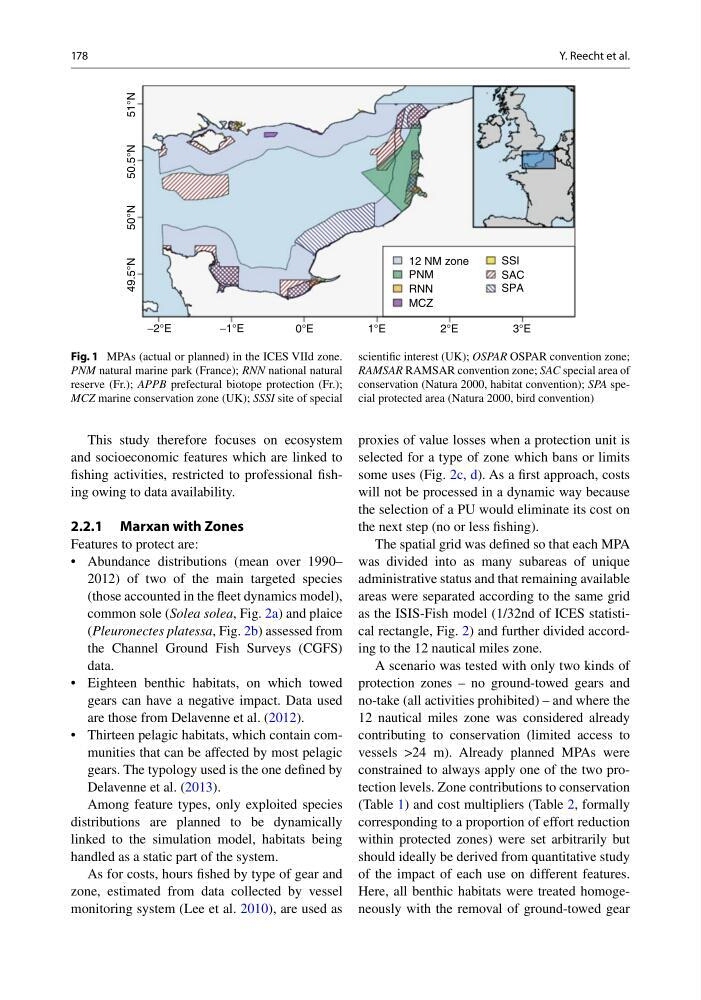
Fig. 1 MPAs (actual or planned) in the ICES VIId zone.
PNM natural marine park (France); RNN national natural
reserve (Fr.); APPB prefectural biotope protection (Fr.);
MCZ marine conservation zone (UK); SSSI site of special
scientific interest (UK); OSPAR OSPAR convention zone;
RAMSAR RAMSAR convention zone; SAC special area of
conservation (Natura 2000, habitat convention); SPA special protected area (Natura 2000, bird convention)
Y. Reecht et al.
This study therefore focuses on ecosystem
and socioeconomic features which are linked to
fishing activities, restricted to professional fishing owing to data availability.
2.2.1 Marxan with Zones
Features to protect are:
• Abundance distributions (mean over 1990–
2012) of two of the main targeted species
(those accounted in the fleet dynamics model),
common sole (Solea solea, Fig. 2a) and plaice
(Pleuronectes platessa, Fig. 2b) assessed from
the Channel Ground Fish Surveys (CGFS)
data.
• Eighteen benthic habitats, on which towed
gears can have a negative impact. Data used
are those from Delavenne et al. (2012).
• Thirteen pelagic habitats, which contain communities that can be affected by most pelagic
gears. The typology used is the one defined by
Delavenne et al. (2013).
Among feature types, only exploited species
distributions are planned to be dynamically
linked to the simulation model, habitats being
handled as a static part of the system.
As for costs, hours fished by type of gear and
zone, estimated from data collected by vessel
monitoring system (Lee et al. 2010), are used as
proxies of value losses when a protection unit is
selected for a type of zone which bans or limits
some uses (Fig. 2c, d). As a first approach, costs
will not be processed in a dynamic way because
the selection of a PU would eliminate its cost on
the next step (no or less fishing).
The spatial grid was defined so that each MPA
was divided into as many subareas of unique
administrative status and that remaining available
areas were separated according to the same grid
as the ISIS-Fish model (1/32nd of ICES statistical rectangle, Fig. 2) and further divided according to the 12 nautical miles zone.
A scenario was tested with only two kinds of
protection zones – no ground-towed gears and
no-take (all activities prohibited) – and where the
12 nautical miles zone was considered already
contributing to conservation (limited access to
vessels >24 m). Already planned MPAs were
constrained to always apply one of the two protection levels. Zone contributions to conservation
(Table 1) and cost multipliers (Table 2, formally
corresponding to a proportion of effort reduction
within protected zones) were set arbitrarily but
should ideally be derived from quantitative study
of the impact of each use on different features.
Here, all benthic habitats were treated homogeneously with the removal of ground-towed gear
−2°E
49.5°N
50°N
50.5°N
51°N
−1°E
0°E
1°E
12 NM zone
SSI
SAC
SPA
PNM
RNN
MCZ
2°E
3 °E
Fig. 1 MPAs (actual or planned) in the ICES VIId zone.
PNM natural marine park (France); RNN national natural
reserve (Fr.); APPB prefectural biotope protection (Fr.);
MCZ marine conservation zone (UK); SSSI site of special
scientific interest (UK); OSPAR OSPAR convention zone;
RAMSAR RAMSAR convention zone; SAC special area of
conservation (Natura 2000, habitat convention); SPA special protected area (Natura 2000, bird convention)
Y. Reecht et al.