

151
As shown in Fig. 4a , ghr mRNA levels in the
livers of stressed fi sh increased. In contrast, the igf1
mRNA levels in stressed fi sh livers decreased gradually after heat stress and decreased signifi cantly as
compared with those in the control fi sh at 48 h poststress (Fig. 4b ).
4
Discussion
The results of this study demonstrated that a
severe acute thermal stressor could affect the
redox state and the expression of growth-related
genes in coho salmon.
The temperature can induce numerous
changes in the biological functions of organisms.
Increased environmental temperature results in
increased oxygen consumption and stimulates
various metabolic processes on the basis of
known thermodynamic principles (Pörtner 2002 ;
Lesser 2006 ; Lushchak and Bagnyukova 2006a, b ;
Lushchak 2011 ).
LPO, expressed as TBARS, in plasma are considered to be metabolites derived from various damaged tissues (Parihar and Dubey 1995 ; Nakano and
Takeuchi 1997 ; Nakano et al. 1999a , b ; Rau et al.
2004 ; Lushchak et al. 2005a, b ; Olsen et al. 2005 ;
Heise et al. 2006 ; Bagnyukova et al. 2007 ). In this
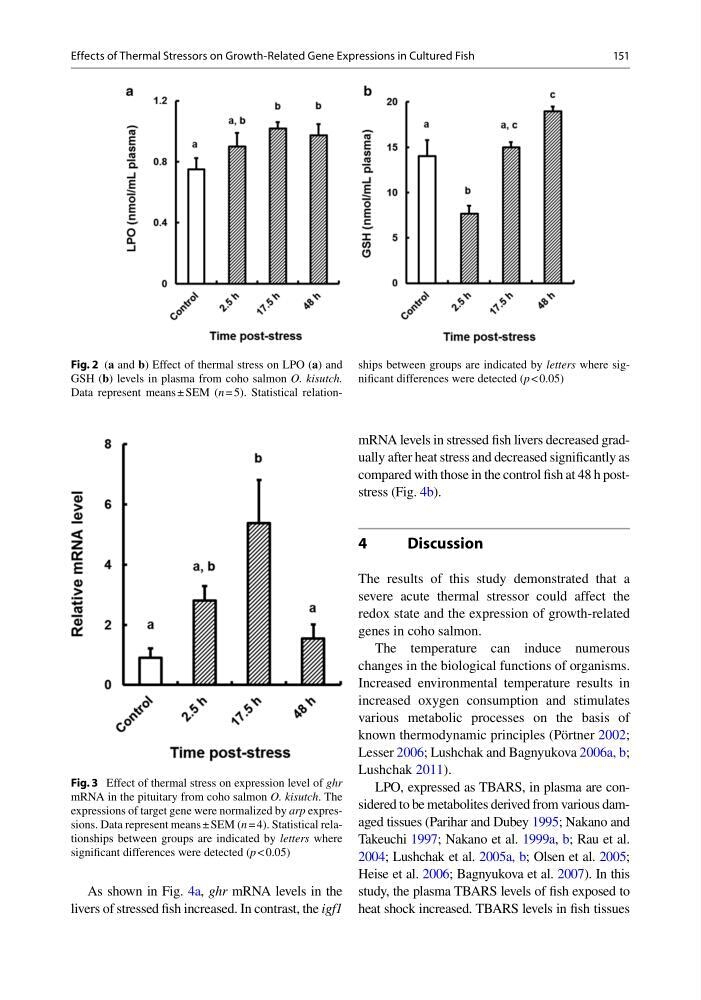
study, the plasma TBARS levels of fi sh exposed to
heat shock increased. TBARS levels in fi sh tissues
Fig. 2 ( a and b ) Effect of thermal stress on LPO ( a ) and
GSH ( b ) levels in plasma from coho salmon O. kisutch.
Data represent means ± SEM ( n = 5). Statistical relationships between groups are indicated by letters where signifi cant differences were detected ( p < 0.05)
Fig. 3 Effect of thermal stress on expression level of ghr
mRNA in the pituitary from coho salmon O. kisutch . The
expressions of target gene were normalized by arp expressions. Data represent means ± SEM ( n = 4). Statistical relationships between groups are indicated by letters where
signifi cant differences were detected ( p < 0.05)
Effects of Thermal Stressors on Growth-Related Gene Expressions in Cultured Fish
As shown in Fig. 4a , ghr mRNA levels in the
livers of stressed fi sh increased. In contrast, the igf1
mRNA levels in stressed fi sh livers decreased gradually after heat stress and decreased signifi cantly as
compared with those in the control fi sh at 48 h poststress (Fig. 4b ).
4
Discussion
The results of this study demonstrated that a
severe acute thermal stressor could affect the
redox state and the expression of growth-related
genes in coho salmon.
The temperature can induce numerous
changes in the biological functions of organisms.
Increased environmental temperature results in
increased oxygen consumption and stimulates
various metabolic processes on the basis of
known thermodynamic principles (Pörtner 2002 ;
Lesser 2006 ; Lushchak and Bagnyukova 2006a, b ;
Lushchak 2011 ).
LPO, expressed as TBARS, in plasma are considered to be metabolites derived from various damaged tissues (Parihar and Dubey 1995 ; Nakano and
Takeuchi 1997 ; Nakano et al. 1999a , b ; Rau et al.
2004 ; Lushchak et al. 2005a, b ; Olsen et al. 2005 ;
Heise et al. 2006 ; Bagnyukova et al. 2007 ). In this
study, the plasma TBARS levels of fi sh exposed to
heat shock increased. TBARS levels in fi sh tissues
Fig. 2 ( a and b ) Effect of thermal stress on LPO ( a ) and
GSH ( b ) levels in plasma from coho salmon O. kisutch.
Data represent means ± SEM ( n = 5). Statistical relationships between groups are indicated by letters where signifi cant differences were detected ( p < 0.05)
Fig. 3 Effect of thermal stress on expression level of ghr
mRNA in the pituitary from coho salmon O. kisutch . The
expressions of target gene were normalized by arp expressions. Data represent means ± SEM ( n = 4). Statistical relationships between groups are indicated by letters where
signifi cant differences were detected ( p < 0.05)
Effects of Thermal Stressors on Growth-Related Gene Expressions in Cultured Fish