

131
that can be directly applied to various aspects of
zooplankton behavioural complexity and used to
infer the stress experienced by these organisms
under a range of conditions. I subsequently introduce the more elaborated and still seldom used,
though more general, concept of multifractal that
may conveniently be used as an objective and
quantitative tool to thoroughly identify models of
movement behaviour, such as Brownian motion,
fractional Brownian motion, ballistic motion, Lévy
flight/walk and multifractal random walk. I stress
that fractal and multifractal analyses can detect
differences in behavioural complexity, where
traditional measures cannot. As such, I finally
discuss their relevance as a practical tool to infer
the nature of both natural and anthropogenic
forcing.
2
From Fractal Theory to Stress
Assessment: Behavioural
Stress Indexes
2.1
A Few Words on Fractals
A fractal is ‘a rough or fragmented geometric
shape that can be split into parts, each of which is
(at least approximately) a reduced-size copy of
the whole’ (13). This property is called scale
invariance and means that the observed structure
remains unchanged under magnification or contraction. This scale invariance can be observed in
two distinct, though conceptually similar, forms
referred to as self-similarity and self-affinity.
Self-similarity has traditionally been illustrated
using theoretical fractal objects (Mandelbrot 1982).
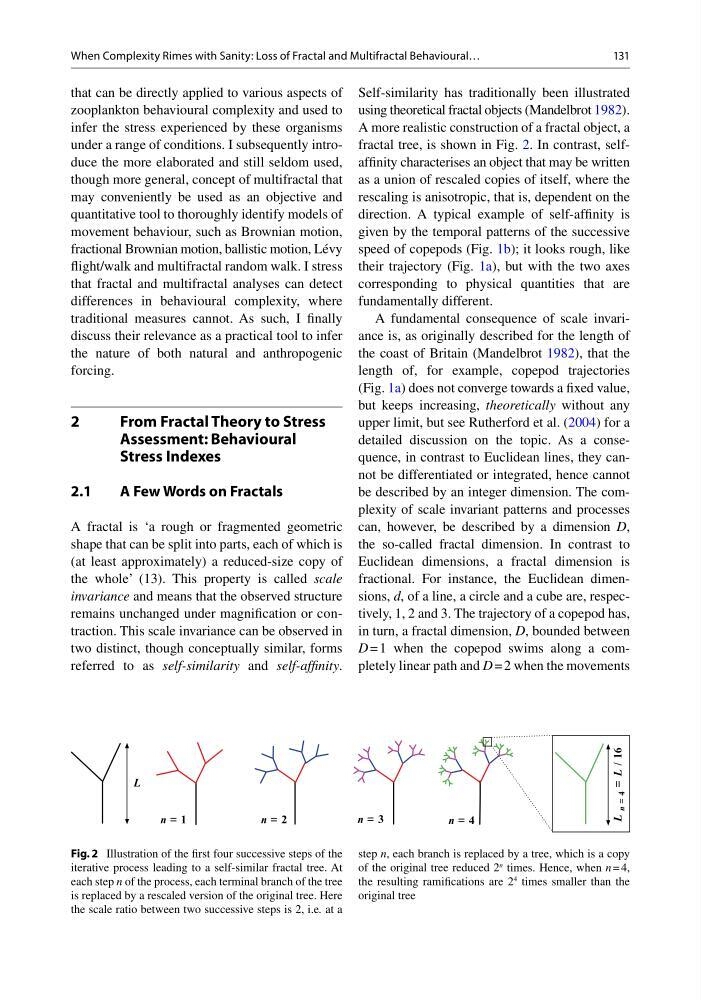
A more realistic construction of a fractal object, a
fractal tree, is shown in Fig. 2. In contrast, selfaffinity characterises an object that may be written
as a union of rescaled copies of itself, where the
rescaling is anisotropic, that is, dependent on the
direction. A typical example of self-affinity is
given by the temporal patterns of the successive
speed of copepods (Fig. 1b); it looks rough, like
their trajectory (Fig. 1a), but with the two axes
corresponding to physical quantities that are
fundamentally different.
A fundamental consequence of scale invariance is, as originally described for the length of
the coast of Britain (Mandelbrot 1982), that the
length of, for example, copepod trajectories
(Fig. 1a) does not converge towards a fixed value,
but keeps increasing, theoretically without any
upper limit, but see Rutherford et al. (2004) for a
detailed discussion on the topic. As a consequence, in contrast to Euclidean lines, they cannot be differentiated or integrated, hence cannot
be described by an integer dimension. The complexity of scale invariant patterns and processes
can, however, be described by a dimension D,
the so-called fractal dimension. In contrast to
Euclidean dimensions, a fractal dimension is
fractional. For instance, the Euclidean dimensions, d, of a line, a circle and a cube are, respectively, 1, 2 and 3. The trajectory of a copepod has,
in turn, a fractal dimension, D, bounded between
D = 1 when the copepod swims along a completely linear path and D = 2 when the movements
n = 1
n = 2
L
n = 3
n = 4
L
n
= 4 = L
/ 16
Fig. 2 Illustration of the first four successive steps of the
iterative process leading to a self-similar fractal tree. At
each step n of the process, each terminal branch of the tree
is replaced by a rescaled version of the original tree. Here
the scale ratio between two successive steps is 2, i.e. at a
step n, each branch is replaced by a tree, which is a copy
of the original tree reduced 2
n times. Hence, when n = 4,
the resulting ramifications are 2
4 times smaller than the
original tree
When Complexity Rimes with Sanity: Loss of Fractal and Multifractal Behavioural…
that can be directly applied to various aspects of
zooplankton behavioural complexity and used to
infer the stress experienced by these organisms
under a range of conditions. I subsequently introduce the more elaborated and still seldom used,
though more general, concept of multifractal that
may conveniently be used as an objective and
quantitative tool to thoroughly identify models of
movement behaviour, such as Brownian motion,
fractional Brownian motion, ballistic motion, Lévy
flight/walk and multifractal random walk. I stress
that fractal and multifractal analyses can detect
differences in behavioural complexity, where
traditional measures cannot. As such, I finally
discuss their relevance as a practical tool to infer
the nature of both natural and anthropogenic
forcing.
2
From Fractal Theory to Stress
Assessment: Behavioural
Stress Indexes
2.1
A Few Words on Fractals
A fractal is ‘a rough or fragmented geometric
shape that can be split into parts, each of which is
(at least approximately) a reduced-size copy of
the whole’ (13). This property is called scale
invariance and means that the observed structure
remains unchanged under magnification or contraction. This scale invariance can be observed in
two distinct, though conceptually similar, forms
referred to as self-similarity and self-affinity.
Self-similarity has traditionally been illustrated
using theoretical fractal objects (Mandelbrot 1982).
A more realistic construction of a fractal object, a
fractal tree, is shown in Fig. 2. In contrast, selfaffinity characterises an object that may be written
as a union of rescaled copies of itself, where the
rescaling is anisotropic, that is, dependent on the
direction. A typical example of self-affinity is
given by the temporal patterns of the successive
speed of copepods (Fig. 1b); it looks rough, like
their trajectory (Fig. 1a), but with the two axes
corresponding to physical quantities that are
fundamentally different.
A fundamental consequence of scale invariance is, as originally described for the length of
the coast of Britain (Mandelbrot 1982), that the
length of, for example, copepod trajectories
(Fig. 1a) does not converge towards a fixed value,
but keeps increasing, theoretically without any
upper limit, but see Rutherford et al. (2004) for a
detailed discussion on the topic. As a consequence, in contrast to Euclidean lines, they cannot be differentiated or integrated, hence cannot
be described by an integer dimension. The complexity of scale invariant patterns and processes
can, however, be described by a dimension D,
the so-called fractal dimension. In contrast to
Euclidean dimensions, a fractal dimension is
fractional. For instance, the Euclidean dimensions, d, of a line, a circle and a cube are, respectively, 1, 2 and 3. The trajectory of a copepod has,
in turn, a fractal dimension, D, bounded between
D = 1 when the copepod swims along a completely linear path and D = 2 when the movements
n = 1
n = 2
L
n = 3
n = 4
L
n
= 4 = L
/ 16
Fig. 2 Illustration of the first four successive steps of the
iterative process leading to a self-similar fractal tree. At
each step n of the process, each terminal branch of the tree
is replaced by a rescaled version of the original tree. Here
the scale ratio between two successive steps is 2, i.e. at a
step n, each branch is replaced by a tree, which is a copy
of the original tree reduced 2
n times. Hence, when n = 4,
the resulting ramifications are 2
4 times smaller than the
original tree
When Complexity Rimes with Sanity: Loss of Fractal and Multifractal Behavioural…