

97
The abundance of litter at sea can be estimated
either by direct observations of large debris items
(e.g. submersible remote observation vehicles
(ROVs) for monitoring litter on the seabed or
ship-based and aerial observations for debris
fl oating at the sea surface) or by large-scale imagery application and net trawls (for smaller items).
Net-based evaluation surveys are the most widespread and adequate methods to date (Goldberg
1994 ), similar to the methodology for monitoring
the benthic species.
The interpretation of trends is diffi cult because
the fate of plastics at depth is not well investigated,
and the accumulation of plastics on the seabed
had begun long before specifi c scientifi c investigations started in the 1990s. Of the areas investigated to date along the European coasts (Galgani
et al. 2000 ), Mediterranean sites tend to show the
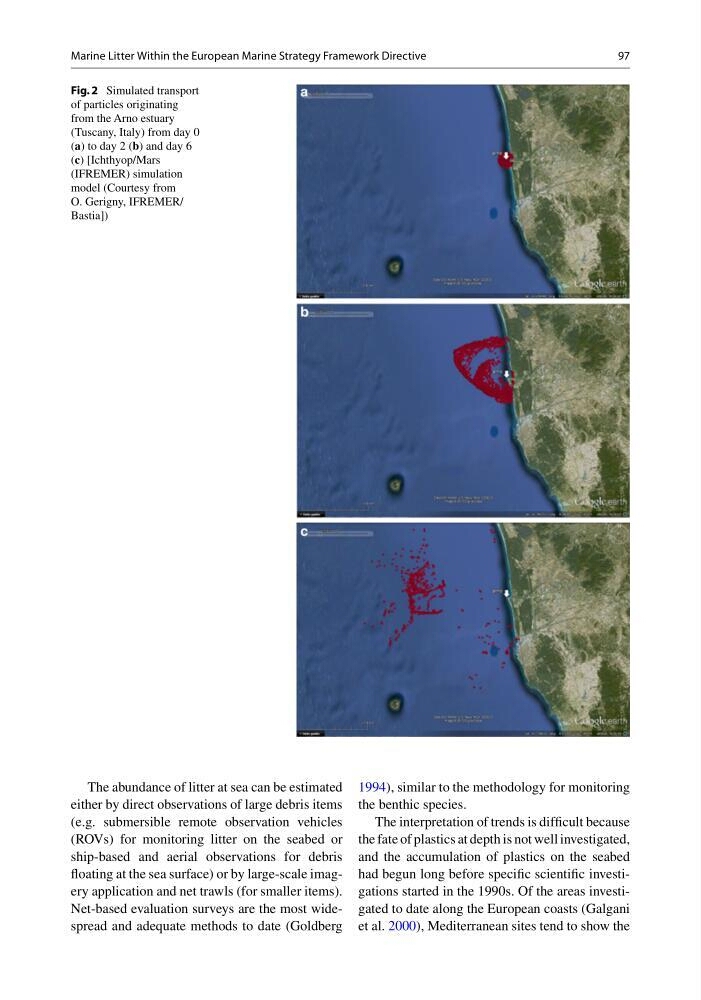
Fig. 2 Simulated transport
of particles originating
from the Arno estuary
(Tuscany, Italy) from day 0
( a ) to day 2 ( b ) and day 6
( c ) [Ichthyop/Mars
(IFREMER) simulation
model (Courtesy from
O. Gerigny, IFREMER/
Bastia])
Marine Litter Within the European Marine Strategy Framework Directive
The abundance of litter at sea can be estimated
either by direct observations of large debris items
(e.g. submersible remote observation vehicles
(ROVs) for monitoring litter on the seabed or
ship-based and aerial observations for debris
fl oating at the sea surface) or by large-scale imagery application and net trawls (for smaller items).
Net-based evaluation surveys are the most widespread and adequate methods to date (Goldberg
1994 ), similar to the methodology for monitoring
the benthic species.
The interpretation of trends is diffi cult because
the fate of plastics at depth is not well investigated,
and the accumulation of plastics on the seabed
had begun long before specifi c scientifi c investigations started in the 1990s. Of the areas investigated to date along the European coasts (Galgani
et al. 2000 ), Mediterranean sites tend to show the
Fig. 2 Simulated transport
of particles originating
from the Arno estuary
(Tuscany, Italy) from day 0
( a ) to day 2 ( b ) and day 6
( c ) [Ichthyop/Mars
(IFREMER) simulation
model (Courtesy from
O. Gerigny, IFREMER/
Bastia])
Marine Litter Within the European Marine Strategy Framework Directive